ISO Emergency Signs
Green square or rectangular signs identify emergency escape routes, safety facilities, and rescue equipment.
ISO safe condition signs guide people to safety: emergency exits, escape routes, first aid, defibrillators, eyewash stations, assembly points, and life-saving equipment. They are designed to be read under stress, often in smoke or low light, so consistency matters more here than anywhere else.
Escape route signs work as a system. A running-figure sign alone does not show a safe route; it needs directional arrows, a continuous sequence of signs, and, in most jurisdictions, emergency lighting or photoluminescent materials. The family also contains a large set of maritime life-saving appliance signs used on ships and offshore installations.
Follow the complete wayfinding system and local emergency plan. A symbol alone does not establish a safe route.
No symbols match. Try another word or clear the search.
Exits and escape routes
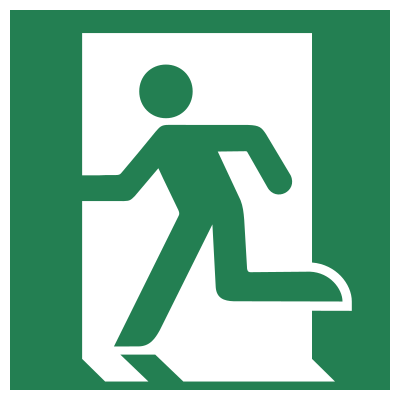 E001Emergency Exit
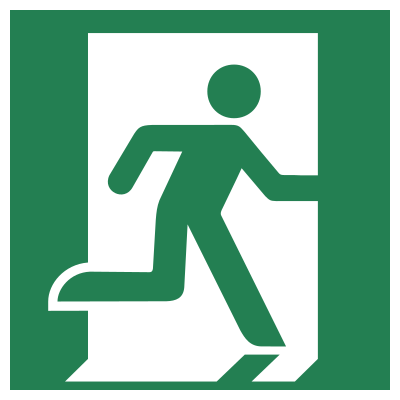 E002Emergency Exit (Right Hand)
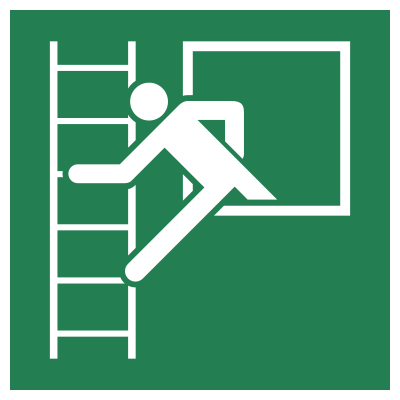 E016Emergency window with escape ladder
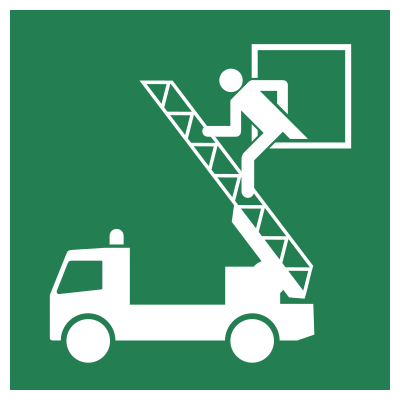 E017Rescue window
 E022Door opens by pushing on the left-hand side
 E023Door opens by pushing on the right-hand side
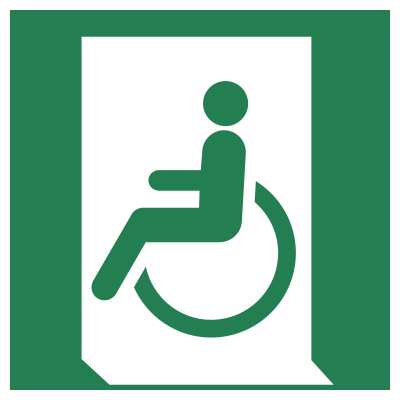 E026Emergency exit for people unable to walk or with walking impairment (left)
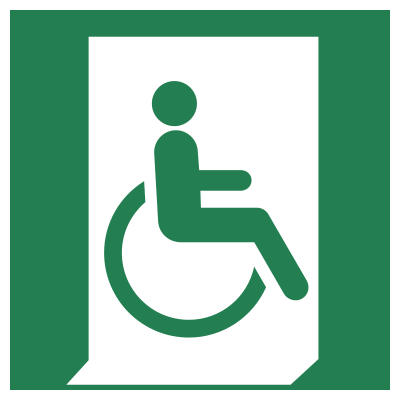 E030Emergency exit for people unable to walk or with walking impairment (right)
 E033Door slides right to open
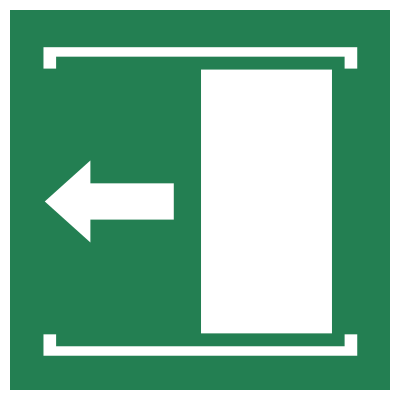 E034Door slides left to open
 E057Door opens by pulling on the left-hand side
 E058Door opens by pulling on the right-hand side
 E059Escape ladder
Evacuation, refuge and assembly


First aid and medical





Emergency controls and equipment
 E004Emergency telephone
 E008Break to obtain access
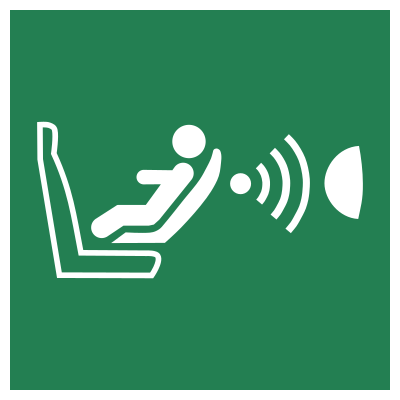 E014Child seat presence and orientation detection system (CPOD)
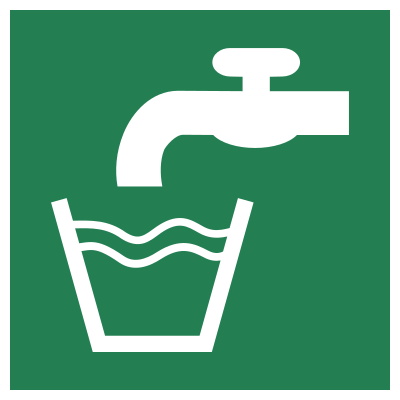 E015Drinking water
 E018Turn anticlockwise to open
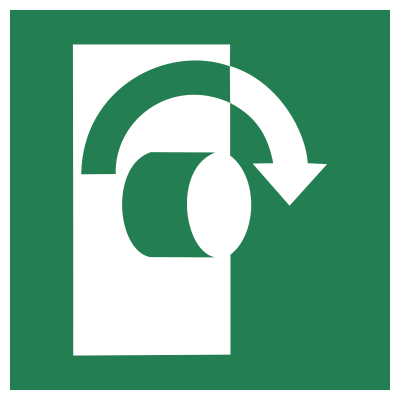 E019Turn clockwise to open
 E020Emergency stop button
 E025Emergency hammer
 E029Emergency escape breathing device
 E072Safe anchorage point
 E074Emergency rations
Natural disasters
Ships and maritime life-saving
 E031Shipboard general alarm
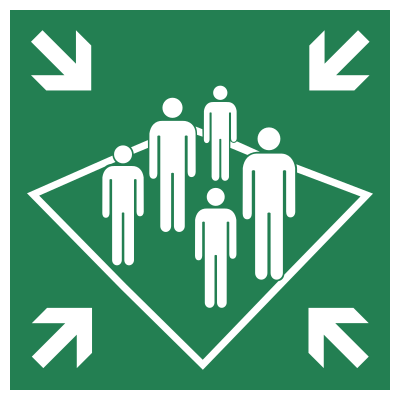 E032Shipboard assembly station
 E035Liferaft knife
 E036Lifeboat
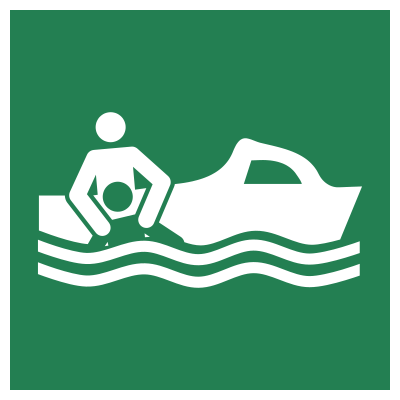 E037Rescue boat
 E038Liferaft
 E039Davit-launched liferaft
 E040Lifebuoy
 E041Lifebuoy with line
 E042Lifebuoy with light
 E043Lifebuoy with line and light
 E044Lifejacket
 E045Child's lifejacket
 E046Infant's lifejacket
 E047Search and rescue transponder
 E048Survival craft distress signal
 E049Rocket parachute flare
 E050Line-throwing appliance
 E051Two-way VHF radiotelephone apparatus
 E052Emergency position indicating radio beacon
 E053Embarkation ladder
 E054Marine evacuation slide
 E055Marine evacuation chute
 E056Survival clothing
 E068Lifebuoy with light and smoke
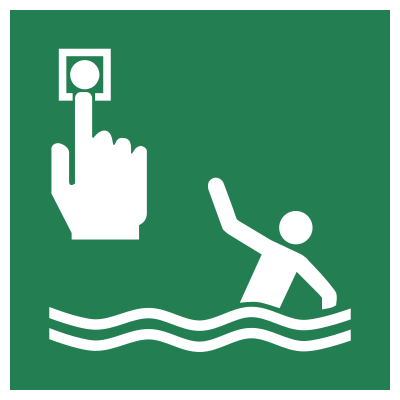 E069Person overboard call point
Water and snow rescue

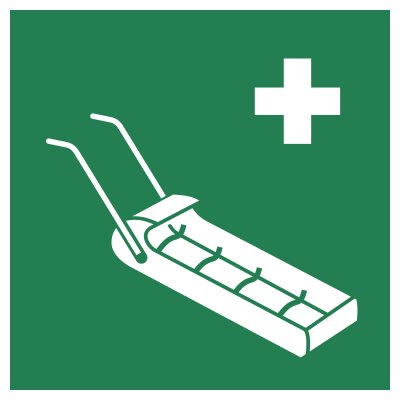
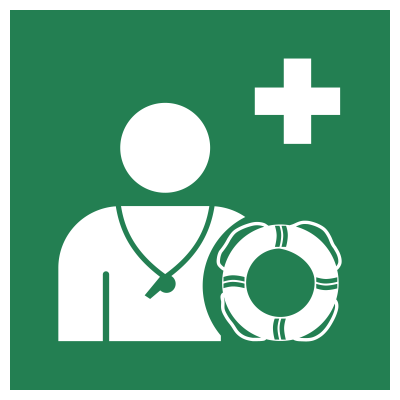
Where safe condition signs come from
ISO 7010 registers the pictograms; ISO 3864-1 sets the colors, shapes, and layout rules they are drawn to. In the EU, Directive 92/58/EEC sets minimum requirements for safety signs at work, and its annex requires the green to cover at least half of an emergency escape or first-aid sign's area. The UK implements the same requirements through the Health and Safety (Safety Signs and Signals) Regulations 1996, and both markets publish ISO 7010 as EN ISO 7010.
In the United States, OSHA 29 CFR 1910.145 and the ANSI Z535 series govern accident-prevention signs. ISO pictograms are widely used inside ANSI Z535 layouts, but the ANSI format adds signal words and text panels that an ISO sign does not carry. Australia uses AS 1319. Always check the rules for the site where the sign will be installed.
Frequently asked questions
What does a green sign with a running man mean?
It marks an emergency exit or escape route (ISO 7010 E001 and E002). The two codes are mirror images for exits to the left and right. In practice they are combined with a directional arrow and placed in a continuous sequence so that people can follow the route to a place of safety.
Why are some exit signs green and others red?
ISO 7010 and EU/UK practice use green running-figure signs. Many US jurisdictions still require red or green "EXIT" wording under building and fire codes and OSHA 1910.37. Follow the code that applies to the building; an ISO pictogram does not automatically replace required exit wording.