Safety shower
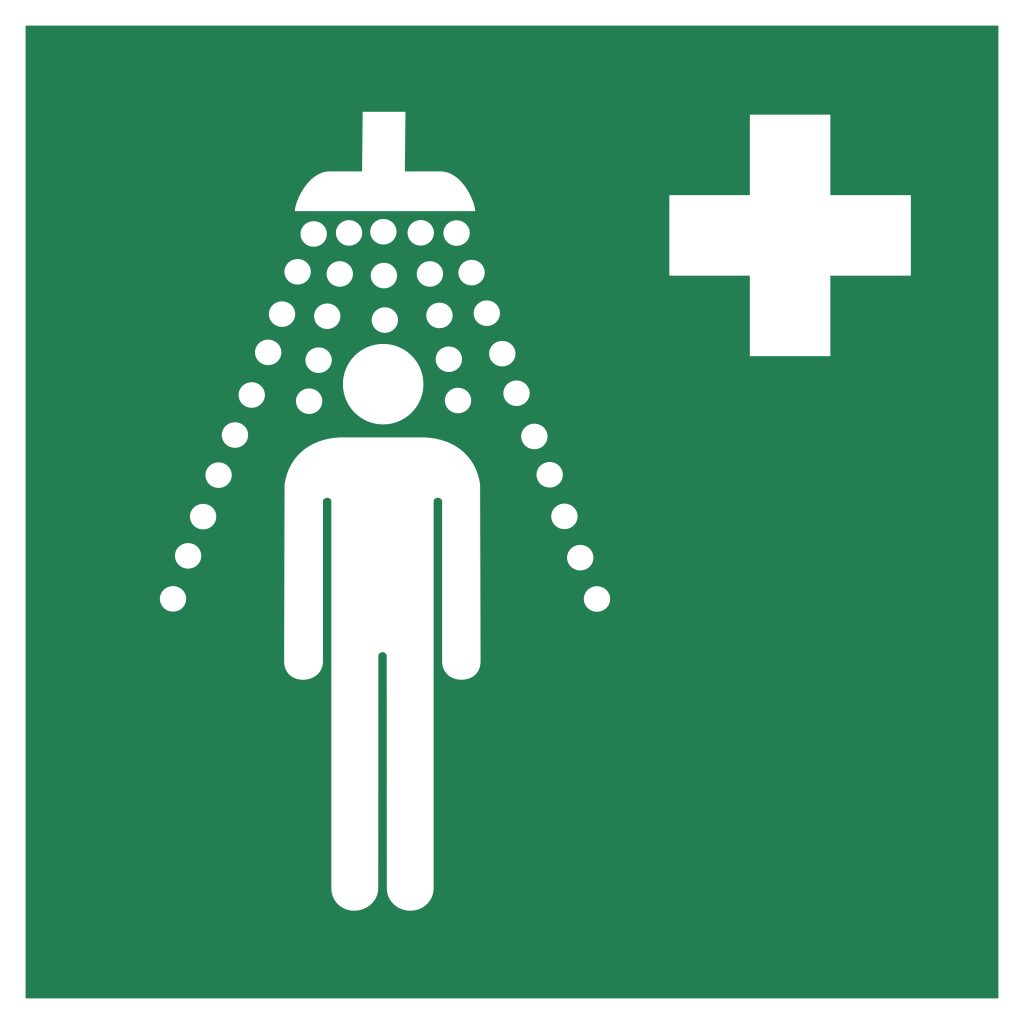
Identifies a safety shower.
Understanding this sign
Green square or rectangular signs identify emergency escape routes, safety facilities, and rescue equipment.
Follow the complete wayfinding system and local emergency plan. A symbol alone does not establish a safe route.
The Safety Shower Sign
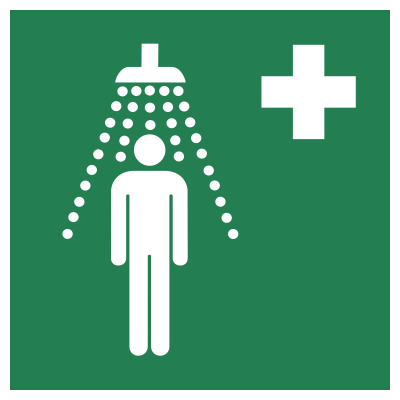
E012 shows a white figure standing beneath a drench shower head with water falling over the whole body, on the green square of the ISO 3864-1 safe-condition family. It indicates a safety shower — equipment for immediately drenching a person whose body or clothing has been contaminated with a corrosive or otherwise injurious chemical. Where the eyewash sign E011 answers a splash to the eyes, E012 answers the larger event: a burst hose, a dropped carboy, a failed coupling that soaks someone from shoulder to boot.
The distinction matters operationally because a body-splash casualty has different needs. They must get under high-volume flow within seconds, strip contaminated clothing while the water runs, and keep flushing for many minutes — usually while unable to see well and possibly in severe pain. The sign therefore has to be findable from anywhere chemicals are handled in quantity, and the route to the shower must accommodate someone stumbling toward it, potentially assisted by a coworker.
What Z358.1 Demands of a Drench Shower
ANSI/ISEA Z358.1 specifies drench shower performance in detail: a minimum flow of 20 gallons (75.7 liters) per minute for at least 15 minutes, delivered in a spray pattern wide enough to cover the body, from a valve that goes from off to fully on in one second or less and remains open without being held. The same siting rules that govern eyewash equipment apply — no more than 10 seconds' travel from the hazard, on the same level, with nothing obstructing the path — and the standard expects each location to be marked so it is conspicuous, the role E012 performs.
Tepid water, 16 to 38 degrees Celsius, is a shower-specific engineering challenge rather than a footnote. Twenty gallons a minute of unheated winter supply will drive a casualty out of the stream long before the flush is complete, and a shower nobody can stand under for 15 minutes does not really deliver its rated performance. Mixing valves with scald protection, freeze-protected lines for outdoor units, and thought about where 300 liters of contaminated runoff will drain all belong to a compliant installation.
Activation Testing and Common Failures
Z358.1 puts plumbed showers on a weekly activation cycle to prove the valve works and to purge the standing water in the branch line, with a complete annual inspection against the full standard. Weekly testing a 20-gpm shower without flooding the area is a solved problem — test carts, funnels, and drain connections exist for exactly this — and its absence is one of the most reliable predictors that a shower has quietly seized since commissioning.
Field audits of safety showers repeat the same findings: pull rods cable-tied out of reach or removed after nuisance activations, showers walled in by new equipment installed since the original layout, valves so stiff that a wet-handed casualty could not operate them, and units plumbed to lines that were isolated during maintenance and never reopened. Every one of these is invisible from a distance; the E012 sign will still be perfectly displayed above a shower that cannot deliver a drop.
Siting, Signage, and Combination Units
Safety showers concentrate where bulk corrosives live: acid and caustic unloading stations, electrolyte and plating lines, chemical dosing rooms in water treatment, and laboratory corridors serving wet chemistry. Mount E012 above or immediately beside the unit, sized for the longest sightline in the area, and consider flag-mounted or ceiling-suspended versions in process halls where columns and vessels block wall signs. A painted clear-floor zone beneath the shower protects the access the 10-second rule assumes.
Many installations are combination units pairing a drench shower with an eyewash on one plumbing drop, and these should carry both E012 and E011 so each function is explicitly advertised — a casualty coached to look for the shower symbol should not have to infer it from an eyewash sign. In plants with distributed hazards, directional E012 signs with arrows along walkways shorten the search, and including shower locations in contractor inductions matters because the people transferring chemicals are often not the people who work in the area daily.
Where you will see E012
Drench showers concentrate where bulk corrosives are handled: acid and caustic unloading stations, electrolyte and plating lines, chemical dosing rooms in water treatment plants, and laboratory corridors serving wet chemistry. The sign is mounted above or beside the unit and sized for the longest sightline, with flag or ceiling-suspended versions in process halls, and combination units carry both E012 and E011 so each function is separately advertised.
Common questions about E012
What is the difference between the E011 and E012 signs?
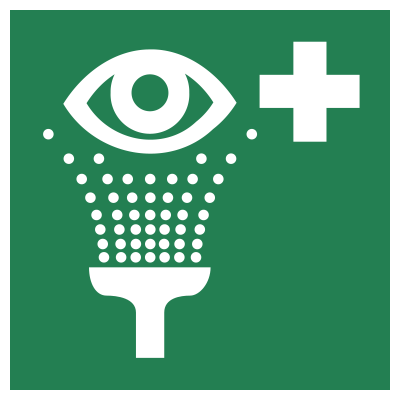
E011 marks an eyewash station for flushing the eyes after a splash; E012 marks a safety shower for drenching the whole body after larger chemical contact. The pictograms differ accordingly — eyes over a fountain versus a figure under a shower head. Combination units providing both functions should display both signs.
How much water does a safety shower have to deliver?
Under ANSI/ISEA Z358.1, a plumbed drench shower must deliver at least 20 gallons (75.7 liters) per minute for a minimum of 15 minutes, in tepid water between 16 and 38 degrees Celsius, from a valve that opens in one second or less and stays open hands-free.
How often should safety showers be flow-tested?
Weekly activation is required for plumbed units under Z358.1, both to confirm the valve and flow and to purge stagnant water from the supply branch, plus a full annual inspection against every requirement of the standard. Test carts and funnels make the weekly activation practical without flooding the work area.
Where are safety showers required?
Wherever workers handle chemicals capable of causing corrosive injury to the body — OSHA 1910.151(c) demands quick-drenching facilities in those areas, and Z358.1 puts the shower within 10 seconds' unobstructed, level travel of the exposure point. Typical locations include acid unloading points, plating and battery areas, chemical dosing rooms, and laboratories handling corrosives in volume.
Reference details
| Symbol code | E012 |
|---|---|
| Sign family | ISO Emergency Signs |
| Standard reference | ISO 7010:2019 / ISO 3864-1 ISO Online Browsing Platform: E012 |
| Screen color reference | #009933. Screen colors are not a production color specification. |
| Download formats | SVG reference artwork; a 1024 × 1024 pixel PNG conversion on a white canvas. |
| Record date | · How to interpret our dates |
| Page updated |
Choosing a physical sign size
Download dimensions are not installation dimensions. Select sign size, material, placement, and lighting using the applicable standard and the actual viewing conditions. Chemical label sizing follows its own rules. Read the artwork and sizing guide.
Sources and artwork credits
- Artwork source
- Wikimedia Commons file page
- Creator credited by source
- Unknown author Vectorization: MaxxL
- License
- Public domain
- Source metadata checked
SVG files are local reference copies. PNG files are raster conversions. Check the linked file history and license terms before reuse; a source-metadata check is not certification of the artwork or a workplace installation.
Report a correction to this reference