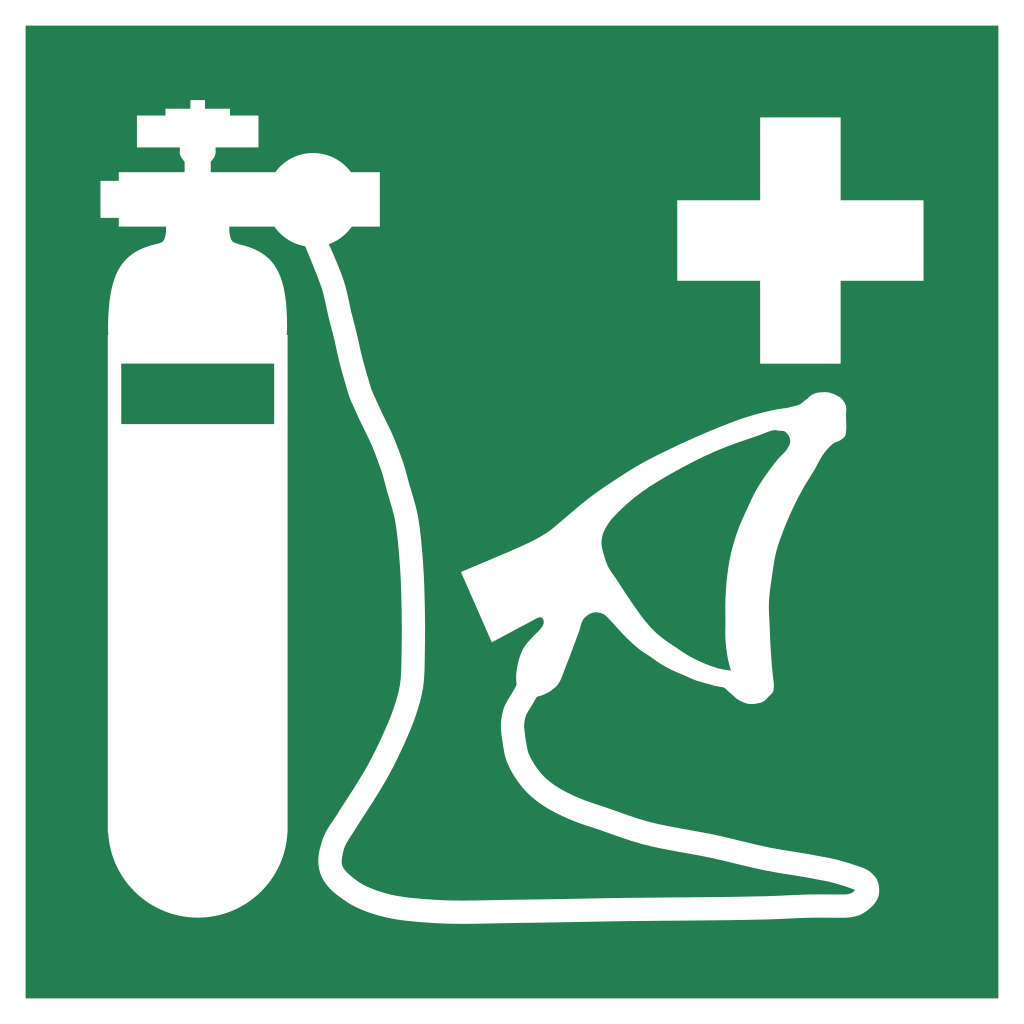
Oxygen resuscitator
Identifies an oxygen resuscitator.
Understanding this sign
Green square or rectangular signs identify emergency escape routes, safety facilities, and rescue equipment.
Follow the complete wayfinding system and local emergency plan. A symbol alone does not establish a safe route.
Equipment Behind the Sign
E028 identifies the stowage of an oxygen resuscitator: a portable set combining an oxygen cylinder with a regulator and delivery equipment — masks, tubing, and typically a bag-valve or demand valve arrangement — used to give supplemental oxygen to a breathing casualty or to support ventilation of one who is not. It occupies a specific rung on the response ladder between basic first aid and clinical care, addressing emergencies where the underlying problem is oxygen delivery: smoke or gas inhalation, drowning, cardiac events, and pressure-related diving injuries.
Because the set involves compressed gas and clinical judgment, the sign marks equipment with prerequisites. Effective and safe use requires training in oxygen administration, and the cylinder itself demands the usual high-pressure oxygen disciplines — no oil or grease near fittings, valves opened slowly, secure stowage away from ignition sources. Sites that stage resuscitators therefore pair the marked location with a trained-operator roster rather than treating it as walk-up equipment.
Where Oxygen Sets Are Staged
Diving operations are the canonical case: oxygen first aid is the front-line field treatment for suspected decompression illness, so commercial dive spreads, dive charter boats, and hyperbaric facilities keep oxygen sets at the dive control point, and industry codes for diving work commonly require them on site. Confined space rescue teams stage resuscitators at entry points where an atmosphere-related casualty is the design scenario. Other regulars include gas plants and refineries, water treatment works handling chlorine, firefighting support units, and remote sites with long ambulance response times.
Placement should track the scenario that justifies the set. At a confined space entry, the resuscitator belongs with the rescue kit at the attendant's station; on a dive deck, within steps of the water; in a plant, at the first aid room plus satellite points near the gas hazard. E028 on each stowage, with the equipment inspection tag alongside, lets mutual aid responders and new crew find serviceable oxygen without a guide.
Relationship to Other Emergency Signs
E028 answers a different question than its green neighbors. E010 locates a defibrillator for cardiac arrest rhythm treatment; E003 locates general supplies; E028 locates the means to oxygenate. Serious response points frequently host all three, and giving each device its own pictogram lets a responder acting on partial information — the radio said breathing difficulty — go straight to the right cabinet. Lumping an oxygen set behind a generic first aid cross wastes that precision.
One boundary is worth drawing explicitly: the resuscitator is casualty-care equipment, not respiratory protection. Escape sets, self-contained breathing apparatus, and airline respirators protect a healthy wearer entering or escaping a bad atmosphere and fall under mandatory-sign and equipment-marking regimes of their own. Rescue plans should name which is staged where, because confusing the two categories in a gas emergency has severe consequences.
Where you will see E028
Commercial dive spreads, dive charter boats, and hyperbaric facilities keep signed oxygen sets at the dive control point, since oxygen first aid is the front-line field treatment for decompression illness. Confined space rescue teams stage them with the rescue kit at the attendant's station, and gas plants, refineries, chlorine-handling water treatment works, and remote sites with long ambulance response times post E028 at the first aid room and satellite points near the gas hazard.
Common questions about E028
What does the oxygen resuscitator sign mean?
E028 marks where an emergency oxygen set is stored — a cylinder with regulator, masks, and ventilation equipment for treating casualties with breathing problems, from smoke inhalation to drowning to diving injuries. It is a green ISO 7010 safe-condition sign, placed directly on the stowage locker or cabinet.
Who is allowed to use emergency oxygen equipment?
Anyone using it should hold current oxygen administration training, which many first aid bodies offer as a short add-on course. Untrained use risks ineffective delivery and mishandling of a high-pressure oxygen cylinder. Sites staging resuscitators should keep a roster of trained operators aligned with shifts, just as they do for first aiders.
Why do dive sites keep oxygen resuscitators?
Breathing high-concentration oxygen is the standard first aid for suspected decompression illness and arterial gas embolism, buying time and reducing harm before recompression treatment. Diving safety codes therefore expect oxygen equipment at the dive site, and E028 marks its position on deck or at dive control so any crew member can retrieve it fast.
Is an oxygen resuscitator the same as breathing apparatus?
No. A resuscitator treats a casualty who already has a breathing problem. Breathing apparatus — SCBA, escape sets, airline respirators — protects a healthy person working in or escaping from a hazardous atmosphere. They are stored, signed, and regulated differently, and emergency plans should state clearly which one each scenario calls for.
Reference details
| Symbol code | E028 |
|---|---|
| Sign family | ISO Emergency Signs |
| Standard reference | ISO 7010:2019 / ISO 3864-1 ISO Online Browsing Platform: E028 |
| Screen color reference | #009933. Screen colors are not a production color specification. |
| Download formats | SVG reference artwork; a 1024 × 1024 pixel PNG conversion on a white canvas. |
| Record date | · How to interpret our dates |
| Page updated |
Choosing a physical sign size
Download dimensions are not installation dimensions. Select sign size, material, placement, and lighting using the applicable standard and the actual viewing conditions. Chemical label sizing follows its own rules. Read the artwork and sizing guide.
Sources and artwork credits
- Artwork source
- Wikimedia Commons file page
- Creator credited by source
- Clemenspool
- License
- CC0
- Source metadata checked
SVG files are local reference copies. PNG files are raster conversions. Check the linked file history and license terms before reuse; a source-metadata check is not certification of the artwork or a workplace installation.
Report a correction to this reference