Search and rescue transponder
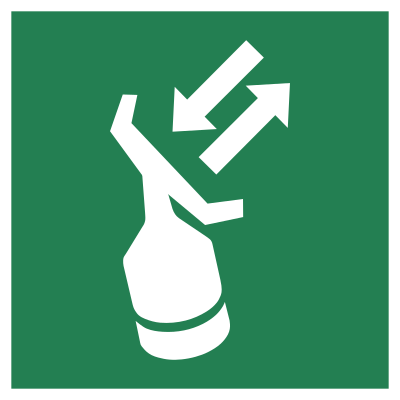
Identifies a search and rescue transponder.
Understanding this sign
Green square or rectangular signs identify emergency escape routes, safety facilities, and rescue equipment.
Follow the complete wayfinding system and local emergency plan. A symbol alone does not establish a safe route.
What ISO 7010 E047 Marks
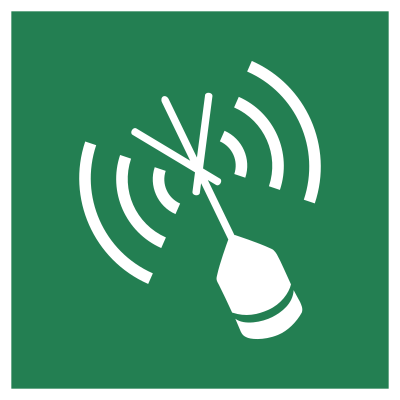
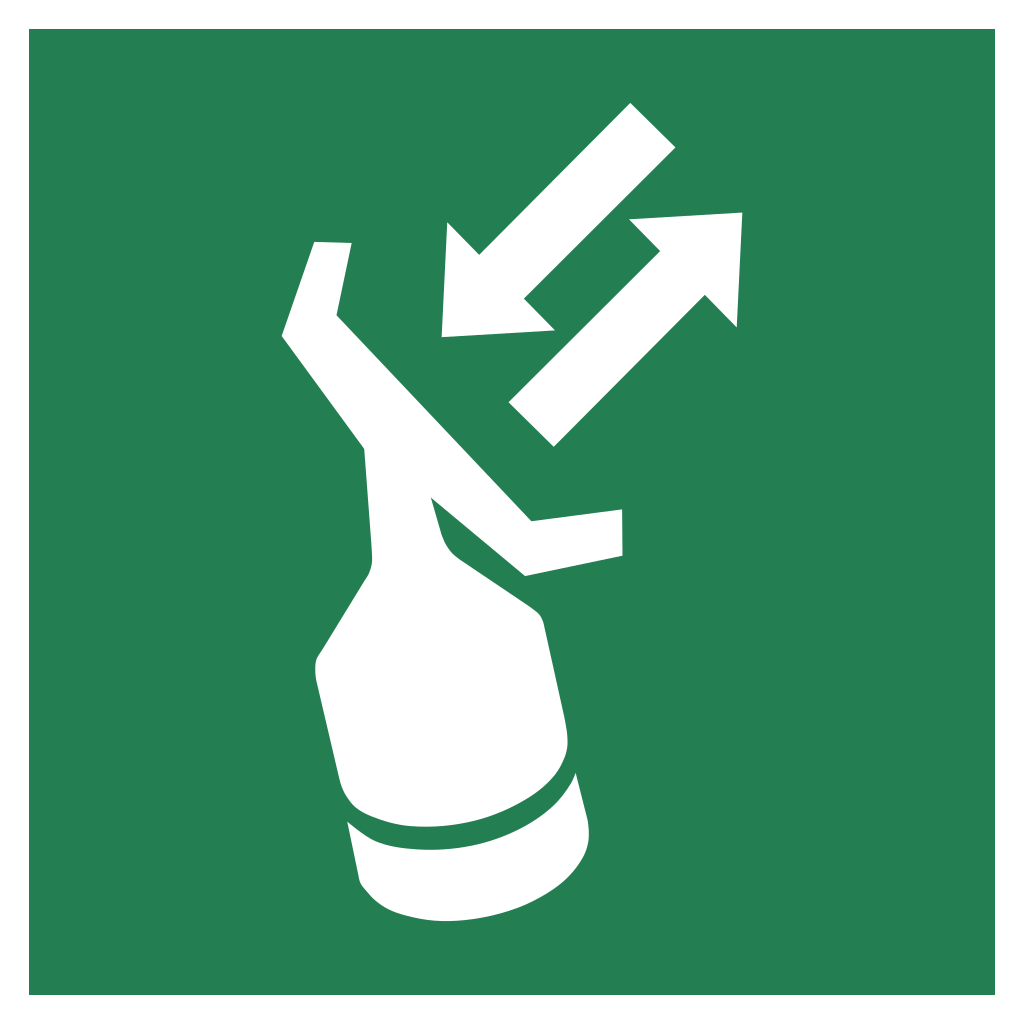
E047 marks the stowage location of a search and rescue transponder, universally abbreviated SART. The pictogram — a white device silhouette with radiating signal arcs on the safe-condition green square — tells crew and passengers exactly where this piece of GMDSS survival equipment is kept so it can be grabbed in the seconds available during abandon-ship. Like the other survival-equipment location signs, it follows the ISO 3864-1 safe-condition format: white graphic on signal green.
A SART is a radar transponder, not a radio or a satellite beacon. When it detects the pulse of a ship's or aircraft's 9 GHz (X-band) radar, it replies with a burst of sweeps that paint a distinctive line of blips on the searching vessel's radar display, stretching outward from the survivor's position. As the rescuer closes in, those blips widen into arcs and finally rings — a built-in visual cue that the target is near.
The SART's Role in the GMDSS Rescue Chain
The Global Maritime Distress and Safety System assigns each survival-craft device a distinct job, and the E-series signs mirror that logic. An EPIRB (E052) alerts the satellite system that a distress exists and gives a rough position; the two-way VHF radios (E051) let survivors talk to rescuers; the SART is the terminal homing device that lets a searching ship or helicopter steer its final miles straight onto the liferaft using nothing but its own radar.
That final-mile function is why the SART must actually make it into the survival craft. SOLAS requires radar transponders to be stowed so they can be rapidly placed in any survival craft, and on many ships they are kept in brackets on the bridge wings or at the muster stations. Wherever the transponder lives, E047 is the sign that identifies the bracket.
Placement Aboard Ship
Post E047 directly at the SART stowage bracket and, where the route is not obvious, add a directional arrow version along the path from the muster station. Because abandon-ship drills are the only rehearsal most crew get, the sign should be positioned exactly as it will be found in darkness and smoke — at the bracket itself, at eye level, with photoluminescent material where required by the ship's low-location lighting plan.
IMO Resolution A.1116(30) aligned shipboard escape-route and equipment-location signage with the ISO 7010 symbol set, so newer vessels use E047 in place of the older IMO pictogram variants. Ships also carry an instruction consideration: crews should be trained that the SART works best mounted high — on the liferaft's pole or held aloft — because its reply range depends on height above the sea surface.
SART, AIS-SART, and Related Signs
Two technologies now satisfy the radar-transponder carriage requirement: the classic radar SART described above and the AIS-SART, which instead transmits its GNSS position as an AIS message that plots directly on nearby ships' chart displays. Both serve the same homing purpose, and shipboard signage practice marks their stowage the same way.
Read E047 alongside its GMDSS siblings when planning a signage survey: E052 for the EPIRB, E051 for the portable VHF sets, E048 and E049 for the pyrotechnic signals, and E050 for the line-throwing appliance. Auditing all six together against the vessel's safety plan is the fastest way to confirm every required device has a marked, drilled, and reachable home.
Where you will see E047
Aboard SOLAS vessels the sign goes directly on the SART bracket — commonly on bridge wings or at muster stations — with directional arrow versions along the route where needed, in photoluminescent material to suit low-location lighting. IMO Resolution A.1116(30) aligned shipboard signage with ISO 7010, so newer ships use E047 in place of older IMO pictograms, audited together with E052 EPIRB, E051 VHF, and the other GMDSS location signs.
Common questions about E047
What does the SART symbol on a ship mean?
It is ISO 7010 sign E047, and it marks where the ship's search and rescue transponder is stowed. The SART is a battery-powered device carried into the lifeboat or liferaft during abandon-ship; once activated, it responds to any 9 GHz marine or aircraft radar so that rescuers can home in on the survivors' exact position.
How is a SART different from an EPIRB?
An EPIRB sends a 406 MHz distress alert through the Cospas-Sarsat satellite system to tell rescue authorities that an emergency exists and roughly where. A SART does not alert anyone by itself — it only responds when a searching radar sweeps over it, painting a distinctive blip pattern that guides the rescuer over the last miles to the survival craft. Ships carry both because they cover different stages of the rescue.
Where should the E047 sign be posted on a vessel?
At the SART's actual stowage bracket — typically on the bridge, bridge wings, or near the survival craft embarkation stations — plus arrowed versions along the route if the bracket is not visible from the muster point. Signage should match the ship's approved fire and safety plan and use photoluminescent material where the escape-route lighting scheme calls for it.
Does E047 also cover an AIS-SART?
In practice, yes. The AIS-SART performs the same survival-craft locating function as the radar SART, transmitting its GNSS position over AIS instead of replying to radar pulses. Shipboard signage marks the stowage location of whichever locating device the vessel carries to meet its radar-transponder requirement.
Reference details
| Symbol code | E047 |
|---|---|
| Sign family | ISO Emergency Signs |
| Standard reference | ISO 7010:2019 / ISO 3864-1 ISO Online Browsing Platform: E047 |
| Screen color reference | #009933. Screen colors are not a production color specification. |
| Download formats | SVG reference artwork; a 1024 × 1024 pixel PNG conversion on a white canvas. |
| Record date | · How to interpret our dates |
| Page updated |
Choosing a physical sign size
Download dimensions are not installation dimensions. Select sign size, material, placement, and lighting using the applicable standard and the actual viewing conditions. Chemical label sizing follows its own rules. Read the artwork and sizing guide.
Sources and artwork credits
- Artwork source
- Wikimedia Commons file page
- Creator credited by source
- Clemenspool
- License
- CC0
- Source metadata checked
SVG files are local reference copies. PNG files are raster conversions. Check the linked file history and license terms before reuse; a source-metadata check is not certification of the artwork or a workplace installation.
Report a correction to this reference