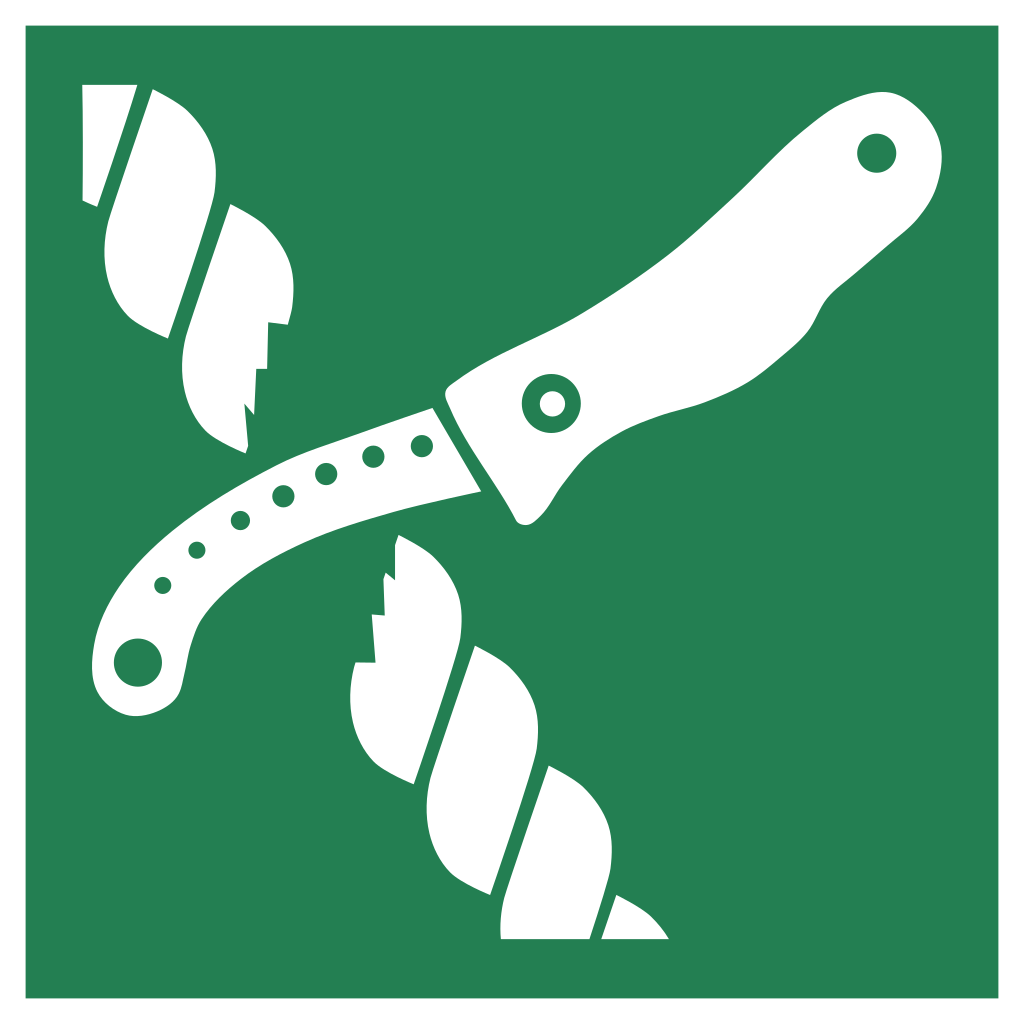
Liferaft knife
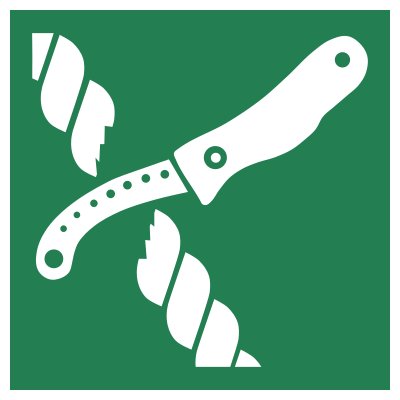
Identifies a liferaft knife.
Understanding this sign
Green square or rectangular signs identify emergency escape routes, safety facilities, and rescue equipment.
Follow the complete wayfinding system and local emergency plan. A symbol alone does not establish a safe route.
Purpose of the E035 Sign
E035 points to a liferaft knife: a dedicated cutting tool stowed at a survival craft position so that the lines holding a raft to the ship can be severed the moment they need to be. The green safe-condition square shows the knife pictogram, and the tool it marks is typically a buoyant, fixed-blade design with a blunt or hooked tip so it can be used against taut rope in a heaving seaway without stabbing the raft's inflated tubes or a crowded occupant.
The sign matters because the knife is small and easy to overlook among davits, cradles, and hydrostatic releases. In an abandonment carried out at night or in heavy weather, a crew member must be able to lay a hand on it within seconds, and a clearly signed bracket is what makes that possible.
Cutting the Painter Free
An inflatable liferaft inflates only after its painter line has been pulled, and that same painter then tethers the loaded raft to a vessel that may be sinking, burning, or drifting down onto it. Once everyone is aboard, the painter is cut and the raft paddles clear — the knife marked by E035 exists for that single decisive action. Rafts carry a knife in their own equipment pack as well, but a shipside knife lets crew free a raft even before boarding is complete if the situation collapses.
At davit-launched raft positions the tool earns its place twice over: bowsing and retaining lines used to hold the raft alongside the embarkation deck may also need to be cut away quickly if the release mechanism fails or the ship's motion threatens to slam the raft against the hull. This is why E035 signs cluster around davit-launching stations in particular.
Placement Alongside the Raft Signs
Mount E035 directly at the knife's stowage bracket, close enough to the raft station that the association is obvious but distinct from the E038 or E039 sign marking the raft itself. Where one launching station serves several raft cradles, a single well-signed knife position at the embarkation point is normal practice; inspectors look for the knife present, secured, sharp, and marked.
The symbol reached ISO 7010 through the harmonization of IMO's lifesaving equipment location markings into the international E-series, so the same green knife sign is now correct on SOLAS vessels, offshore units, and any installation that stations raft-cutting knives at embarkation points. As a niche sign it rarely appears in general signage catalogs ashore, but on a survey checklist it carries the same weight as the raft markings it accompanies.
Where you will see E035
The sign is fixed directly at the knife's stowage bracket at raft embarkation points, clustering especially around davit-launching stations where bowsing and retaining lines may also need cutting away if a release mechanism fails. Harmonized from IMO lifesaving equipment markings, it applies on SOLAS vessels, offshore units, and any installation stationing raft-cutting knives, and surveyors check the knife is present, secured, sharp, and marked.
Common questions about E035
What is a liferaft knife used for?
Its primary job is cutting the painter — the line that triggers inflation and then tethers the liferaft to the ship — once survivors are aboard, so the raft can get clear of the vessel. At davit-launched stations it also serves to cut bowsing or retaining lines if the raft must be freed quickly.
Why do liferaft knives have blunt or hooked tips?
A pointed blade wielded in a pitching, crowded raft is as dangerous to the inflated buoyancy tubes and the occupants as it is useful against rope. Blunt-tipped, buoyant, fixed-blade designs cut a taut painter effectively while minimizing the chance of puncturing the raft or injuring someone, and they float if dropped.
Where should the E035 sign be posted?
At the knife's stowage bracket beside the raft launching or embarkation position — especially at davit-launched liferaft stations, where lines under load are most likely to need cutting. It complements, and should not be confused with, the E038 and E039 signs that mark the rafts themselves.
Reference details
| Symbol code | E035 |
|---|---|
| Sign family | ISO Emergency Signs |
| Standard reference | ISO 7010:2019 / ISO 3864-1 ISO Online Browsing Platform: E035 |
| Screen color reference | #009933. Screen colors are not a production color specification. |
| Download formats | SVG reference artwork; a 1024 × 1024 pixel PNG conversion on a white canvas. |
| Record date | · How to interpret our dates |
| Page updated |
Choosing a physical sign size
Download dimensions are not installation dimensions. Select sign size, material, placement, and lighting using the applicable standard and the actual viewing conditions. Chemical label sizing follows its own rules. Read the artwork and sizing guide.
Sources and artwork credits
- Artwork source
- Wikimedia Commons file page
- Creator credited by source
- Clemenspool
- License
- CC0
- Source metadata checked
SVG files are local reference copies. PNG files are raster conversions. Check the linked file history and license terms before reuse; a source-metadata check is not certification of the artwork or a workplace installation.
Report a correction to this reference