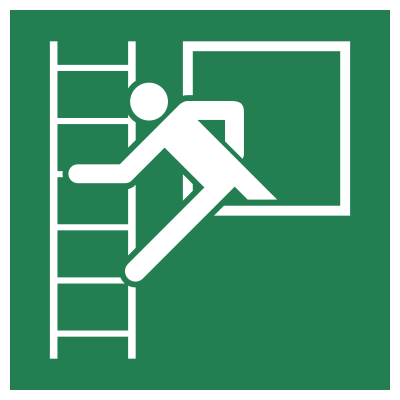
Escape ladder
Identifies an escape ladder.

Understanding this sign
Green square or rectangular signs identify emergency escape routes, safety facilities, and rescue equipment.
Follow the complete wayfinding system and local emergency plan. A symbol alone does not establish a safe route.
Marking the Vertical Way Out
E059 indicates the position of a permanently fixed escape ladder — the ISO register wording is specific about the fixed installation. It belongs where the emergency route drops or climbs vertically because a stair was never feasible: the green square tells an occupant that the ladder ahead of them is part of the planned escape, not just a maintenance access that happens to be nearby.
That distinction is the sign's real job. Industrial sites are full of ladders, and in smoke or darkness a person can waste critical time descending one that ends on a locked platform or inside a fenced compound. E059 singles out the ladder whose bottom rung actually leads somewhere safe.
Where Escape Ladders Earn Their Place
Typical hosts are flat roofs and rooftop plant decks whose single stair could be cut off, mezzanines and elevated control platforms served by one staircase, marine and offshore decks, tower structures, and deep basements or service pits. In low-rise residential and hospitality settings, fold-out and collapsible fire escape ladders stowed at windows serve a similar purpose; strictly, the registered referent is a permanently fixed ladder, so sites marking stowed equipment usually add a text panel making clear what is inside the cabinet.
Whatever the setting, the sign should be readable from the point where a person commits to that direction of travel, with a repeat at the ladder head itself. On roofs, mount it high enough to clear parapets and plant, and choose materials rated for permanent weather exposure — a chalked-out pictogram over a rusting ladder inspires exactly the confidence it deserves.
Limits, Codes, and Upkeep
A ladder is a last-resort escape, and codes treat it that way: most jurisdictions accept fixed ladders only as secondary or emergency egress for small numbers of able-bodied occupants, never as a primary exit from a normally occupied floor. It also contributes nothing to accessible egress — anyone covered by the E024 refuge and E026/E030 route provisions needs a different plan, and the emergency strategy must say so explicitly.
Maintenance is unglamorous and decisive. Rungs corrode, cages trap debris, roof hatches seize, and the landing zone at the base quietly becomes pallet storage. Put every signed escape ladder on the same inspection cycle as fire doors, verify the full climb periodically rather than just glancing from below, and treat ice and algae on outdoor rungs as seasonal hazards worth a recurring work order.
Where you will see E059
Typical hosts are flat roofs and rooftop plant decks whose single stair could be cut off, mezzanines and elevated control platforms with one staircase, marine and offshore decks, tower structures, and deep basements or service pits. The sign should be readable from the point where a person commits to that direction, with a repeat at the ladder head, in weather-rated materials on roofs, and every signed ladder belongs on the same inspection cycle as fire doors.
Common questions about E059
What does the ISO 7010 E059 escape ladder sign mean?
It shows where to find a permanently fixed ladder that forms part of the emergency escape route — for example from a roof, mezzanine, tower, or basement where a stairway is not available. The green safe-condition format distinguishes the designated escape ladder from the many ordinary access ladders on an industrial site.
Can a fixed ladder count as a fire exit?
Only in limited circumstances. Building and fire codes generally allow ladders as secondary or emergency egress from spaces with few occupants — roofs, plant platforms, small mezzanines — not as a required exit from normally occupied areas, and details vary by jurisdiction. A ladder route is also unusable by many people, so it can never satisfy accessible egress requirements on its own.
Does E059 cover fold-out or collapsible fire escape ladders?
The ISO register describes E059 as indicating a permanently fixed escape ladder. Many premises nonetheless use it, with an explanatory text panel, to mark cabinets or window points holding collapsible escape ladders, since no closer pictogram exists. If you do this, make the supplementary text unambiguous so occupants expect stowed equipment rather than a ladder already in place.
Reference details
| Symbol code | E059 |
|---|---|
| Sign family | ISO Emergency Signs |
| Standard reference | ISO 7010:2019 / ISO 3864-1 ISO Online Browsing Platform: E059 |
| Screen color reference | #009933. Screen colors are not a production color specification. |
| Download formats | SVG reference artwork; a 1024 × 1024 pixel PNG conversion on a white canvas. |
| Record date | · How to interpret our dates |
| Page updated |
Choosing a physical sign size
Download dimensions are not installation dimensions. Select sign size, material, placement, and lighting using the applicable standard and the actual viewing conditions. Chemical label sizing follows its own rules. Read the artwork and sizing guide.
Sources and artwork credits
- Artwork source
- Wikimedia Commons file page
- Creator credited by source
- Maxi123ID
- License
- Public domain
- Source metadata checked
SVG files are local reference copies. PNG files are raster conversions. Check the linked file history and license terms before reuse; a source-metadata check is not certification of the artwork or a workplace installation.
Report a correction to this reference