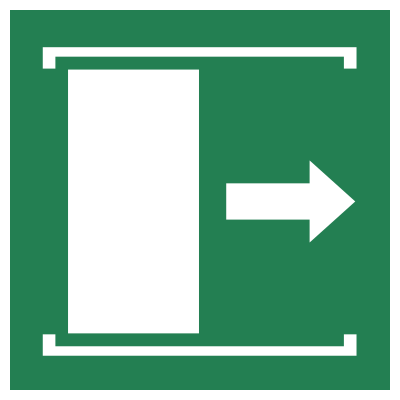
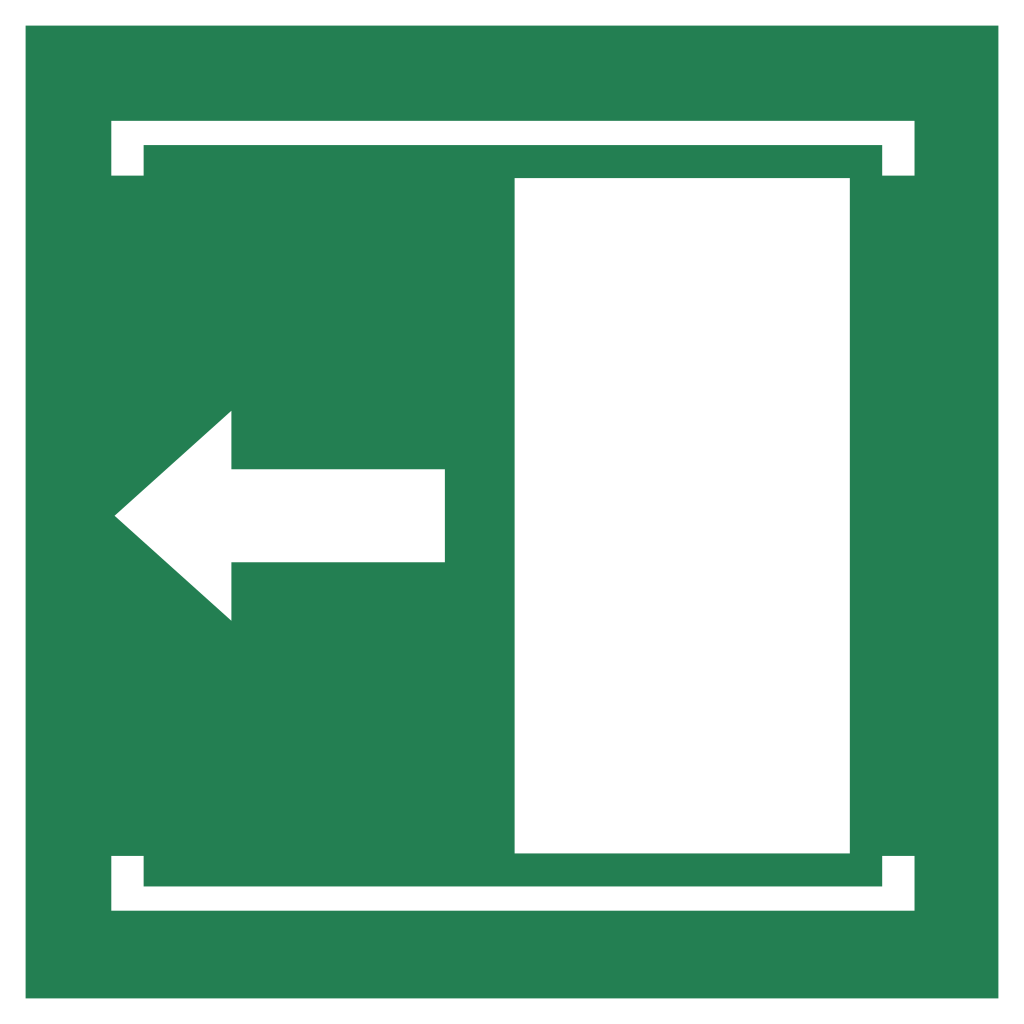
Door slides left to open
Indicates that the door slides to the left to open.
Understanding this sign
Green square or rectangular signs identify emergency escape routes, safety facilities, and rescue equipment.
Follow the complete wayfinding system and local emergency plan. A symbol alone does not establish a safe route.
Leftward Travel on a Track
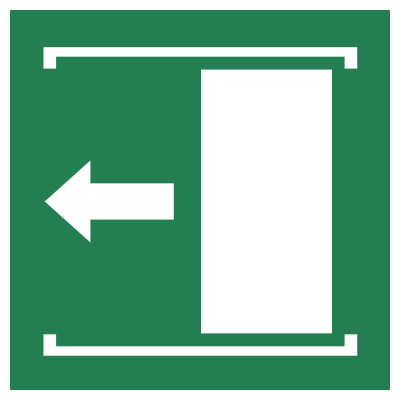
E034 belongs on a sliding door whose leaf moves to the left, from the viewpoint of the person about to open it. ISO 7010 defines the sign simply as indicating the direction in which a sliding door opens, and the green-and-white pictogram pairs the door leaf with a left-pointing arrow so the required movement is understood before the hand reaches the handle. E033 is the corresponding sign for rightward travel.
The instruction sounds trivial until the door is heavy, manual, and unfamiliar. A steel enclosure panel or an insulated cold-store leaf can weigh enough that hauling it toward the closed end produces no perceptible movement, and the person concludes the way is blocked. In an evacuation, that misreading sends someone back into the space they were leaving. The arrow exists to make the first pull the correct one.
One Door, Two Signs: the Viewpoint Problem
Sliding doors have a property hinged doors lack: their opening direction is a mirror image on each face. The identical panel that travels left for a person inside a machinery enclosure travels right for a colleague outside it. Any door whose both faces meet escape approaches therefore typically wears E034 on one side and E033 on the other, and ordering two copies of the same sign for the two faces is a standing procurement mistake worth checking for on site.
The verification method is physical: stand on each approach in turn, operate the door, and record the travel direction as seen from that spot before signs are ordered. Rail vehicles, vessels, and modular plant complicate this further because nominally identical units can be assembled with opposite-handed doors, so fleet operators should sign per door as built rather than per drawing.
Power Operation, Breakout, and Failure Modes
Automatic sliding doors add layers the sign must be honest about. Many pedestrian units in public buildings have a breakout feature that lets the panels swing outward under push during an emergency — in which case the emergency operation is not sliding at all, and marking should follow the manufacturer's emergency-egress instructions rather than a bare E034. Purely manual escape operation, via a release that lets the leaf be slid by hand, is the case where the leftward arrow genuinely describes what the user must do with the power off.
Whatever the drive arrangement, escape-route sliding doors need scheduled functional checks: track obstruction, roller wear, and frozen or debris-fouled bottom guides all raise operating effort past what a smaller occupant can deliver. The inspection should be done at the door's worst credible state — power failed, from the escape side — because that is the state in which the sign will be relied on.
Where you will see E034
It suits manual sliding doors on machinery enclosures, insulated cold-store leaves, and escape-route sliding doors whose emergency operation is sliding by hand with the power off. Because a sliding door's travel direction mirrors on each face, the same panel typically carries E034 on one side and E033 on the other — a point of care on rail vehicles, vessels, and modular plant, where nominally identical units can be assembled with opposite-handed doors.
Common questions about E034
What does the E034 door sign mean?
The door it is fixed to opens by sliding, and the leaf travels to the left from where you are standing. Take the handle and move the panel leftward along its track instead of pushing, pulling, or looking for a hinge. It is part of the ISO 7010 green escape-information series.
Do both sides of a sliding door get the same direction sign?
No — they usually get opposite ones. A sliding leaf that moves left as seen from one face moves right as seen from the other, so a door serving escape approaches on both faces would carry E034 on one side and E033 on the reverse. Always confirm the direction from each approach before ordering.
How do automatic sliding doors work in a power failure?
It depends on the model. Some fail open, some hold their last position with a manual release for hand sliding, and many pedestrian units have breakout panels that swing open when pushed. Signage must match the actual emergency behavior: a leftward-slide arrow is only correct if manual leftward sliding really is the escape operation with the power off.
Why do people push sliding doors instead of sliding them?
Because most doors in daily life are hinged, and a closed sliding leaf gives few visual cues about its mechanism. Under stress, people default to pushing, and a slab that will not swing reads as locked. Direction signs like E034, mounted next to the handle, break that default at the moment it matters.
Reference details
| Symbol code | E034 |
|---|---|
| Sign family | ISO Emergency Signs |
| Standard reference | ISO 7010:2019 / ISO 3864-1 ISO Online Browsing Platform: E034 |
| Screen color reference | #009933. Screen colors are not a production color specification. |
| Download formats | SVG reference artwork; a 1024 × 1024 pixel PNG conversion on a white canvas. |
| Record date | · How to interpret our dates |
| Page updated |
Choosing a physical sign size
Download dimensions are not installation dimensions. Select sign size, material, placement, and lighting using the applicable standard and the actual viewing conditions. Chemical label sizing follows its own rules. Read the artwork and sizing guide.
Sources and artwork credits
- Artwork source
- Wikimedia Commons file page
- Creator credited by source
- Clemenspool
- License
- CC0
- Source metadata checked
SVG files are local reference copies. PNG files are raster conversions. Check the linked file history and license terms before reuse; a source-metadata check is not certification of the artwork or a workplace installation.
Report a correction to this reference