Rescue toboggan
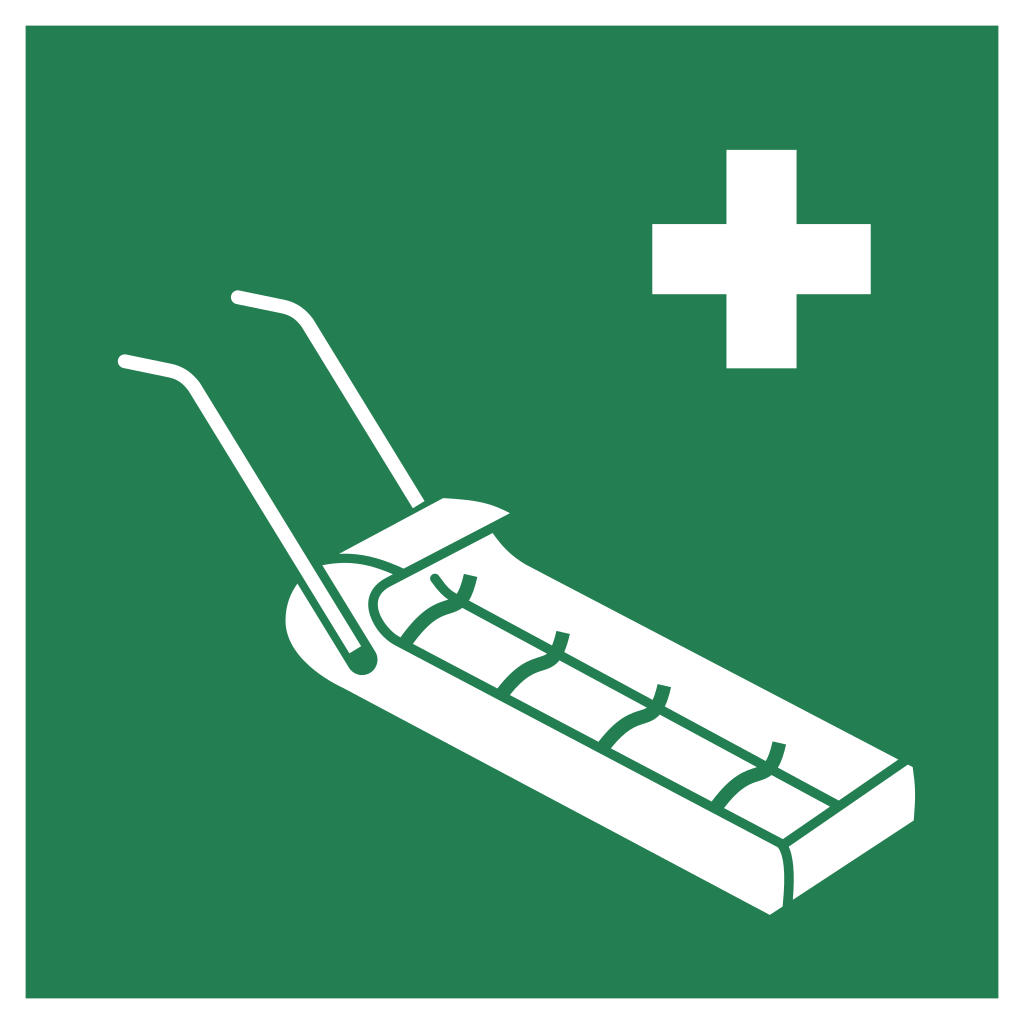
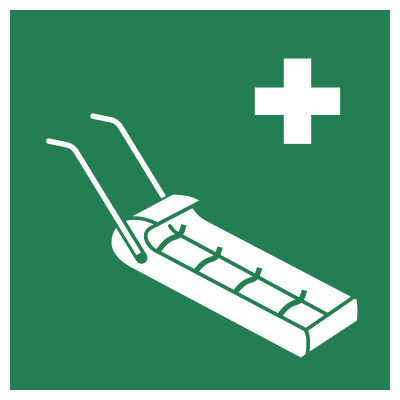
Identifies a rescue toboggan.
Understanding this sign
Green square or rectangular signs identify emergency escape routes, safety facilities, and rescue equipment.
Follow the complete wayfinding system and local emergency plan. A symbol alone does not establish a safe route.
A Sign Born on the Mountain
E071 marks the stowage point of a rescue toboggan — the sled, often called an akja, that ski patrols use to move an injured person over snow when no wheeled vehicle can reach them. The casualty lies packaged in the shell while one or two handlers control it downhill, which makes the toboggan the ambulance of terrain that has lifts instead of roads.
Its inclusion in ISO 7010 gives snow operations something the rest of industry has long enjoyed: a standardized way to mark emergency transport equipment so that any patroller, seasonal hire, or mutual-aid responder can locate the kit at an unfamiliar station without a guided tour. Resorts draw staff from many countries and turn much of the roster over every winter, which makes a language-free pictogram worth more here than in most workplaces.
Where the Sign Gets Posted
Typical positions are the top and mid stations of lifts, patrol huts and first-aid rooms, and piste-side caches at known accident clusters — locations chosen so a toboggan is minutes, not a full lift cycle, away from most of the ski area. Beyond resorts, glacier operations, snowbound research stations, and winter construction or energy sites keep rescue sleds for the same reason and benefit from the same marking.
Snow rewrites the visibility rules. Mount the sign high enough that mid-winter snowpack and drifting cannot bury it, on posts or building faces rather than low racks, and prefer large formats with good contrast: green reads well against snow, but flat light and goggle glare flatten everything, so oversizing is cheap insurance. Materials must shrug off UV at altitude and freeze-thaw cycling.
The Equipment Behind the Pictogram
The sign locates the sled; the rescue depends on what travels with it. A cached toboggan is normally stocked as a package — immobilization splints, blankets or a casualty bag against hypothermia, and rigging for the handlers — and seasonal checks before opening plus restocking after every use keep the package honest. An empty shell at the E071 sign is a failed inspection, not a rescue asset.
Handling a loaded toboggan on steep or icy terrain is a trained skill: patrollers practice brake work, line choice, and two-handler technique before they ever carry a real casualty. For the public, the sign's message is simpler and still valuable — it tells a bystander reporting an accident exactly where rescue equipment lives, which is precise, useful information to pass to the patrol.
Where you will see E071
Resorts post it at the top and mid stations of lifts, at patrol huts and first-aid rooms, and at piste-side caches near known accident clusters, mounted high enough that mid-winter snowpack and drifting cannot bury it. Glacier operations, snowbound research stations, and winter construction or energy sites keep signed rescue sleds for the same reason, favoring large, high-contrast formats that withstand UV at altitude and freeze-thaw cycling.
Common questions about E071
What is a rescue toboggan?
A rescue sled — often called an akja — used by ski patrols and mountain rescuers to transport an injured person over snow. The casualty is secured and insulated inside the shell while trained handlers control the sled downhill to a point where road transport or a helicopter can take over. ISO 7010 E071 marks where one is stored.
Where is the E071 rescue toboggan sign used?
Mainly at ski areas: lift top and mid stations, patrol huts, first-aid rooms, and piste-side equipment caches. It also suits any snowbound operation that stages rescue sleds — glacier work sites, polar and high-altitude research stations, and winter infrastructure projects — where responders need to find casualty transport quickly at an unfamiliar location.
Can anyone use a rescue toboggan in an emergency?
Controlling a loaded sled on steep snow requires training, and mishandling can injure both casualty and handler, so use is normally reserved for ski patrol and trained rescuers. If you witness an accident, the better use of the E071 sign is informational: report the incident to the patrol and tell them which marked cache is nearest the casualty.
Reference details
| Symbol code | E071 |
|---|---|
| Sign family | ISO Emergency Signs |
| Standard reference | ISO 7010:2019 / ISO 3864-1 ISO Online Browsing Platform: E071 |
| Screen color reference | #009933. Screen colors are not a production color specification. |
| Download formats | SVG reference artwork; a 1024 × 1024 pixel PNG conversion on a white canvas. |
| Record date | · How to interpret our dates |
| Page updated |
Choosing a physical sign size
Download dimensions are not installation dimensions. Select sign size, material, placement, and lighting using the applicable standard and the actual viewing conditions. Chemical label sizing follows its own rules. Read the artwork and sizing guide.
Sources and artwork credits
- Artwork source
- Wikimedia Commons file page
- Creator credited by source
- Clemenspool
- License
- CC0
- Source metadata checked
SVG files are local reference copies. PNG files are raster conversions. Check the linked file history and license terms before reuse; a source-metadata check is not certification of the artwork or a workplace installation.
Report a correction to this reference