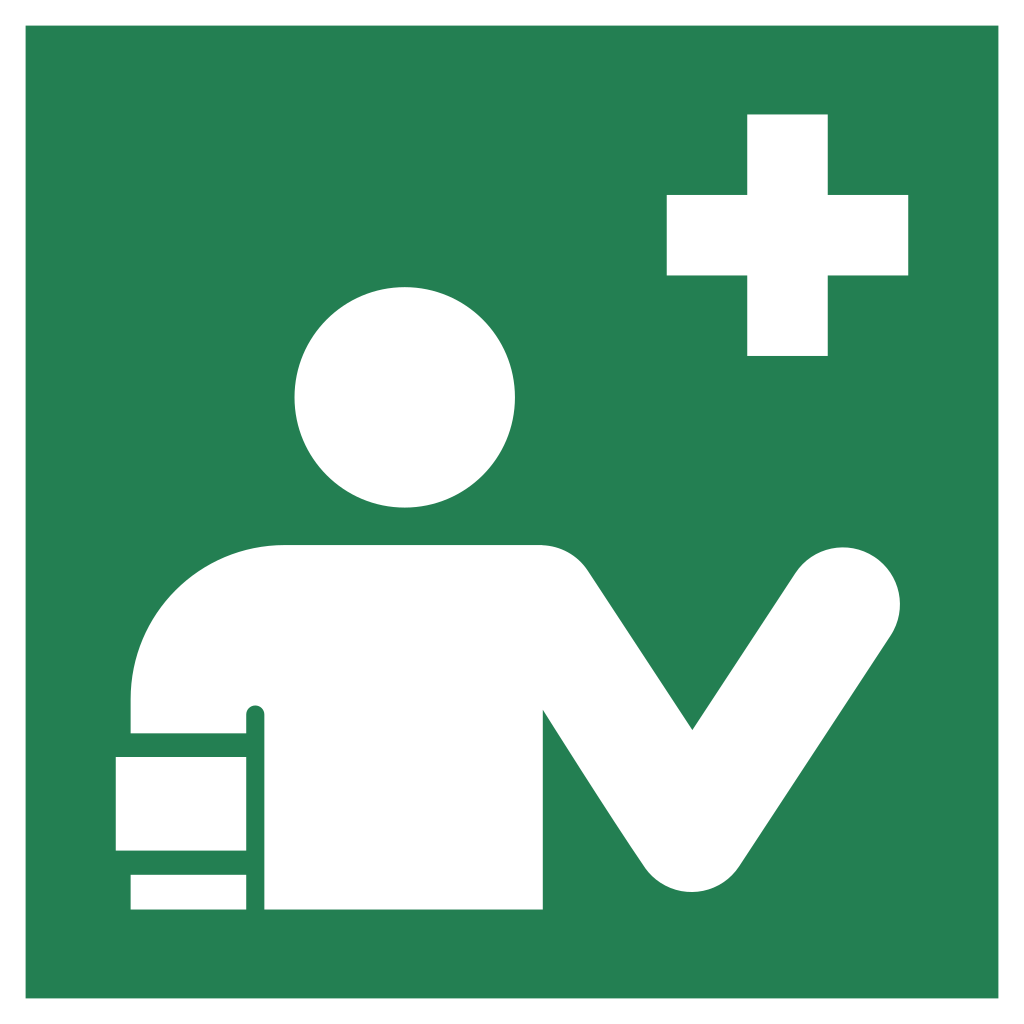
First aid responder
Identifies a first aid responder.

Understanding this sign
Green square or rectangular signs identify emergency escape routes, safety facilities, and rescue equipment.
Follow the complete wayfinding system and local emergency plan. A symbol alone does not establish a safe route.
Signing People, Not Cabinets
E064 exists because first aid is delivered by people, and people are harder to find than wall boxes. The ISO register defines the sign as indicating a person trained in first aid, and it typically appears at the workstation, office door, or duty point of a designated responder. Where E003 says the equipment is here, E064 says the competence is here — a distinction that matters most in the first minute of a serious incident, when what a casualty needs is judgment and hands, not a cabinet.
The sign is a relatively recent addition to the ISO 7010 catalogue, filling a gap facilities had long improvised around with printed lists on noticeboards and homemade door stickers. A standardized pictogram beats a list because it works for visitors, contractors, and staff from other buildings who would never think to consult the noticeboard, and it stays legible in the same way at every site that adopts it.
Deploying E064 Across a Site
The practical pattern is one sign per responder duty point, kept ruthlessly current. Mark the desk, control room seat, or gatehouse where each trained first aider normally works, and add name and extension on a supplementary panel so a caller can also reach them by phone. Shift operations need the marking to reflect coverage, not individuals — a signed responder point that is empty on nights is a false promise, so some sites sign the role location and manage the rota behind it.
Coverage planning drives the count. Employers in most jurisdictions must provide first aiders in numbers justified by their risk assessment — headcount, hazard level, site spread, and distance from medical care all push the number up — and regulators or national guidance often suggest indicative ratios rather than fixed quotas. Once the roster exists, E064 is the mechanism that converts a compliance list into something a panicking colleague can actually use.
How It Complements E003
The two signs are designed to work as a system. A casualty event usually needs both a responder and supplies, so aligning them pays off: many sites position a responder's marked duty point beside the kit location, or add directional E064 signage pointing from the first aid cabinet toward the nearest trained person. During emergencies involving evacuation, identification moves onto the person — high-visibility vests or helmet markings with the first aid cross let responders be spotted in a crowd at the assembly point.
Keep the semantics clean when combining signs. E003 on a door with E064 beside it reads as supplies and a trained person here, which is exactly right for a staffed first aid room. Using E064 alone over a kit, or E003 on an individual's desk, muddies a distinction the standard took the trouble to draw, and consistency across a site is what lets people stop reading and start recognizing.
Where you will see E064
Sites post one sign per responder duty point — a desk, control room seat, or gatehouse — with name and extension on a supplementary panel, keeping the marking current with shift coverage. Many facilities place a responder's marked point beside the first aid kit location or add directional E064 signage from the cabinet toward the nearest trained person, and a staffed first aid room correctly displays E003 and E064 together.
Common questions about E064
What does the ISO 7010 E064 sign mean?
It identifies a person trained in first aid — marking the workstation, office, or duty point where a designated first aid responder can be found. It complements E003, which marks first aid equipment and facilities rather than trained people.
How many first aiders does a workplace need?
There is no universal number. Most regulations require provision adequate to the workplace's risk assessment, weighing headcount, hazards, shift patterns, site layout, and distance from medical care; national guidance often gives indicative ratios per number of employees. Higher-risk and multi-shift operations need more responders and, correspondingly, more marked responder points.
Where should the first aid responder sign be displayed?
At each place a trained responder reliably works — a desk, control room, reception, or gatehouse — ideally with a supplementary panel giving the name and internal number. Update the signage whenever responders change roles or shifts, because an out-of-date responder sign actively misdirects people in an emergency.
Can first aiders wear the E064 symbol instead of posting it on a wall?
Wearable identification — vests, badges, or helmet decals carrying the first aid symbol — is a common and sensible complement, especially at assembly points, events, and construction sites where people move around. It does not replace fixed signage at duty points, which is what lets someone locate help when no responder is in sight.
Reference details
| Symbol code | E064 |
|---|---|
| Sign family | ISO Emergency Signs |
| Standard reference | ISO 7010:2019 / ISO 3864-1 ISO Online Browsing Platform: E064 |
| Screen color reference | #009933. Screen colors are not a production color specification. |
| Download formats | SVG reference artwork; a 1024 × 1024 pixel PNG conversion on a white canvas. |
| Record date | · How to interpret our dates |
| Page updated |
Choosing a physical sign size
Download dimensions are not installation dimensions. Select sign size, material, placement, and lighting using the applicable standard and the actual viewing conditions. Chemical label sizing follows its own rules. Read the artwork and sizing guide.
Sources and artwork credits
- Artwork source
- Wikimedia Commons file page
- Creator credited by source
- Clemenspool
- License
- CC0
- Source metadata checked
SVG files are local reference copies. PNG files are raster conversions. Check the linked file history and license terms before reuse; a source-metadata check is not certification of the artwork or a workplace installation.
Report a correction to this reference