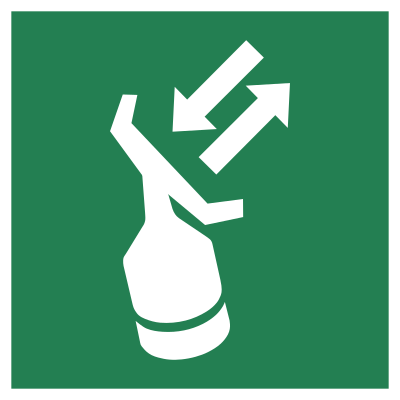
Rocket parachute flare
Identifies a rocket parachute flare.

Understanding this sign
Green square or rectangular signs identify emergency escape routes, safety facilities, and rescue equipment.
Follow the complete wayfinding system and local emergency plan. A symbol alone does not establish a safe route.
What ISO 7010 E049 Marks
E049 is the safe-condition sign for the stowage location of rocket parachute flares — the longest-range visual distress signal in the maritime pyrotechnic family. The white pictogram on green shows the rocket ascending with its parachute deployed, distinguishing it at a glance from E048, which covers a survival craft's mixed distress-signal outfit.
A rocket parachute flare is fired from the hand or a launcher, climbs to an altitude on the order of 300 metres, then ejects a brilliant red flare that descends slowly under a small parachute, burning for around 40 seconds or more. Height plus burn time is the whole point: the signal rises above the horizon of vessels many miles away and stays visible long enough for a watchkeeper to take a bearing on it.
Where Rocket Parachute Flares Are Stowed
Unlike most survival equipment, these flares live in two places aboard a SOLAS ship. Each lifeboat's pyrotechnic outfit includes them for use after abandoning ship, and a separate stock is kept on or near the navigation bridge so the ship can signal distress while still afloat and manned. E049 identifies both stowages, and its most important application is the bridge locker, where E048 would be the wrong sign.
Fix the sign on the flare container or locker door itself, sized for the compartment's viewing distance and photoluminescent where the vessel's safety-sign scheme requires low-light visibility. IMO Resolution A.1116(30) harmonized shipboard location markings with ISO 7010, so surveys and port state inspections increasingly expect this exact symbol rather than legacy pictograms.
Using the Signal Effectively
A red rocket parachute flare is a recognized distress signal under the International Regulations for Preventing Collisions at Sea, so firing one is a formal declaration of distress — never a test or celebration device. Doctrine taught in sea-survival courses is to fire in pairs a couple of minutes apart: the first catches a distant watchkeeper's eye, the second lets them confirm and take a bearing. Firing downwind at a slight angle keeps the burning flare from drifting back over the craft.
Because each unit is single-use and the outfit is small, conserving rockets until a ship or aircraft is plausibly within visual range matters more than with radio devices. This is where the GMDSS electronics marked by E052 (EPIRB) and E047 (SART) carry the load: they summon and steer the rescuer, and the pyrotechnics confirm the exact spot in the final visual search.
Where you will see E049
SOLAS ships stow these flares in two places and the sign identifies both: each lifeboat's pyrotechnic outfit and a separate locker on or near the navigation bridge for signalling distress while the ship is still afloat and manned. It is fixed on the flare container or locker door itself, and port state inspections increasingly expect this exact symbol under IMO Resolution A.1116(30).
Common questions about E049
How high does a rocket parachute flare go and how long does it burn?
Marine rocket parachute flares built to the IMO LSA Code performance standard reach an altitude of roughly 300 metres and burn a bright red light for at least about 40 seconds while descending slowly under the parachute. That combination makes them visible from many nautical miles away at night, far beyond the range of a hand flare.
Where does the E049 sign go on a ship?
On every stowage that holds rocket parachute flares: the dedicated locker on or near the navigation bridge, and any container serving the survival craft. If a locker holds a craft's complete pyrotechnic outfit — rockets plus hand flares and smoke signals — the broader E048 survival craft distress signal sign is the better fit.
Is firing a red parachute flare always a distress signal?
Yes. Under the international collision regulations, a rocket throwing a red star or a red parachute flare is a defined distress signal, and using one when not in distress can trigger a search and rescue response and legal consequences. Training exercises use dedicated practice signals or are coordinated in advance with the local rescue authority.
When should survivors fire a parachute flare instead of a hand flare or smoke signal?
Fire the rocket when a potential rescuer is distant or its position is unknown, especially at night — its altitude puts it above the horizon of far-off ships. Switch to hand flares once a vessel or aircraft is clearly approaching, and use buoyant orange smoke in daylight for the final close-range location, particularly for helicopters judging wind and position.
Reference details
| Symbol code | E049 |
|---|---|
| Sign family | ISO Emergency Signs |
| Standard reference | ISO 7010:2019 / ISO 3864-1 ISO Online Browsing Platform: E049 |
| Screen color reference | #009933. Screen colors are not a production color specification. |
| Download formats | SVG reference artwork; a 1024 × 1024 pixel PNG conversion on a white canvas. |
| Record date | · How to interpret our dates |
| Page updated |
Choosing a physical sign size
Download dimensions are not installation dimensions. Select sign size, material, placement, and lighting using the applicable standard and the actual viewing conditions. Chemical label sizing follows its own rules. Read the artwork and sizing guide.
Sources and artwork credits
- Artwork source
- Wikimedia Commons file page
- Creator credited by source
- Clemenspool
- License
- CC0
- Source metadata checked
SVG files are local reference copies. PNG files are raster conversions. Check the linked file history and license terms before reuse; a source-metadata check is not certification of the artwork or a workplace installation.
Report a correction to this reference