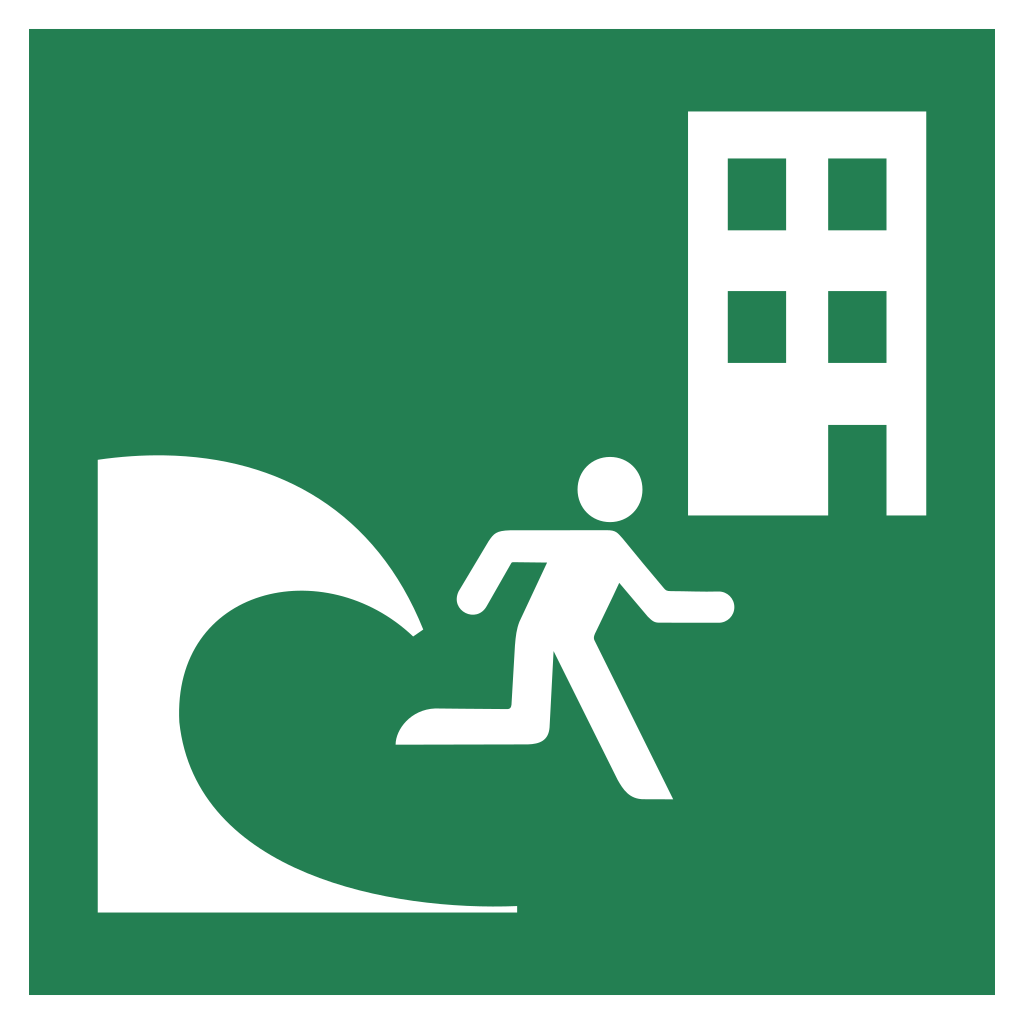
Tsunami evacuation building
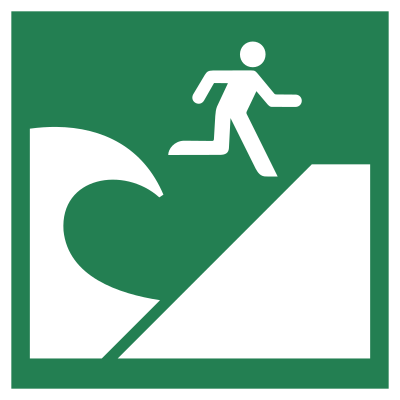
Identifies a tsunami evacuation building.
Understanding this sign
Green square or rectangular signs identify emergency escape routes, safety facilities, and rescue equipment.
Follow the complete wayfinding system and local emergency plan. A symbol alone does not establish a safe route.
What ISO 7010 E063 Means
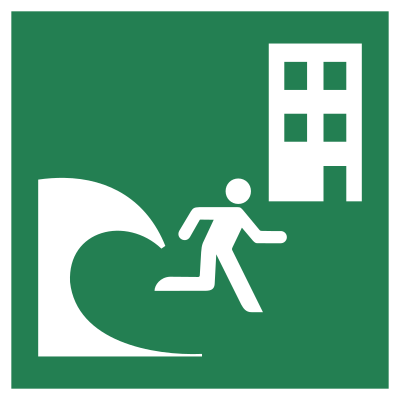
E063 identifies a tsunami evacuation building: a structure officially designated for vertical evacuation, where people climb above the expected water level instead of outrunning it. The green pictogram shows a person ascending a multi-storey building above a wave symbol, and it appears on the building itself and on arrowed route signs leading to it.
Vertical evacuation is the answer to an unforgiving equation. On low-lying coastal plains, the nearest high ground may be farther away than anyone can travel in the interval between a near-shore earthquake and the first wave. Japan pioneered designating and purpose-building such refuges, and the concept — along with its signage — spread internationally through ISO standardization as other exposed coastlines adopted the model.
What Qualifies a Building
Not any tall building will do, which is precisely why official designation and signage matter. A tsunami evacuation building must resist both the earthquake that typically precedes the waves and the hydrodynamic loading, scour, and debris impact of the flow itself; its refuge floors must stand above the modelled inundation depth with margin; and it needs access that works when the power is out — external stairs or unlocked stairwells available around the clock.
Authorities formalize these judgments through engineering criteria and agreements with building owners, then mark the qualifying structures with E063, often adding supplementary text stating which floor to reach. Guidance for vertical evacuation structures, such as FEMA's work in the United States and Japanese national criteria, underpins the designation process, though the sign itself communicates only the essential instruction: this building, upward.
E063 in a Coastal Signage System
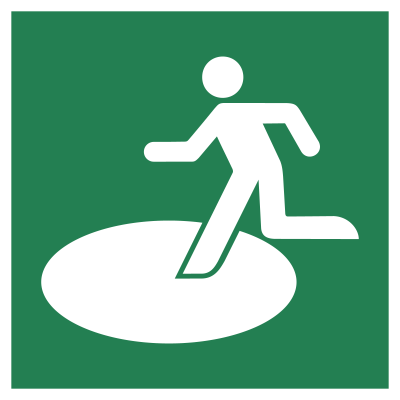
E063 works as the fallback tier in a layered plan. The primary instruction in most tsunami plans is horizontal evacuation to the high-ground assembly areas marked E062; evacuation buildings capture everyone the clock strands — beachgoers, the mobility-impaired, hotel guests far from the hills. Route maps and street signage should make the hierarchy legible so people do not divert to a nearer building when high ground is genuinely reachable.
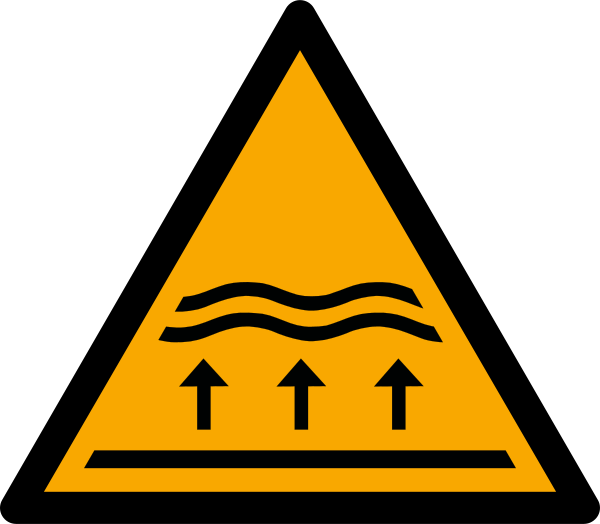
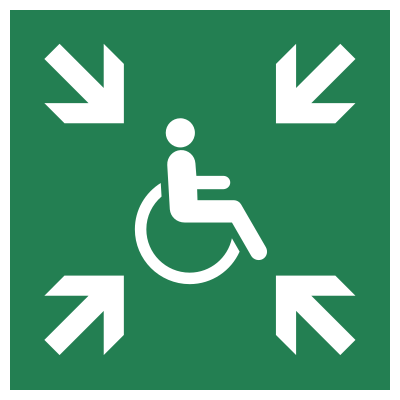
The companion symbols complete the picture: hazard-zone warnings from the ISO W-series (for example W077 for flood zones, alongside coastal-hazard warnings) tell people they are in exposed territory, E062 and E063 tell them where safety lies, and E065 covers general-purpose outdoor disaster refuges that may not be tsunami-safe. Municipalities mixing these symbols should audit for the fatal error of an E065 refuge inside the inundation line being mistaken for tsunami shelter.
Where you will see E063
Coastal municipalities on low-lying plains display it on the qualifying structure itself and on arrowed street routes leading to it, often with text stating which floor to reach. Japan pioneered the model, which now serves beachfronts, hotels, and districts where high ground is beyond reach in the warning interval, working alongside E062 high-ground assembly signs and tsunami hazard-zone warnings.
Common questions about E063
What is a tsunami evacuation building?
A structure officially designated for vertical evacuation during a tsunami — engineered or assessed to survive the earthquake and the wave loading, with refuge floors above the modelled inundation level and access routes that stay open around the clock. The ISO 7010 E063 sign on its facade tells people they can climb this specific building to escape the water.
When should I go to a tsunami evacuation building instead of high ground?
Only when high ground is out of reach in the time available. Horizontal evacuation to an elevated assembly area (sign E062) is the preferred option because it removes you from the hazard entirely. If you are on a flat coastal strip and waves could arrive within minutes, the nearest signed evacuation building is the survivable alternative — go up, as high as the signage directs.
Can any tall building be used to escape a tsunami?
As a last resort, climbing any solid reinforced-concrete building beats staying at ground level, but designated buildings are marked because they have been vetted: structural resistance to wave forces and debris, refuge floors above predicted flood depth, and stair access that does not depend on staff or power. An unvetted building may be locked, too weak, or too low.
Who designates and signs tsunami evacuation buildings?
Local emergency management authorities, applying national or regional engineering criteria and usually formal agreements with building owners covering access and maintenance. Once designated, the building is marked with the E063 symbol, added to evacuation maps, and incorporated into drills so residents and visitors know it before an event.
Reference details
| Symbol code | E063 |
|---|---|
| Sign family | ISO Emergency Signs |
| Standard reference | ISO 7010:2019 / ISO 3864-1 ISO Online Browsing Platform: E063 |
| Screen color reference | #009933. Screen colors are not a production color specification. |
| Download formats | SVG reference artwork; a 1024 × 1024 pixel PNG conversion on a white canvas. |
| Record date | · How to interpret our dates |
| Page updated |
Choosing a physical sign size
Download dimensions are not installation dimensions. Select sign size, material, placement, and lighting using the applicable standard and the actual viewing conditions. Chemical label sizing follows its own rules. Read the artwork and sizing guide.
Sources and artwork credits
- Artwork source
- Wikimedia Commons file page
- Creator credited by source
- Clemenspool
- License
- CC0
- Source metadata checked
SVG files are local reference copies. PNG files are raster conversions. Check the linked file history and license terms before reuse; a source-metadata check is not certification of the artwork or a workplace installation.
Report a correction to this reference