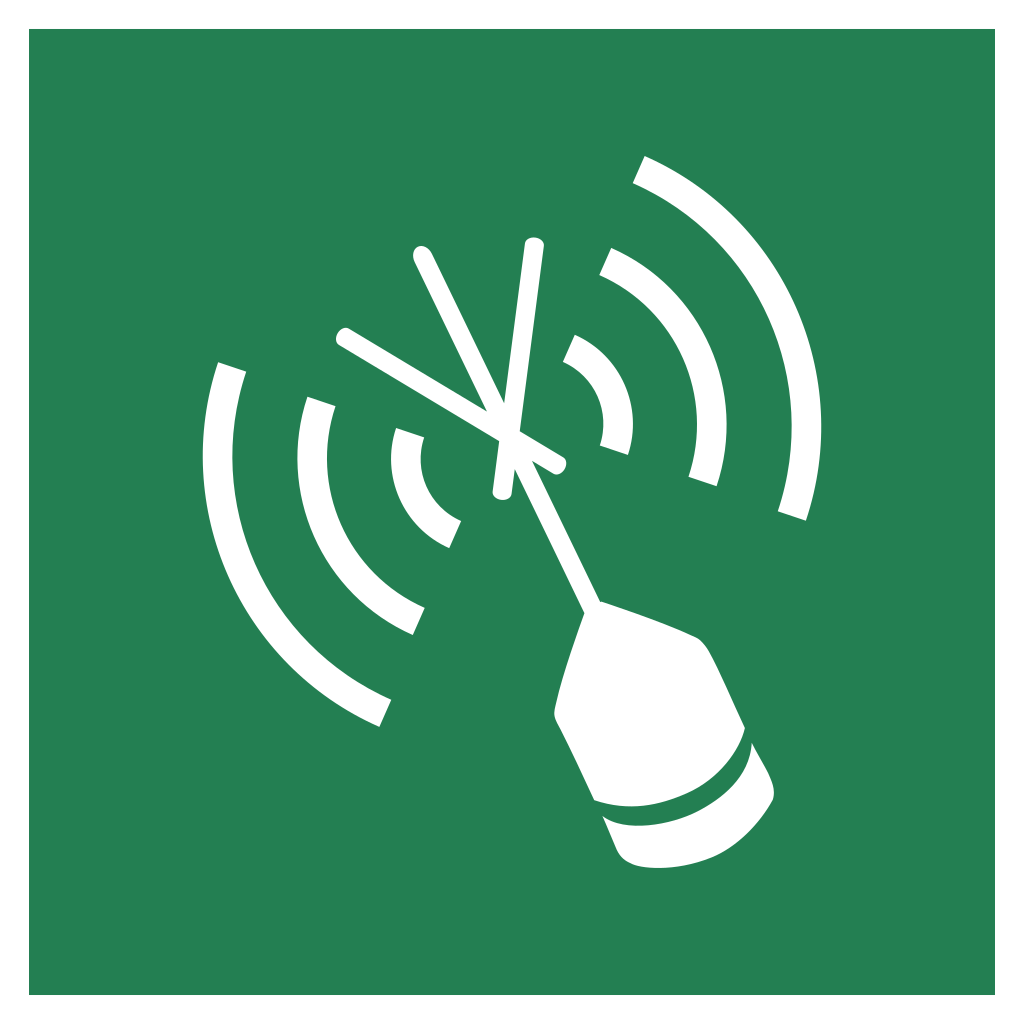
Emergency position indicating radio beacon
Identifies an emergency position indicating radio beacon (EPIRB).
Understanding this sign
Green square or rectangular signs identify emergency escape routes, safety facilities, and rescue equipment.
Follow the complete wayfinding system and local emergency plan. A symbol alone does not establish a safe route.
What ISO 7010 E052 Marks
E052 marks the mounting location of the ship's EPIRB — the emergency position indicating radio beacon that is arguably the single most important distress device aboard. The green square with its white beacon-and-signal pictogram is a location sign using ISO 3864-1's white-on-green convention; on most vessels it sits beside a float-free bracket on an open deck near the bridge.
An EPIRB transmits a coded distress message on 406 MHz to the Cospas-Sarsat international satellite system. The satellites relay the alert, with the beacon's identity and position, to a ground station and on to the responsible rescue coordination centre — no other person, ship, or shore station needs to be listening. Modern units embed a GNSS receiver so the alert carries precise coordinates, and a low-power homing transmitter helps aircraft find the beacon in the final search.
Float-Free Release and Automatic Activation
The defining installation feature is the hydrostatic release unit. If the ship sinks before anyone can act, water pressure at shallow depth triggers the release, the buoyant beacon floats clear of the vessel, and contact with seawater activates it automatically. That is why the E052 sign so often appears on an external bulkhead rather than inside: the bracket must have a clear path to the surface, unobstructed by awnings, rigging, or superstructure.
The same logic dictates maintenance duties that signage audits should sweep up: the hydrostatic release is a dated consumable that requires periodic replacement, the beacon battery has an expiry date, and SOLAS ships are subject to routine testing and shore-based maintenance regimes. A correctly signed but expired EPIRB fails the only test that matters.
Registration: The Paperwork That Saves Hours
Every 406 MHz beacon transmits a unique hexadecimal identity, and owners are required to register it with their national authority — in the United States that is NOAA's beacon registration database. Registration links the ID to the vessel, owner, and emergency contacts, letting a rescue coordination centre phone the listed contacts within minutes of an alert to confirm whether the vessel is genuinely at sea.
An unregistered or stale registration slows everything down and complicates the false-alert filtering that keeps rescue assets available — most 406 MHz activations turn out to be accidental, and a working phone number resolves them in minutes. Buying a vessel with an installed EPIRB, changing flag, or changing owner contact details all trigger a re-registration duty that is easy to overlook and free to perform.
E052 in the Wider Distress-Signal Set
Among the GMDSS location signs, E052 marks the alerting device: the EPIRB starts the rescue. E047's SART and E051's two-way VHF then take over as the homing and voice tools once rescuers are en route, while the pyrotechnics behind E048 and E049 provide the visual confirmation layer. A vessel signage plan that covers all five gives crew a findable home for the complete distress chain.
Since IMO Resolution A.1116(30) pointed shipboard equipment markings to the ISO 7010 symbol library, E052 has been displacing older beacon pictograms at survey and refit. Where the EPIRB is duplicated — some operators carry a second, manually deployed unit in the grab bag or wheelhouse — each stowage should carry its own sign.
Where you will see E052
On most vessels the sign sits beside the float-free hydrostatic bracket on an open deck near the bridge, often on an external bulkhead so the buoyant beacon has a clear path to the surface if the ship sinks. Operators carrying a second, manually deployed unit in the grab bag or wheelhouse sign each stowage separately, and since IMO Resolution A.1116(30) the symbol has been displacing older beacon pictograms at survey and refit.
Common questions about E052
What does an EPIRB do when a ship sinks?
If the vessel goes down, water pressure trips the hydrostatic release on the EPIRB's bracket, the buoyant beacon floats free, and seawater contact switches it on automatically. It then transmits a coded 406 MHz distress signal with its identity and GNSS position to the Cospas-Sarsat satellite system, which routes the alert to the appropriate rescue coordination centre without any action from the crew.
Why is the EPIRB mounted outside on deck instead of inside the bridge?
Because the float-free function only works if the beacon has an unobstructed path to the surface as the ship sinks. Mounting it on an open deck or external bulkhead — the location the E052 sign marks — lets the released beacon float clear. A unit stowed inside a compartment can be trapped with the wreck and never reach the surface to transmit effectively.
Do I have to register my EPIRB?
Yes. Every 406 MHz beacon carries a unique identity code that must be registered with the owner's national authority (NOAA in the US). Registration gives rescue coordinators the vessel description and emergency contacts tied to the alert, dramatically speeding response and helping resolve false alarms. Registration is free and must be updated when the vessel, owner, or contact details change.
How often does EPIRB maintenance come due?
Three clocks run at once: the hydrostatic release unit is a dated part that needs periodic replacement, the battery has a printed expiry date, and SOLAS vessels must also carry out routine self-tests plus shore-based servicing at prescribed intervals. Check all three during safety-equipment surveys — the E052 sign marks the bracket, but only in-date components make the beacon dependable.
Reference details
| Symbol code | E052 |
|---|---|
| Sign family | ISO Emergency Signs |
| Standard reference | ISO 7010:2019 / ISO 3864-1 ISO Online Browsing Platform: E052 |
| Screen color reference | #009933. Screen colors are not a production color specification. |
| Download formats | SVG reference artwork; a 1024 × 1024 pixel PNG conversion on a white canvas. |
| Record date | · How to interpret our dates |
| Page updated |
Choosing a physical sign size
Download dimensions are not installation dimensions. Select sign size, material, placement, and lighting using the applicable standard and the actual viewing conditions. Chemical label sizing follows its own rules. Read the artwork and sizing guide.
Sources and artwork credits
- Artwork source
- Wikimedia Commons file page
- Creator credited by source
- Clemenspool
- License
- CC0
- Source metadata checked
SVG files are local reference copies. PNG files are raster conversions. Check the linked file history and license terms before reuse; a source-metadata check is not certification of the artwork or a workplace installation.
Report a correction to this reference