Evacuation Assembly Point
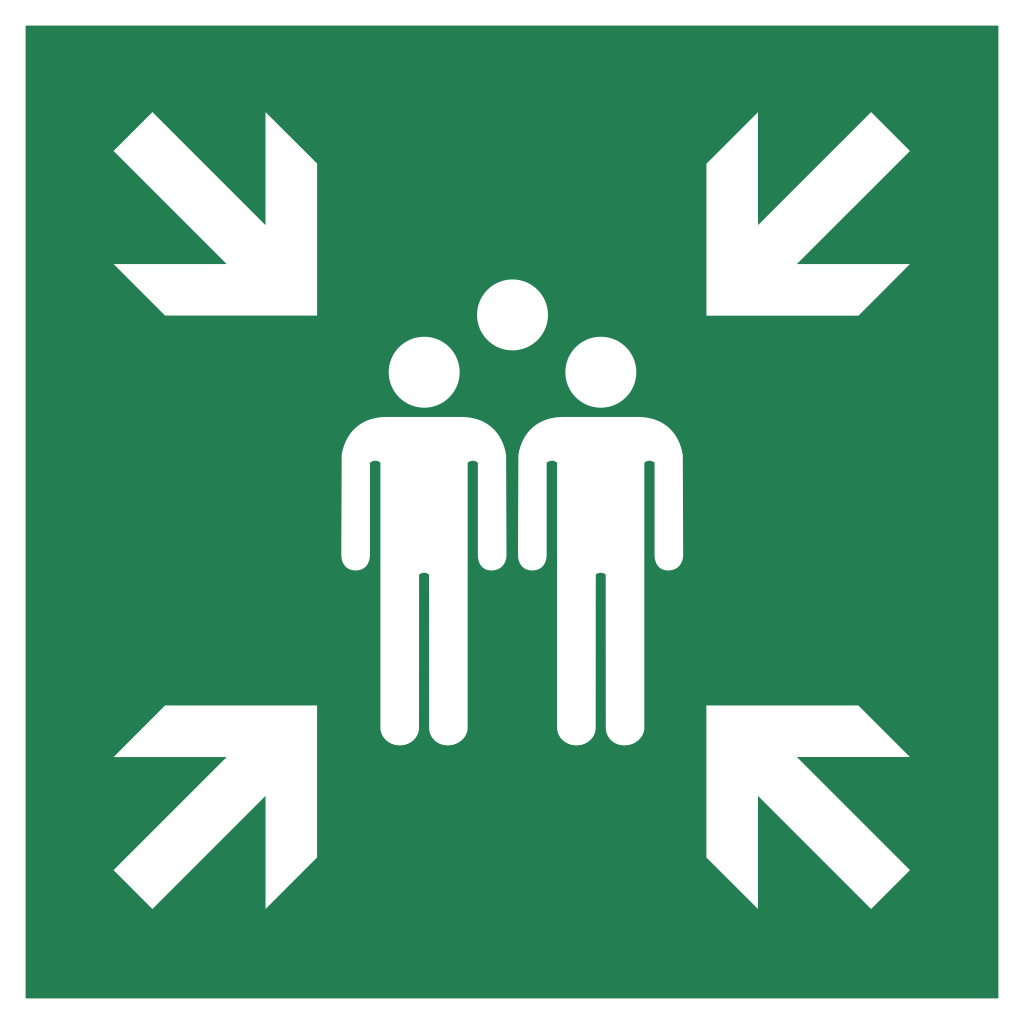
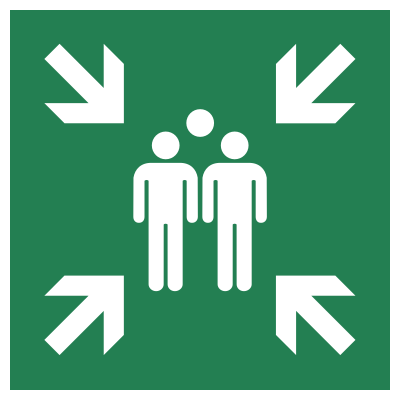
Identifies an evacuation assembly point.
Understanding this sign
Green square or rectangular signs identify emergency escape routes, safety facilities, and rescue equipment.
Follow the complete wayfinding system and local emergency plan. A symbol alone does not establish a safe route.
What the Assembly Point Sign Designates
E007 shows four white arrows converging on a group of four human figures, all on a green square. It designates the assembly point — also called the muster point — where evacuees are expected to gather after leaving a building, so that supervisors can take headcounts, identify anyone missing, and pass accurate information to arriving emergency services. It is the endpoint of the escape-route chain that begins with the running-man signs inside the building: E001 and E002 get people out, E007 tells them where out ends.
The sign matters because evacuation without accountability is only half an evacuation. If occupants scatter to cars, smoking areas, or the far side of the site, no one can say whether the building is empty, and firefighters may commit to a search for people who are standing in the parking lot. A clearly marked, universally known assembly point converts a crowd into a countable roster, and drills that end at the E007 sign build the habit that makes the real event orderly.
Choosing Where the Assembly Point Goes
Location selection comes before signage. The point should be far enough from the building to be outside the reach of radiant heat, falling glass, and smoke — and on chemical sites, positioned with prevailing wind in mind so a vapor release does not drift across the muster area. It must not sit on fire apparatus access routes or hydrant positions, since several hundred people standing in the fire lane is a classic planning failure. Capacity, level ground, lighting for night shifts, and safe pedestrian routes from every exit all belong in the assessment.
Most sites need more than one point. A single muster area can be made unusable by the incident itself — downwind of the release, adjacent to the burning wing — so plans commonly designate primary and alternate points and give each an identifier such as a letter or number displayed on the sign's text panel. Multi-building campuses typically assign points per building or department, and the emergency plan, the training, and the physical signs must all use the same names, or the radio traffic during an incident becomes guesswork.
OSHA Emergency Action Plans and Accountability
For most US employers, the assembly point is where a regulatory obligation lands physically. OSHA's emergency action plan standard, 29 CFR 1910.38, requires covered workplaces to maintain a plan that includes evacuation procedures and exit route assignments, and specifically procedures to account for all employees after evacuation. An unmarked, informally understood gathering spot makes that accountability procedure fragile; posting E007 at the designated location, and referencing it in the written plan and training, makes it auditable.
The accountability mechanics deserve as much attention as the sign. Sites use roll calls against shift rosters, badge-reader mustering, floor-warden reports, or sweep confirmation, and each method assumes people actually arrive at the point. Contractors and visitors are the usual gap: they were never trained on the assembly point and follow whoever they happen to be near. Induction briefings that physically show newcomers the E007 location, and host responsibilities written into permit-to-work systems, close that gap far more reliably than another sign indoors.
Making an Outdoor Sign Actually Visible
E007 lives outdoors among parked vehicles, landscaping, and crowds, which changes the signage math. It should be mounted high — commonly two meters or more on a dedicated post — so it remains visible above a gathered crowd and can be spotted from the exits it serves. Large formats, double-sided or panoramic mounting for approaches from multiple directions, and reflective or photoluminescent material for night and power-failure conditions are all standard practice on industrial sites.
Supplementary text panels carry the local content the pictogram cannot: the point's identifier, the departments or buildings assigned to it, and sometimes a simple site map. Weathering is the maintenance issue signage plans forget; a sign that has faded to pale mint after five summers no longer reads as a safety color at distance. Include assembly point signs in the same periodic inspection cycle as internal escape signage, and check sightlines after any change to parking layouts, fencing, or vegetation.
Where you will see E007
Used at outdoor muster points, campus evacuation zones, refinery and warehouse assembly areas, contractor meeting points, utility sites, and multi-building facilities where orderly post-evacuation accountability is part of the emergency plan.
Common questions about E007
What is a muster point sign?
It is the ISO 7010 E007 sign — four arrows converging on a group of figures, white on green — marking the designated location where evacuees gather after leaving a building so headcounts and accountability checks can be completed. Muster point, assembly point, and evacuation assembly area are different names for the same designated location.
Does OSHA require an assembly point sign?
OSHA 1910.38 requires emergency action plans to include procedures for accounting for all employees after evacuation, but it does not mandate a specific sign. Posting E007 at the designated point is the practical way to make the accountability procedure work and demonstrate it during an inspection, so it is standard practice even though the pictogram itself is not cited in the rule.
How far from the building should a fire assembly point be?
No universal distance is prescribed; it is a risk-based decision. The point must be beyond the reach of radiant heat, falling debris, and smoke, clear of fire apparatus access and hydrants, and on chemical sites placed with wind direction in mind. Large or high-hazard buildings justify greater distances, and many sites designate an alternate point in case the primary is compromised.
How high should an assembly point sign be mounted?
High enough to stay visible above a gathered crowd and readable from the exits it serves — in practice usually two meters or more on a dedicated post, in a large format, often double-sided. Reflective or photoluminescent versions keep the point findable during night shifts and power failures.
Reference details
| Symbol code | E007 |
|---|---|
| Sign family | ISO Emergency Signs |
| Standard reference | ISO 7010:2019 / ISO 3864-1 ISO Online Browsing Platform: E007 |
| Screen color reference | #009933. Screen colors are not a production color specification. |
| Download formats | SVG reference artwork; a 1024 × 1024 pixel PNG conversion on a white canvas. |
| Record date | · How to interpret our dates |
| Page updated |
Choosing a physical sign size
Download dimensions are not installation dimensions. Select sign size, material, placement, and lighting using the applicable standard and the actual viewing conditions. Chemical label sizing follows its own rules. Read the artwork and sizing guide.
Sources and artwork credits
- Artwork source
- Wikimedia Commons file page
- Creator credited by source
- MaxxL
- License
- Public domain
- Source metadata checked
SVG files are local reference copies. PNG files are raster conversions. Check the linked file history and license terms before reuse; a source-metadata check is not certification of the artwork or a workplace installation.
Report a correction to this reference