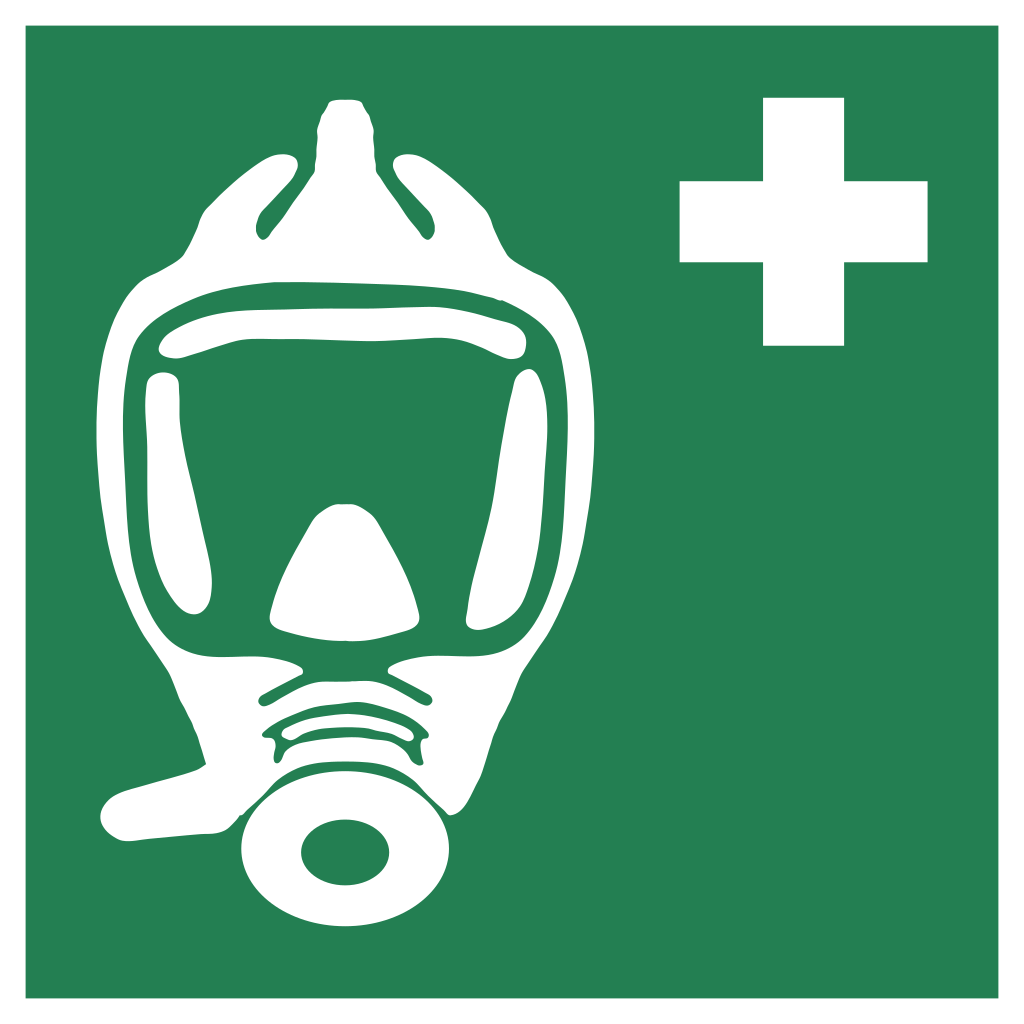
Emergency escape breathing device
Identifies an emergency escape breathing device.
Understanding this sign
Green square or rectangular signs identify emergency escape routes, safety facilities, and rescue equipment.
Follow the complete wayfinding system and local emergency plan. A symbol alone does not establish a safe route.
What ISO 7010 E029 Marks
E029 identifies the stowage position of an emergency escape breathing device (EEBD): a compact hood or mask with its own short-duration air supply that lets a person walk out of a smoke-filled or oxygen-deficient compartment. The pictogram shows a figure wearing the hood, rendered in white on the safe-condition green square defined by ISO 3864-1. Like the other maritime E-series signs, it entered ISO 7010 as part of the harmonization of IMO escape route and equipment location markings, so the same symbol now appears on ships, offshore installations, and land facilities that stock escape sets.
The device behind the sign is deliberately simple. An EEBD is designed to be donned in seconds without fitting or adjustment, works for wearers with beards or glasses, and supplies breathable air for a limited period — SOLAS-compliant units must last at least ten minutes. That is enough to traverse a machinery space stairtower or a smoke-logged corridor, and nothing more.
SOLAS and FSS Code Background
On SOLAS ships, EEBDs are not optional equipment. Chapter II-2 of the convention requires them in accommodation spaces and in machinery spaces, positioned so that anyone working there can reach a set on the way out; the Fire Safety Systems (FSS) Code sets the performance specification, including the minimum service duration and the requirement that the unit be usable without training-dependent adjustment. Ships also carry spare units dedicated to training so that live sets stay sealed.
Because the escape sets only save lives if crew can find them under stress, flag and port state inspectors routinely check that every stowage box carries the correct location sign and that brief operating instructions are posted with it. E029 is the symbol that satisfies that marking expectation, usually in photoluminescent material so it remains visible during a blackout or under a smoke layer.
Escape Only — Never Entry or Rescue
The single most important message attached to this sign is what the equipment must not be used for. An EEBD provides no protection for firefighting, has no facility for entering a hazardous space, and cannot be shared with a casualty. Anyone going into smoke to fight a fire or retrieve a person needs a self-contained breathing apparatus from a fireman's outfit, worn by a trained team with backup.
This is why EEBD stowages are oriented along escape routes rather than at attack points: the device is picked up while moving toward fresh air. Crew familiarization covers donning the hood, activating the supply, and heading directly for the nearest exit — and drills reinforce that once the hood is on, the wearer does not stop to perform other duties.
Where to Post E029
Mark every EEBD stowage point: brackets beside engine room workstations, boxes at the base and intermediate levels of machinery space escape trunks, cabinets in accommodation corridors, and any additional sets carried in cargo control rooms or steering gear compartments. The sign belongs on or immediately above the stowage so it can be spotted from the normal working position, not hidden behind machinery.
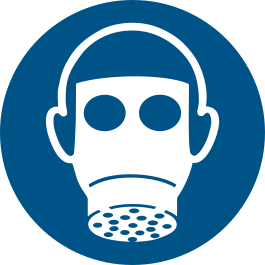
Outside shipping, the same symbol is increasingly used wherever escape sets are staged — tunnels, mines, chemical plants, and wind turbine towers. In those settings E029 should be distinguished from M017 (respiratory protection must be worn): M017 mandates PPE for routine work in contaminated air, while E029 points to emergency-only equipment for getting out.
Where you will see E029
On SOLAS ships every stowage point is marked: brackets beside engine room workstations, boxes at the levels of machinery space escape trunks, cabinets in accommodation corridors, and sets in cargo control rooms or steering gear compartments, usually in photoluminescent material for blackout visibility. Ashore, the same symbol increasingly marks escape sets staged in tunnels, mines, chemical plants, and wind turbine towers, distinct from M017 respiratory-protection mandates.
Common questions about E029
What is an EEBD on a ship?
An emergency escape breathing device: a hood or mask with a self-contained air supply, carried on SOLAS ships in machinery and accommodation spaces so a person caught by smoke or toxic gas can breathe long enough to escape. Compliant units supply air for at least ten minutes and are designed to be put on in seconds without prior fitting.
Can an emergency escape breathing device be used to rescue someone?
No. EEBDs are certified for self-escape only. They carry too little air, offer no protection for firefighting, and cannot support entry into a dangerous space. Rescue and fire attack require self-contained breathing apparatus worn by trained personnel — using an escape set for entry is a common and serious audit finding.
Where are EEBDs required on board?
SOLAS Chapter II-2 requires them in accommodation spaces and machinery spaces, distributed so that a set is reachable along the escape routes — typically at engine room working levels and inside escape trunks. Each stowage must be clearly marked, which is exactly the role of the E029 sign.
What is the difference between E029 and the M017 respiratory protection sign?
M017 is a blue mandatory sign ordering workers to wear respiratory PPE for the task or area. E029 is a green safe-condition sign that only shows where emergency escape sets are stored. One governs routine work; the other supports evacuation.
Reference details
| Symbol code | E029 |
|---|---|
| Sign family | ISO Emergency Signs |
| Standard reference | ISO 7010:2019 / ISO 3864-1 ISO Online Browsing Platform: E029 |
| Screen color reference | #009933. Screen colors are not a production color specification. |
| Download formats | SVG reference artwork; a 1024 × 1024 pixel PNG conversion on a white canvas. |
| Record date | · How to interpret our dates |
| Page updated |
Choosing a physical sign size
Download dimensions are not installation dimensions. Select sign size, material, placement, and lighting using the applicable standard and the actual viewing conditions. Chemical label sizing follows its own rules. Read the artwork and sizing guide.
Sources and artwork credits
- Artwork source
- Wikimedia Commons file page
- Creator credited by source
- Clemenspool
- License
- CC0
- Source metadata checked
SVG files are local reference copies. PNG files are raster conversions. Check the linked file history and license terms before reuse; a source-metadata check is not certification of the artwork or a workplace installation.
Report a correction to this reference