Stretcher
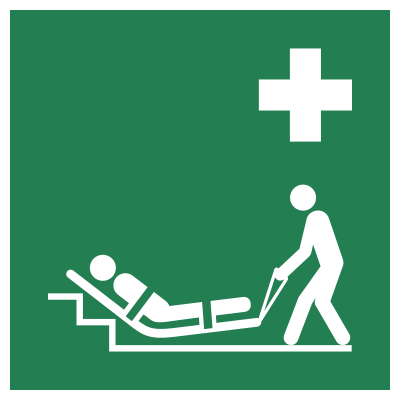
Identifies a stretcher.

Understanding this sign
Green square or rectangular signs identify emergency escape routes, safety facilities, and rescue equipment.
Follow the complete wayfinding system and local emergency plan. A symbol alone does not establish a safe route.
Marking the Stretcher Point
E013 shows a stretcher in profile on the green safe-condition field and identifies where one is stored. A stretcher solves a specific problem in casualty care: moving someone who cannot walk without worsening their injury. Between the moment a casualty is stabilized and the moment professional transport arrives — or across the distance an ambulance cannot cover, such as a mine level, a ship's engine room, or the far end of a large plant — the stretcher is the bridge, and finding it quickly is precisely what the sign exists for.
Stretchers are bulky, infrequently used, and therefore chronically at risk of being buried. They end up behind stored pallets, on top of lockers, or migrated to a workshop after a drill. E013 works as a contract with housekeeping: the marked bracket stays stocked, the access to it stays clear, and periodic checks confirm the straps, wheels, or lifting bridles are still serviceable.
Where Stretchers Are Staged
Stretcher points concentrate where carrying distances are long or extraction is awkward. Underground mines position them at refuge stations and shaft landings, and mining regulations in several jurisdictions expressly require stretchers as part of first aid equipment. Ships and offshore platforms stage basket stretchers that can be craned or winched with the casualty secured. Onshore, sensible locations include remote process units, tank farms, rooftops with plant access, tower crane bases, and trailheads or beaches in recreational settings far from vehicle access.
The stored device should match the extraction route. A flat folding stretcher suits corridors and open ground; a basket or Stokes-type litter is the choice where the casualty must be hauled vertically, dragged through a manway, or transferred by winch; a scoop stretcher suits lifting a person with suspected spinal injury from where they lie. Signing the location with E013 while stocking the wrong pattern for the terrain is a gap drills tend to expose.
E013 Alongside Other Rescue Signs
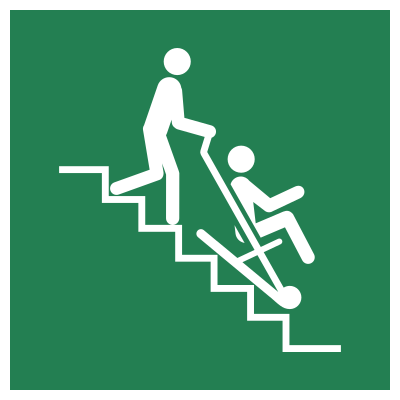
Within the green family, E013 covers the classic carry stretcher, while purpose-built evacuation devices have their own identities — the evacuation chair (E060) for stair descent of seated occupants and the evacuation mattress (E067) for bed-bound patients. Healthcare buildings usually need the latter two; industrial and marine sites usually need E013. Co-locating the stretcher with the first aid point under a shared green bay, each item individually signed, mirrors how responders search.
The sign deserves a line in emergency response documentation, too. Muster plans and rescue procedures that name signed stretcher points by location let a two-person team split efficiently: one stays with the casualty, one goes directly to the nearest marked bracket. Where stretcher carries exceed a realistic two-person effort, the plan — not the sign — must supply the extra bearers, so E013 placement and staffing assumptions should be reviewed together.
Where you will see E013
Underground mines stage stretchers at refuge stations and shaft landings, while ships and offshore platforms keep basket stretchers that can be craned or winched with the casualty secured. Onshore placements include remote process units, tank farms, rooftops with plant access, tower crane bases, and trailheads or beaches far from vehicle access, often co-located with the first aid point under a shared green bay.
Common questions about E013
Where should stretcher signs be placed in a workplace?
Directly at each stretcher storage point, mounted high and visible across the area it serves, with directional versions along routes in large facilities. Prioritize locations with long carry distances or difficult extraction — remote process areas, underground workings, vessels, rooftops — and keep the sign paired with an actually stocked, unobstructed bracket.
Are workplaces legally required to provide a stretcher?
It depends on the sector and jurisdiction. Mining and maritime rules commonly require stretchers explicitly, and general workplace first aid regulations elsewhere require equipment appropriate to the risk assessment, which for large sites, remote areas, or hazardous work often means a stretcher. Check the rules for your industry rather than assuming a universal duty.
What type of stretcher should be stored at a signed location?
One matched to the extraction route. Folding pole stretchers work for level carries through corridors and open ground; basket or Stokes litters are needed for vertical hauling, winching, or confined space extraction; scoop stretchers suit lifting casualties with suspected spinal injuries. The E013 sign marks the location — the risk assessment picks the device.
What is the difference between the stretcher sign and the evacuation chair or mattress signs?
E013 marks a carry stretcher for moving an injured person, typically in industrial, marine, or outdoor settings. E060 marks an evacuation chair for taking a seated person down stairs, and E067 marks an evacuation mattress for sliding a bed-bound patient out of a building. They are distinct devices with distinct signs and should not substitute for one another.
Reference details
| Symbol code | E013 |
|---|---|
| Sign family | ISO Emergency Signs |
| Standard reference | ISO 7010:2019 / ISO 3864-1 ISO Online Browsing Platform: E013 |
| Screen color reference | #009933. Screen colors are not a production color specification. |
| Download formats | SVG reference artwork; a 1024 × 1024 pixel PNG conversion on a white canvas. |
| Record date | · How to interpret our dates |
| Page updated |
Choosing a physical sign size
Download dimensions are not installation dimensions. Select sign size, material, placement, and lighting using the applicable standard and the actual viewing conditions. Chemical label sizing follows its own rules. Read the artwork and sizing guide.
Sources and artwork credits
- Artwork source
- Wikimedia Commons file page
- Creator credited by source
- MaxxL
- License
- Public domain
- Source metadata checked
SVG files are local reference copies. PNG files are raster conversions. Check the linked file history and license terms before reuse; a source-metadata check is not certification of the artwork or a workplace installation.
Report a correction to this reference