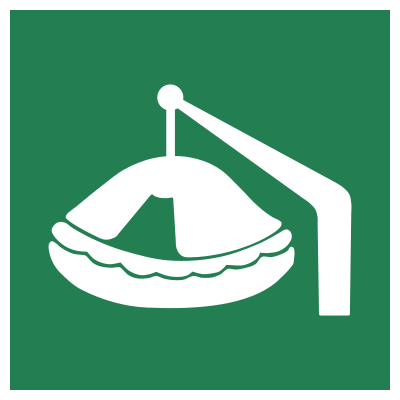
Liferaft
Identifies a liferaft.

Understanding this sign
Green square or rectangular signs identify emergency escape routes, safety facilities, and rescue equipment.
Follow the complete wayfinding system and local emergency plan. A symbol alone does not establish a safe route.
What ISO 7010 E038 Shows
E038 marks an inflatable liferaft stowed for throw-overboard launching — the white fiberglass canisters sitting in cradles along a ship's deck rails. Its green square depicts the canopied raft afloat, and the sign belongs at each cradle and at the embarkation position it serves. It joined ISO 7010 with the rest of the maritime location symbols when IMO's lifesaving signage was harmonized into the international E-series.
Inside each canister is a packed raft with a CO2 inflation system, a canopy, and a survival equipment pack. Rafts are the most widely distributed survival craft at sea because they need no launching machinery: a cradle, a securing strap, and a painter connected to the ship are the whole installation, which is why even small cargo vessels and fishing boats carry them.
How a Throw-Overboard Raft Deploys
Manual launching is brutally simple: release the securing arrangement, check the painter is made fast, throw or roll the canister over the side, then haul out the painter until a sharp tug fires the gas inflation. The canister halves separate as the raft inflates on the water, and survivors board by ladder, by jumping onto the canopy entrance from low height, or from the water itself. The E053-marked embarkation ladder is the intended dry route down where one is rigged.
The cradle also protects against the scenario where nobody launches anything. A hydrostatic release unit frees the canister automatically at shallow depth if the ship sinks, the tightening painter triggers inflation, and a weak link parts before the sinking hull can drag the raft under — so a float-free raft surfaces for survivors even after a rapid capsize.
E038 Versus the Davit-Launched Raft Sign
Its closest sibling, E039, covers rafts served by a launching davit, and the operational difference is where you get in. An E038 raft inflates on the sea, so boarding usually involves a ladder descent, a jump, or a swim; an E039 raft is inflated and boarded dry at deck level, then lowered loaded. High-freeboard passenger ships favor the davit method because putting elderly or injured people into the water is unacceptable, while cargo vessels rely mainly on throw-overboard units.
Use E038 only at cradles intended for over-the-side launching. At a davit station the E039 symbol governs, typically accompanied by E035 for the knife that cuts lines under load. Getting the pair right tells an evacuee whether to expect a climb down or a step in, and it tells crew which launching procedure — and which equipment checks — apply at that exact position during drills and surveys.
Placement and Servicing Realities
Sign every cradle position and, where rafts are grouped, the embarkation point that serves the group, adding directional arrows from the muster stations. SOLAS distributes rafts on both sides of the ship and often adds a forward or aft unit on cargo vessels where the distance from accommodation to the main stations is long; each remote position needs its own clearly visible symbol.
The sign also anchors inspection routines. Annual servicing at an approved station, in-date hydrostatic releases, sound securing straps, and legible capacity markings are all checked at the marked location during surveys, so a missing or faded E038 sign tends to surface as a port state control observation alongside any equipment defect.
Where you will see E038
The sign belongs at each raft cradle along a ship's deck rails and at the embarkation position it serves, with directional arrows leading from the muster stations. SOLAS distributes rafts on both sides of the vessel, and cargo ships and fishing boats often add forward or aft units far from accommodation, each remote position needing its own visible symbol; the marked location also anchors annual servicing checks, hydrostatic release dates, and port state control inspections.
Common questions about E038
How does a throw-overboard liferaft work?
You release the canister from its cradle, confirm the painter line is attached to the ship, throw the canister into the sea, and pull the painter until it triggers CO2 inflation. The raft inflates in under a minute, survivors board from the ladder, deck edge, or water, and the painter is then cut so the raft can clear the ship.
What happens to the liferaft if the ship sinks before anyone launches it?
The hydrostatic release unit senses water pressure a few meters down and frees the canister, which floats up. The painter, still attached to the ship, pulls taut and fires inflation, and a weak link then breaks so the raft is not dragged down. This float-free arrangement is why cradle-mounted rafts need correctly installed and in-date release units.
What is the difference between the E038 and E039 liferaft signs?
E038 marks rafts launched by throwing the canister overboard, boarded after they inflate on the water. E039 marks rafts served by a launching davit, which inflate at the deck edge, take their occupants aboard dry, and are then lowered loaded. The signs prepare evacuees for two very different boarding experiences.
How often must liferafts be serviced?
Inflatable liferafts on SOLAS ships are serviced at an approved service station at intervals not exceeding twelve months, where they are opened, inflated, inspected, and repacked. Hydrostatic release units are either serviced on the same cycle or replaced by their expiry date if they are disposable.
Reference details
| Symbol code | E038 |
|---|---|
| Sign family | ISO Emergency Signs |
| Standard reference | ISO 7010:2019 / ISO 3864-1 ISO Online Browsing Platform: E038 |
| Screen color reference | #009933. Screen colors are not a production color specification. |
| Download formats | SVG reference artwork; a 1024 × 1024 pixel PNG conversion on a white canvas. |
| Record date | · How to interpret our dates |
| Page updated |
Choosing a physical sign size
Download dimensions are not installation dimensions. Select sign size, material, placement, and lighting using the applicable standard and the actual viewing conditions. Chemical label sizing follows its own rules. Read the artwork and sizing guide.
Sources and artwork credits
- Artwork source
- Wikimedia Commons file page
- Creator credited by source
- Clemenspool
- License
- CC0
- Source metadata checked
SVG files are local reference copies. PNG files are raster conversions. Check the linked file history and license terms before reuse; a source-metadata check is not certification of the artwork or a workplace installation.
Report a correction to this reference