Lifeguard
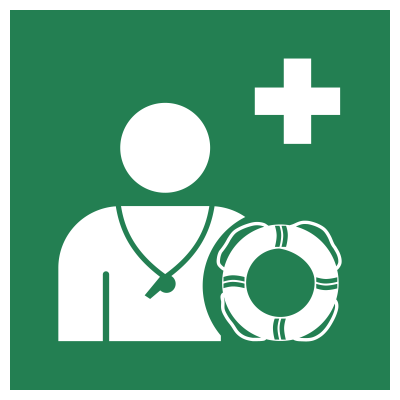
Identifies a lifeguard.
Understanding this sign
Green square or rectangular signs identify emergency escape routes, safety facilities, and rescue equipment.
Follow the complete wayfinding system and local emergency plan. A symbol alone does not establish a safe route.
Locating the Lifeguard
E075 indicates where a lifeguard is stationed. Drowning is uniquely time-critical among emergencies — a swimmer in trouble can be beyond help within minutes — so the person who spots an incident needs to know instantly where trained rescue capability sits. The sign answers that question at beaches, pools, water parks, and open-water swimming venues, marking the tower, chair, patrol hut, or poolside station from which supervision is provided.
Like every sign that advertises a human capability, E075 carries an availability problem: lifeguards keep hours, and drownings do not. Venues handle this by pairing the station sign with clear on-duty indication — flags flying, boards showing patrol times, or shutters over the sign outside season. A permanently displayed lifeguard sign at an unstaffed winter beach quietly teaches visitors to distrust it, so the honest pattern is sign plus live status.
The Sign Within Beach Safety Systems
On patrolled coastlines, E075 operates inside a larger visual language standardized in ISO 20712, the water safety signs and beach flags standard that shares its design grammar with ISO 7010. The red-over-yellow flag pair marks the boundaries of the zone lifeguards are actively watching, a plain red flag closes the water, and warning signs cover rip currents, shore break, and other local hazards. The lifeguard sign anchors this system by showing where the patrol itself is based, which is also where rescue boards, tubes, and communication equipment concentrate.
Swim-between-the-flags campaigns run by lifesaving organizations worldwide depend on bathers understanding that supervision is spatial: the safe area is defined by the flags, not by the beach as a whole. Directional E075 signage from car parks and promenade entrances steers arriving visitors toward the patrolled zone before they pick a spot, which is far more effective than trying to relocate them once towels are down.
Pools, Parks, and Staffing Signals
Indoor and outdoor pools use the sign differently than beaches. Supervision positions are fixed and close, so E075 typically marks the lifeguard chair or office where a responder and rescue equipment can be found, and doubles as the reporting point for incidents anywhere in the building. Water parks with dispersed attractions gain the most from consistent marking, since a guest who witnesses trouble on one slide may need to fetch help from a station serving another.
Whether a lifeguard must be provided at all is a matter of local regulation and risk assessment — jurisdictions vary widely on when pools require dedicated supervision versus trained staff on call. What the sign contributes is independent of that answer: wherever the venue's plan says qualified aquatic rescue is stationed, E075 makes the plan legible to strangers, including the off-duty nurse or trained bystander looking for equipment and backup in the first seconds of an incident.
Where you will see E075
Patrolled beaches mount it on lifeguard towers and patrol huts within the ISO 20712 flag system, with directional versions from car parks and promenade entrances steering visitors toward the supervised zone before they settle. Pools use it on the lifeguard chair or office that doubles as the incident reporting point, and water parks with dispersed attractions mark every station consistently; venues pair the sign with flags, patrol-hours boards, or off-season shutters so it never advertises supervision that is not on duty.
Common questions about E075
What does the lifeguard sign mean?
ISO 7010 E075 marks the location of a lifeguard — the tower, chair, hut, or station where trained aquatic rescue personnel are based. The green color places it among the safe-condition signs, and at well-run venues it is paired with an indication of whether the patrol is currently on duty.
What do red-over-yellow beach flags indicate?
Red-over-yellow flags mark the limits of the area actively supervised by lifeguards — the zone where you should swim. A solid red flag means the water is closed to bathing. The flag system comes from the ISO beach safety standard and works together with the E075 sign marking the patrol station itself.
Does the lifeguard sign mean a lifeguard is always on duty?
No — it marks the station, not a guarantee of continuous staffing. Reputable venues display patrol hours alongside, fly flags only while guards are actively watching, and cover or remove signage out of season. If no on-duty indication accompanies the sign, treat supervision as unconfirmed.
Are pools required to have lifeguards?
Requirements vary by jurisdiction, pool type, and operator risk assessment: some public pools must staff dedicated lifeguards, while smaller or hotel pools may lawfully rely on trained on-call staff and prominent no-lifeguard warnings. Where supervision is provided, E075 shows patrons and staff exactly where the responder and rescue equipment are.
Reference details
| Symbol code | E075 |
|---|---|
| Sign family | ISO Emergency Signs |
| Standard reference | ISO 7010:2019 / ISO 3864-1 ISO Online Browsing Platform: E075 |
| Screen color reference | #009933. Screen colors are not a production color specification. |
| Download formats | SVG reference artwork; a 1024 × 1024 pixel PNG conversion on a white canvas. |
| Record date | · How to interpret our dates |
| Page updated |
Choosing a physical sign size
Download dimensions are not installation dimensions. Select sign size, material, placement, and lighting using the applicable standard and the actual viewing conditions. Chemical label sizing follows its own rules. Read the artwork and sizing guide.
Sources and artwork credits
- Artwork source
- Wikimedia Commons file page
- Creator credited by source
- Clemenspool
- License
- CC0
- Source metadata checked

SVG files are local reference copies. PNG files are raster conversions. Check the linked file history and license terms before reuse; a source-metadata check is not certification of the artwork or a workplace installation.
Report a correction to this reference