Drinking water
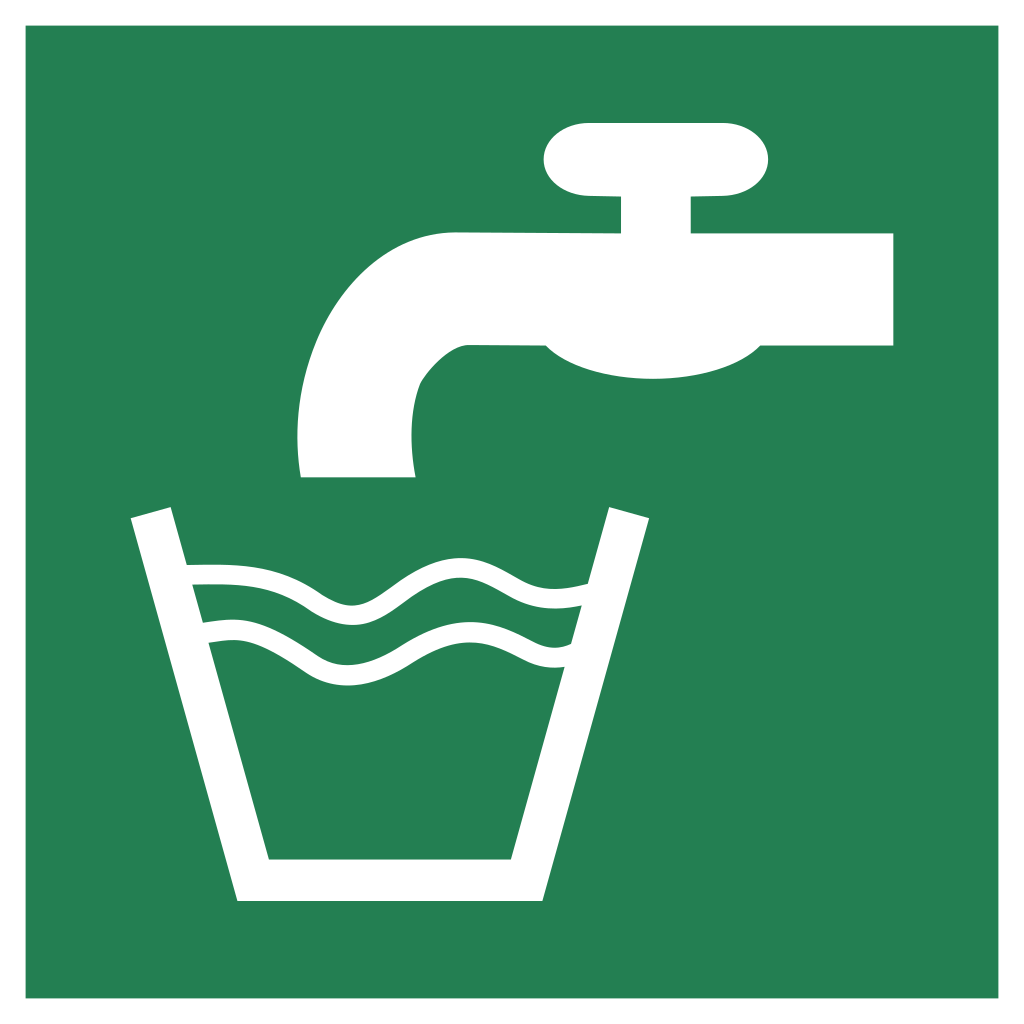
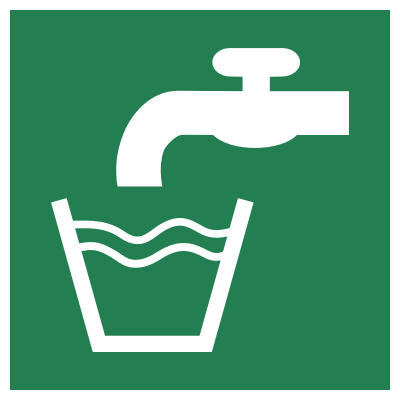
Identifies drinking water.
Understanding this sign
Green square or rectangular signs identify emergency escape routes, safety facilities, and rescue equipment.
Follow the complete wayfinding system and local emergency plan. A symbol alone does not establish a safe route.
A Positive Marker for Potable Water
E015 depicts a tap filling a glass, rendered white on green, and declares the water at that point safe to drink. Unusually for the emergency family, its subject is welfare rather than injury response, yet the classification earns its keep: knowing which water is potable becomes acutely important in heat, during long shifts, and in any incident where mains supply is disrupted. On sites with multiple water systems, the sign converts a guess into a fact.
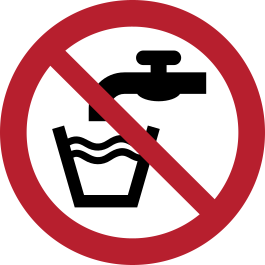
Its mirror image is the prohibition sign P005, not drinking water, which crosses out the same tap-and-glass motif in red. The two signs are designed to be read as a pair: process water, reclaimed water, firefighting mains, and untreated borehole outlets carry P005, while verified potable points carry E015. The pairing only works if it is applied consistently — an unmarked tap on a site that labels some outlets invites exactly the wrong inference.
Why Segregation Is a Legal Matter
Workplace sanitation rules across jurisdictions require employers to provide potable drinking water and to prevent confusion with non-potable systems. In the United States, OSHA's sanitation standard obliges employers to supply potable water and to post non-potable outlets so employees do not drink from them; comparable welfare regulations in the UK, EU member states, and elsewhere impose the same twin duty of provision and distinction. E015 is the standard positive half of demonstrating compliance, especially on industrial sites where pipework carries several grades of water.
The stakes are higher than taste. Non-potable systems can carry chemical treatment residues, legionella, or cross-connections to process fluids, and construction or agricultural sites often run temporary lines whose provenance nobody remembers by mid-project. Marking confirmed potable points, and only those points, means the labeling regime keeps protecting people even as the site plumbing evolves.
Placement in Practice
Post E015 at every intended drinking point: fountains, break room taps, water coolers fed from the mains, filling stations for personal bottles, and tanker or bowser outlets on construction sites and at outdoor events. In hot-work environments and heat stress programs, signage doubles as a nudge — hydration stations that are visibly marked get used more, and supervisors can direct crews to them by sign rather than by description.
Two disciplines keep the sign trustworthy. First, verify before posting: temporary supplies, long dead-legs, and tanks need testing or flushing regimes, and a green sign on unverified water is worse than none. Second, re-survey when plumbing changes. A renovation that reroutes a marked tap onto a non-potable riser silently falsifies the sign, so water point labeling belongs on the checklist for any pipework modification.
Where you will see E015
Fountains, break room taps, mains-fed water coolers, bottle filling stations, and tanker or bowser outlets on construction sites and at outdoor events all take the sign. Industrial plants whose pipework carries several grades of water rely on it to satisfy sanitation rules such as OSHA's potable-water requirements, and heat stress programs use visibly marked hydration stations to steer crews toward safe supplies.
Common questions about E015
What does the green drinking water sign mean?
E015 indicates that the water at the marked outlet is potable — verified safe for drinking. It uses the green safe-condition format and shows a tap filling a glass. Its opposite is P005, the red prohibition sign with the same motif crossed out, which marks non-potable outlets.
Is it a legal requirement to label drinking water taps?
Most workplace sanitation rules require potable water to be provided and non-potable outlets to be clearly identified so no one drinks from them; OSHA's sanitation standard in the US takes this approach. The strict legal emphasis usually falls on marking the unsafe outlets, but on any site with mixed systems, positively marking the safe points with E015 is how the distinction stays usable.
Should I use E015 or P005 on a water outlet?
Use E015 only on outlets confirmed to deliver potable water, and P005 on every outlet that does not — process water, rainwater harvesting, firefighting mains, untreated wells. On sites carrying both systems, label both directions consistently; leaving some taps unmarked undermines the scheme because people assume unlabeled means fine.
Do temporary water supplies on construction sites need the drinking water sign?
Yes, and they benefit from it most. Temporary bowsers, tanks, and hose runs are exactly where potable and non-potable lines get confused, so mark verified drinking points with E015, keep the supply on a testing and flushing regime, and re-check the labeling every time the temporary plumbing is rearranged.
Reference details
| Symbol code | E015 |
|---|---|
| Sign family | ISO Emergency Signs |
| Standard reference | ISO 7010:2019 / ISO 3864-1 ISO Online Browsing Platform: E015 |
| Screen color reference | #009933. Screen colors are not a production color specification. |
| Download formats | SVG reference artwork; a 1024 × 1024 pixel PNG conversion on a white canvas. |
| Record date | · How to interpret our dates |
| Page updated |
Choosing a physical sign size
Download dimensions are not installation dimensions. Select sign size, material, placement, and lighting using the applicable standard and the actual viewing conditions. Chemical label sizing follows its own rules. Read the artwork and sizing guide.
Sources and artwork credits
- Artwork source
- Wikimedia Commons file page
- Creator credited by source
- Unknown author
- License
- CC0
- Source metadata checked
SVG files are local reference copies. PNG files are raster conversions. Check the linked file history and license terms before reuse; a source-metadata check is not certification of the artwork or a workplace installation.
Report a correction to this reference