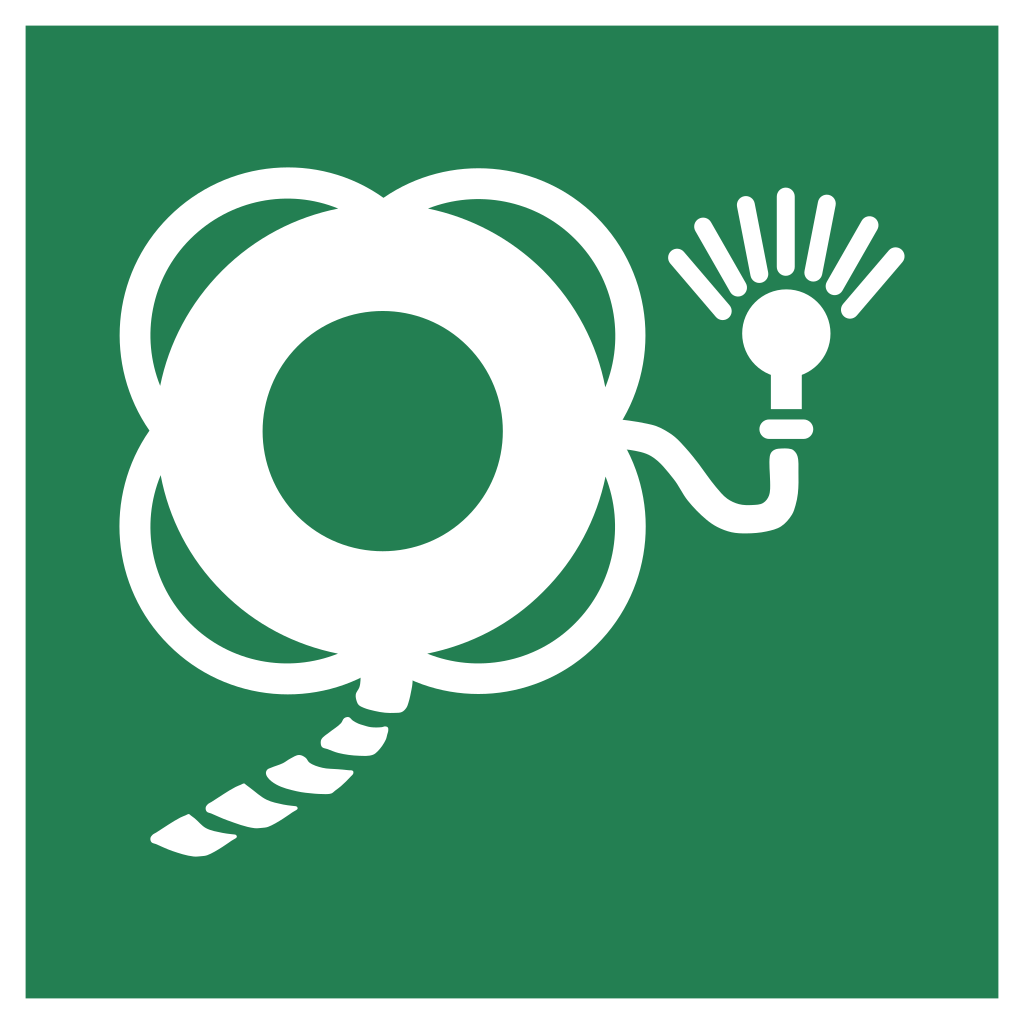
Lifebuoy with line and light
Identifies a lifebuoy with a line and a light.
Understanding this sign
Green square or rectangular signs identify emergency escape routes, safety facilities, and rescue equipment.
Follow the complete wayfinding system and local emergency plan. A symbol alone does not establish a safe route.
The Fully Equipped Rescue Station
E043 designates a lifebuoy carrying both a buoyant rescue line and a self-igniting light, the most capable single-buoy station in the ISO 7010 family short of the E068 marker buoy. Its pictogram combines the trailing rope of E041 with the light unit of E042. One piece of equipment at one point covers two failure modes at once: the casualty drifting beyond reach, and the casualty disappearing into darkness.
Because the combination is more expensive to buy and maintain than either component alone, E043 stations are not scattered everywhere. They are concentrated at the points where a rescue is most likely to be attempted directly from the structure, at any hour, by whoever is nearest. Placement therefore begins with a risk assessment of where people fall in and who would respond, and the E043 sign is the visible output of that assessment.
Where the Combination Earns Its Place
On ships, the natural E043 locations are the accommodation ladder and pilot boarding positions, gangway heads, and working areas over the side, places where people transfer between vessel and shore or boat and where a fall alongside is the classic accident. The line lets the deck party recover the person from between hull and quay; the light covers the reality that pilot transfers and cargo operations run through the night.
Ashore, the same logic points to ferry and cruise berths in continuous operation, lock approaches used after dark, night-fishing harbours, and marina fuel pontoons. If an honest assessment of a location says both that the casualty must be hauled back and that the incident could happen in darkness, the station should carry line and light, and the sign should say so.
Keeping the Sign True
An E043 sign is a promise about two accessories, which doubles the ways the promise can quietly break. Routine checks must confirm the light activates and holds charge, the line is attached, full length, and rot-free, and both remain properly secured to the ring. When either component is removed for servicing, good practice is to substitute a complete spare buoy rather than leave a station whose signage overstates its contents.
Photoluminescent E043 signs are worth specifying by default, since the whole premise of the station is use in darkness. Mount the sign at the bracket and, on long piers or decks, repeat it with directional arrows so a responder mid-emergency can navigate to the nearest fully equipped station rather than the nearest bare ring. In an emergency nobody reads small print, so the pictogram difference has to do the work at a glance.
Where you will see E043
Aboard ship the stations sit at accommodation ladder and pilot boarding positions, gangway heads, and working areas over the side, where a fall between hull and quay is the classic accident. Ashore it marks ferry and cruise berths in continuous operation, lock approaches used after dark, night-fishing harbours, and marina fuel pontoons, ideally rendered in photoluminescent material.
Common questions about E043
What does the lifebuoy with line and light sign mean?
E043 tells you the lifebuoy at that station has two accessories fitted: a buoyant line, so a rescuer on the deck or quay can pull the casualty back in, and a self-igniting light that switches on in the water to mark the casualty's position after dark. It marks the most fully equipped standard lifebuoy station in ISO 7010.
Is E043 the same as the man-overboard buoy on the bridge wings?
No. The bridge-wing man-overboard buoys are fitted with a light and a smoke signal and are designed for quick release from the navigating bridge to mark the position where someone went over; they carry the E068 sign. E043 buoys are thrown by hand and connected to a line so the casualty can be recovered directly, not just marked.
Where should a lifebuoy with line and light be located?
At points combining night-time exposure with the chance of hauling a casualty straight back to the structure: gangways and accommodation ladders, pilot boarding areas, continuously operating ferry berths, lock entrances, and fuel pontoons. Less critical positions along the same deck or waterfront can be covered by simpler E040, E041, or E042 stations.
How often should the line and light on a lifebuoy be checked?
Fold the checks into the existing safety equipment round, typically weekly to monthly on commercial vessels plus formal annual survey. Verify the light activates and its battery is in date, and inspect the line for degradation, correct length, kink-free stowage, and secure attachment to the ring. Any defect means the station no longer matches its E043 sign and needs immediate correction.
Reference details
| Symbol code | E043 |
|---|---|
| Sign family | ISO Emergency Signs |
| Standard reference | ISO 7010:2019 / ISO 3864-1 ISO Online Browsing Platform: E043 |
| Screen color reference | #009933. Screen colors are not a production color specification. |
| Download formats | SVG reference artwork; a 1024 × 1024 pixel PNG conversion on a white canvas. |
| Record date | · How to interpret our dates |
| Page updated |
Choosing a physical sign size
Download dimensions are not installation dimensions. Select sign size, material, placement, and lighting using the applicable standard and the actual viewing conditions. Chemical label sizing follows its own rules. Read the artwork and sizing guide.
Sources and artwork credits
- Artwork source
- Wikimedia Commons file page
- Creator credited by source
- Clemenspool
- License
- CC0
- Source metadata checked
SVG files are local reference copies. PNG files are raster conversions. Check the linked file history and license terms before reuse; a source-metadata check is not certification of the artwork or a workplace installation.
Report a correction to this reference