Safe anchorage point
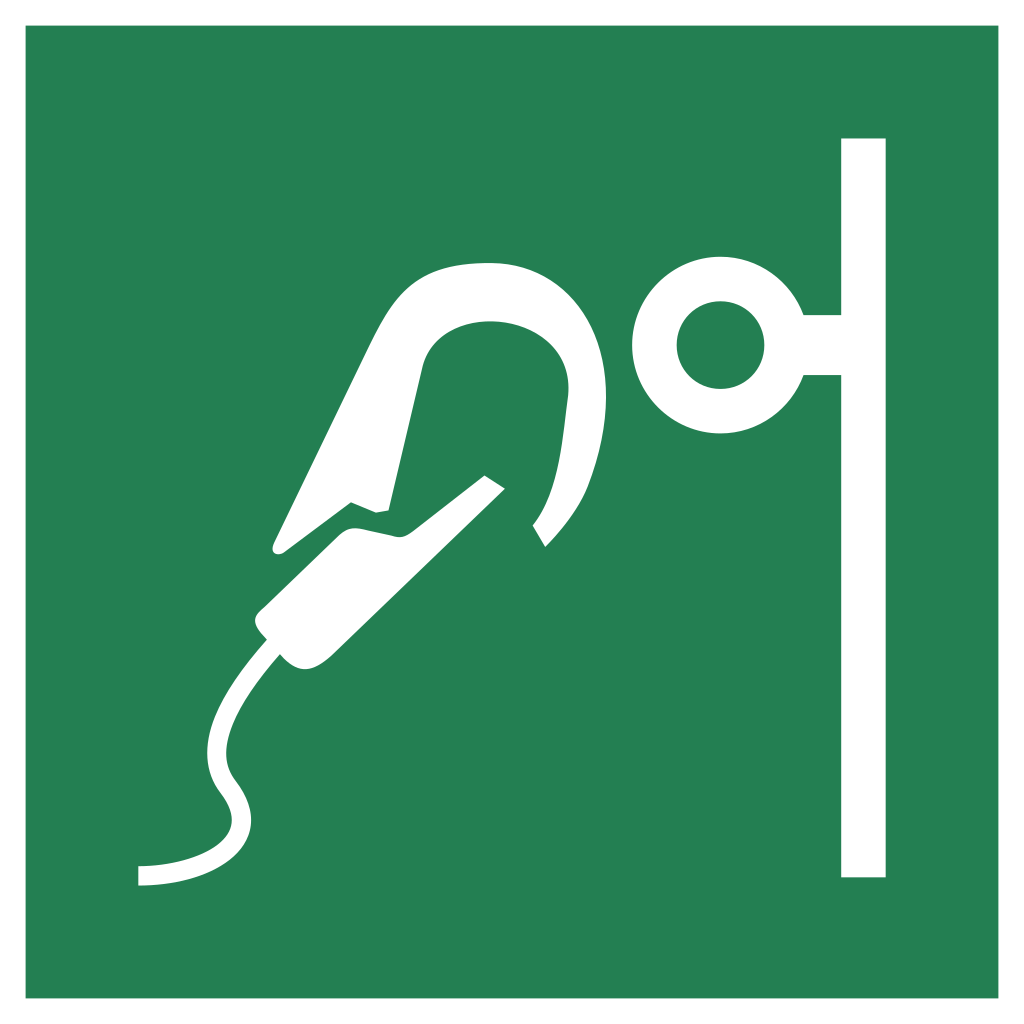
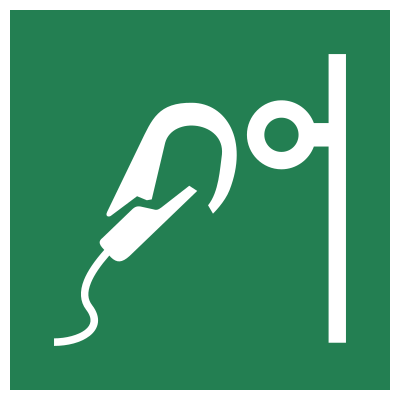
Identifies a safe anchorage point. The pictogram does not specify its load rating or permitted equipment.
Understanding this sign
Green square or rectangular signs identify emergency escape routes, safety facilities, and rescue equipment.
Follow the complete wayfinding system and local emergency plan. A symbol alone does not establish a safe route.
An Anchor Reserved for Emergencies
E072 identifies a safe anchorage point — a structural attachment verified for connecting rescue and evacuation systems such as controlled descent devices, rope rescue rigs, and casualty retrieval lines. Its green safe-condition format is doing real work here: it declares that this specific point has been engineered and approved for emergency loading, in environments where the surrounding steel may look equally sturdy and be nothing of the kind.
That is the failure the sign prevents. A rescuer improvising under pressure will clip to whatever is nearest — a handrail, a conduit bracket, a pipe support — and unrated attachments fail exactly when a life is hanging from them. Marking the verified point removes the improvisation.
Rescue Anchors Versus Everyday Fall-Arrest Anchors
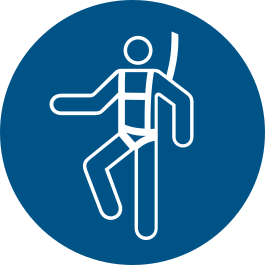
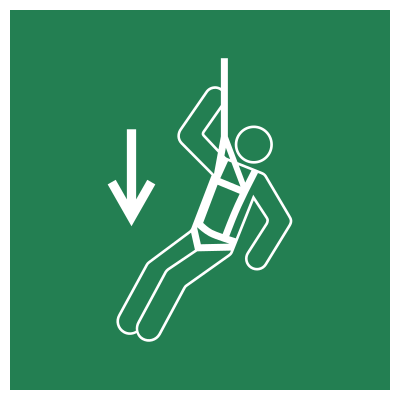
Work at height already involves anchorage: wherever M018 requires a safety harness, workers connect fall-arrest lanyards to anchor points that are typically identified by equipment tags and inspection labels under the site's fall-protection program. E072 addresses a related but distinct need — the anchor used when things have gone wrong, for emergency descent from a crane cab or nacelle, or for rigging a rescue of a suspended or incapacitated worker.
The engineering world behind both is shared: anchor devices in Europe fall under EN 795, US programs work within ANSI Z359 and OSHA fall-protection rules, and every anchor needs documented rating, installation records, and periodic inspection by a competent person. What E072 adds is instant legibility in a crisis — no tag reading, no guessing — for the points the emergency plan actually depends on.
Placement and Management
Characteristic homes for E072 are tower crane cabs and jibs where the pre-rigged escape descender attaches, wind turbine nacelles, high-bay racking and stacker crane cabins, facade-access and rooftop rescue positions, and frames above confined-space entries where a retrieval system mounts. The sign must sit at the anchor itself, unambiguously — a sign a meter from two similar eyebolts recreates the guessing game it exists to end.
Keep the marked anchors on an inspection register, re-verify after any structural modification or load event, and pair each with the equipment sign it serves, most often E073 for the descent device stored alongside. Rescue drills should use the marked points, because an anchor position that turns out to be unreachable in a harness, or that fouls the descent path, is a defect best discovered in practice rather than performance.
Where you will see E072
Characteristic homes are tower crane cabs and jibs where pre-rigged escape descenders attach, wind turbine nacelles, stacker crane cabins in high-bay warehouses, facade-access and rooftop rescue positions, and frames above confined-space entries where retrieval systems mount. The sign must sit at the anchor itself to avoid recreating the guessing game, with each point kept on an inspection register, re-verified after structural changes, and exercised in rescue drills.
Common questions about E072
What does the ISO 7010 E072 safe anchorage point sign mean?
It marks a structural anchor point that has been verified as safe for emergency and rescue use — attaching descent devices, rope rescue systems, or retrieval lines. The green emergency format tells responders they can trust this specific point under load, instead of guessing which nearby steelwork would hold.
Is E072 the same as a fall-arrest anchor point marking?
Not quite. Routine fall-arrest anchors — the ones used with a mandatory harness under sign M018 during normal work — are usually identified through equipment tags and the site's inspection regime. E072 is an emergency-series sign highlighting anchorage for rescue and evacuation systems, such as the attachment for a crane cab escape descender. One physical anchor can serve both roles if it is rated and managed for them.
What standards apply to anchor points?
In Europe, anchor devices are covered by EN 795, alongside national work-at-height regulations; in the United States, OSHA fall-protection rules and the ANSI Z359 series govern anchorage strength and system design. Whatever the jurisdiction, an anchorage needs a documented rating for its intended use, correct installation, and periodic inspection by a competent person — the sign certifies findability, not strength.
Where are safe anchorage point signs typically installed?
Wherever an emergency plan depends on someone connecting to a known-good point: tower crane cabs, wind turbine nacelles, automated warehouse crane cabins, rooftop and facade rescue positions, and above confined-space entry openings where retrieval equipment mounts. The sign goes directly at the anchor so there is no ambiguity about which fixing it certifies.
Reference details
| Symbol code | E072 |
|---|---|
| Sign family | ISO Emergency Signs |
| Standard reference | ISO 7010:2019 / ISO 3864-1 ISO Online Browsing Platform: E072 |
| Screen color reference | #009933. Screen colors are not a production color specification. |
| Download formats | SVG reference artwork; a 1024 × 1024 pixel PNG conversion on a white canvas. |
| Record date | · How to interpret our dates |
| Page updated |
Choosing a physical sign size
Download dimensions are not installation dimensions. Select sign size, material, placement, and lighting using the applicable standard and the actual viewing conditions. Chemical label sizing follows its own rules. Read the artwork and sizing guide.
Sources and artwork credits
- Artwork source
- Wikimedia Commons file page
- Creator credited by source
- Clemenspool
- License
- CC0
- Source metadata checked
SVG files are local reference copies. PNG files are raster conversions. Check the linked file history and license terms before reuse; a source-metadata check is not certification of the artwork or a workplace installation.
Report a correction to this reference