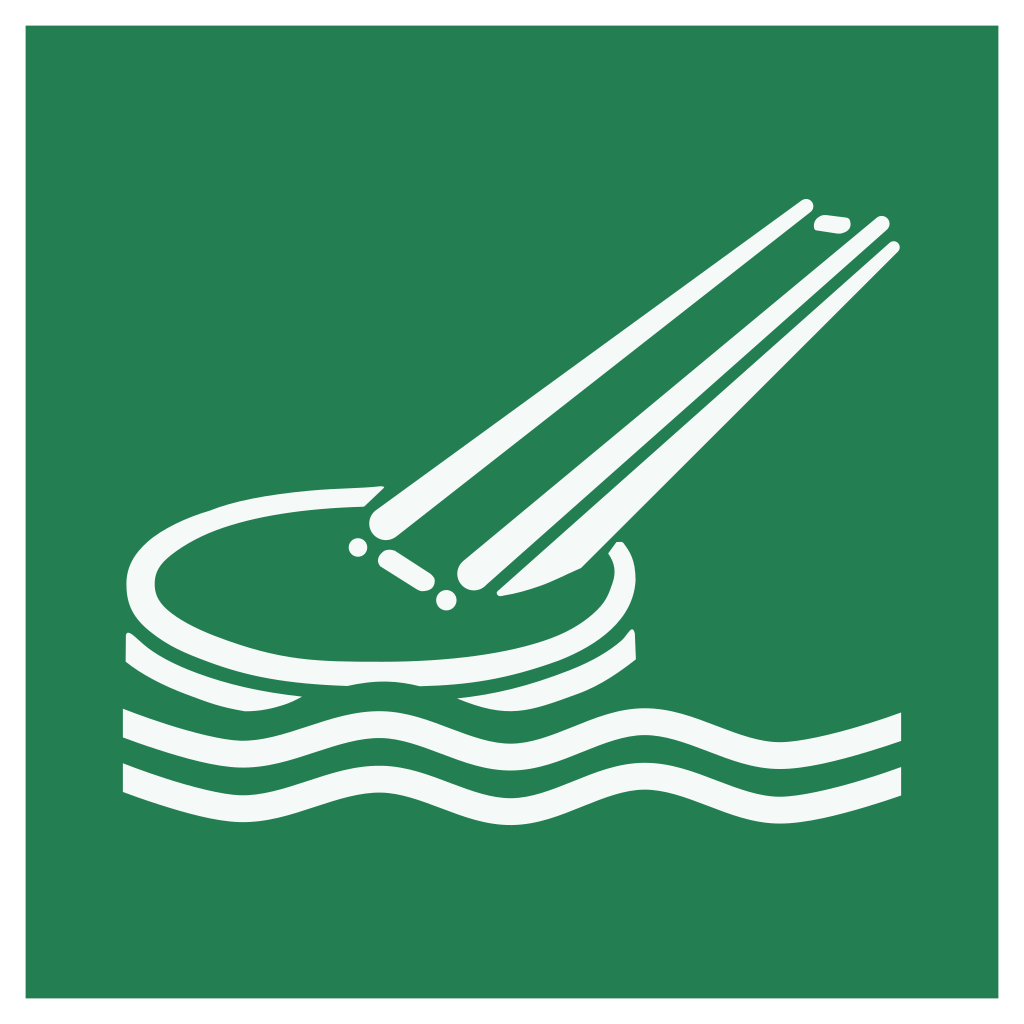
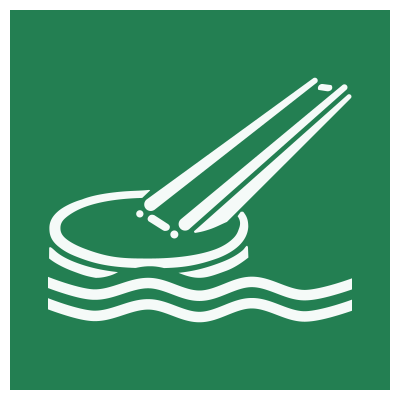
Marine evacuation slide
Identifies a marine evacuation slide.
Understanding this sign
Green square or rectangular signs identify emergency escape routes, safety facilities, and rescue equipment.
Follow the complete wayfinding system and local emergency plan. A symbol alone does not establish a safe route.
What ISO 7010 E054 Indicates
E054 marks the boarding point of a slide-type marine evacuation system (MES): an inflatable inclined slide that carries evacuees from an embarkation deck down to a floating platform and its attendant liferafts. The green safe-condition square shows a figure descending the slide, and the sign sits at the deck station where the packed system is installed and where passengers will queue when it is deployed.
Marine evacuation systems exist because davits and ladders cannot move hundreds of people quickly. A slide MES deploys from its stowage container in minutes, inflating the slide and platform together, after which a continuous stream of evacuees can descend — the same logic as an aircraft escape slide, adapted for freeboard, weather, and transfer into rafts rather than onto a runway.
How a Slide System Works
Trained crew activate the system at the E054-marked station: the container opens, the slide and platform inflate on the water, and crew descend first to stabilize the platform and prepare the rafts, which either inflate as part of the system or are launched to marshal alongside. Passengers then go down feet-first in quick succession, are received on the platform, and are distributed into the rafts by the platform crew.
The inclined geometry is the system's signature. Descent is a visible, gravity-paced glide rather than a vertical drop, which many operators consider easier for nervous passengers to attempt but which requires more clearance from the ship's side and behaves differently as freeboard and list change. Ferries with moderate embarkation heights are the natural fit, and ro-ro passenger ships were the driving application for MES adoption.
Slide or Chute: Reading E054 Against E055
ISO 7010 splits the two MES families because a passenger's next physical action differs. E054 means an open inclined slide you sit into and ride down its outer surface. E055, the marine evacuation chute, means a vertical fabric tube you climb inside, controlling your descent against internal baffles. Chutes suit very high freeboards and occupy a smaller footprint; slides favor speed and simplicity at lower heights.
Ships fit whichever system the builder and operator selected, and mixed arrangements exist across a fleet, so the two symbols must track the actual installation at each station. Posting a slide symbol at a chute station would misprime hundreds of people about the descent they are seconds away from making.
Signing, Drills, and Servicing
Post E054 at each MES station on the embarkation deck, with directional signage feeding it from the assembly stations it serves — on many ferries the MES is the primary abandonment capacity, so the arrows from E032 stations lead here rather than to boats. Capacity and operating placards for crew accompany the symbol at the station itself.
Because a packed MES cannot be part-tested in place, SOLAS backs the signage with a deployment regime: systems are serviced at approved intervals and periodically deployed on a rotational basis across the ship's installations, with crews practicing the launch. The sign marks a station whose readiness is proven by that cycle rather than by daily visual checks.
Where you will see E054
Ferries and ro-ro passenger ships with moderate embarkation heights are the natural installations, with the sign at each MES station on the embarkation deck and directional signage feeding it from the assembly stations it serves. On many ferries the MES provides the primary abandonment capacity, so arrows from E032 stations lead here rather than to boats, accompanied by capacity and operating placards for the crew.
Common questions about E054
What is a marine evacuation slide?
An inflatable inclined slide, stowed in a deck container, that deploys with a floating platform at its foot. Evacuees slide from the embarkation deck to the platform, where crew transfer them into liferafts. It is one of the two marine evacuation system types recognized in ISO 7010, marked E054; the vertical chute type is marked E055.
What is the difference between a marine evacuation slide and a chute?
A slide is an open inclined surface you ride down on the outside, like an aircraft escape slide; a chute is a vertical fabric tube you descend inside, braking against its internal structure. Chutes handle greater freeboard in a smaller footprint, slides offer a faster and more intuitive descent at moderate heights. Use E054 for slides and E055 for chutes.
How fast can a marine evacuation system get people off a ship?
Deployment takes minutes, and once the platform crew is in place the system moves a continuous flow of evacuees — throughput far beyond what davit-launched craft achieve, which is why ferries and other high-density passenger ships carry MES as principal abandonment capacity. Exact rates depend on the certified system and are demonstrated during approval.
Do passengers ever practice using the evacuation slide?
Not on board — a packed system is only opened during scheduled rotational deployments and servicing. Passengers learn the station location and the symbol through the muster briefing, while crew train on deployment and platform duties, sometimes at shore facilities with live systems.
Reference details
| Symbol code | E054 |
|---|---|
| Sign family | ISO Emergency Signs |
| Standard reference | ISO 7010:2019 / ISO 3864-1 ISO Online Browsing Platform: E054 |
| Screen color reference | #009933. Screen colors are not a production color specification. |
| Download formats | SVG reference artwork; a 1024 × 1024 pixel PNG conversion on a white canvas. |
| Record date | · How to interpret our dates |
| Page updated |
Choosing a physical sign size
Download dimensions are not installation dimensions. Select sign size, material, placement, and lighting using the applicable standard and the actual viewing conditions. Chemical label sizing follows its own rules. Read the artwork and sizing guide.
Sources and artwork credits
- Artwork source
- Wikimedia Commons file page
- Creator credited by source
- Clemenspool
- License
- CC0
- Source metadata checked
SVG files are local reference copies. PNG files are raster conversions. Check the linked file history and license terms before reuse; a source-metadata check is not certification of the artwork or a workplace installation.
Report a correction to this reference