Person overboard call point
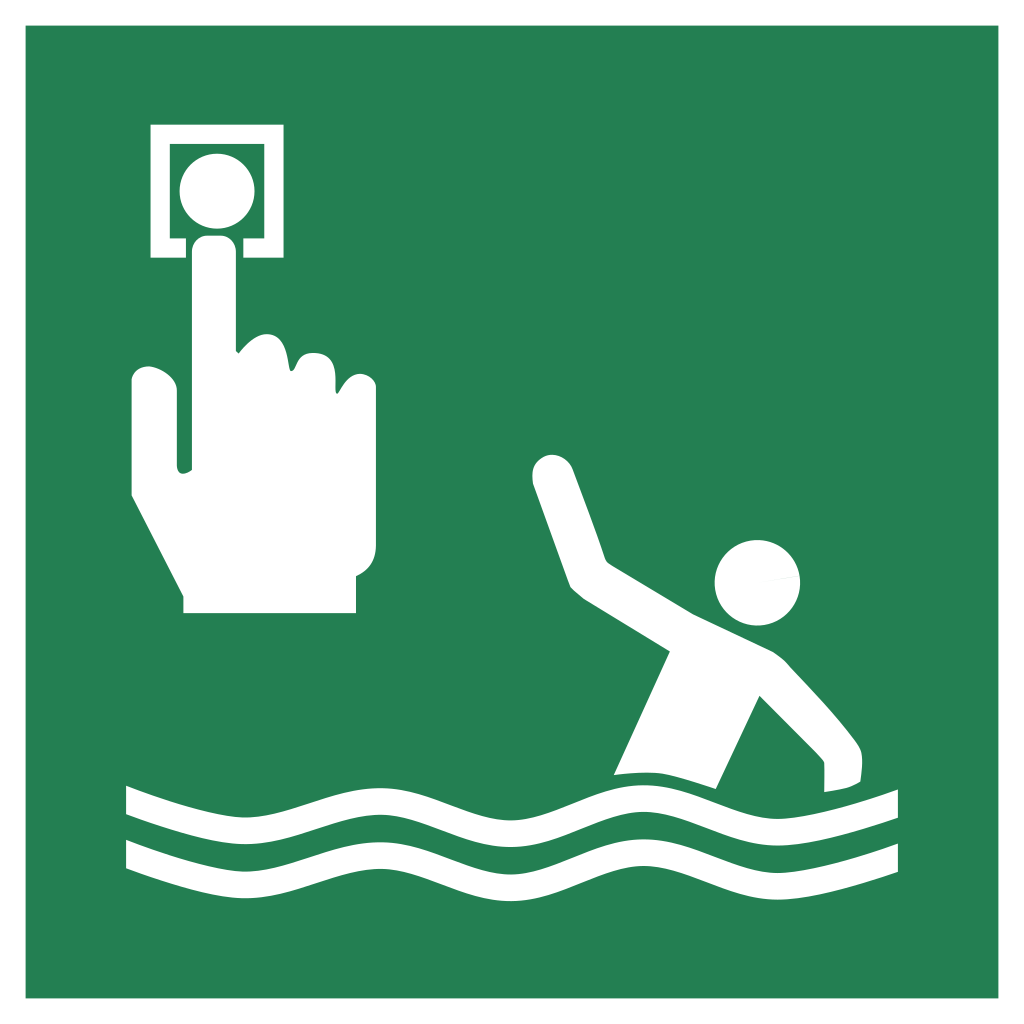
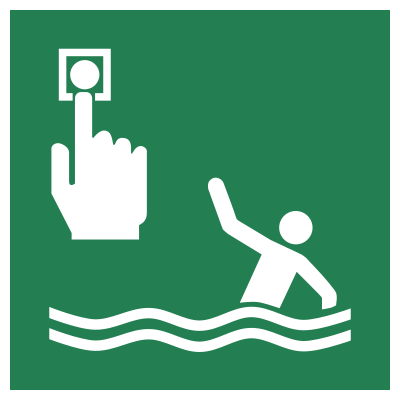
Identifies a person-overboard call point.
Understanding this sign
Green square or rectangular signs identify emergency escape routes, safety facilities, and rescue equipment.
Follow the complete wayfinding system and local emergency plan. A symbol alone does not establish a safe route.
What ISO 7010 E069 Marks
E069 identifies a person overboard call point: a dedicated alarm station on deck where a witness to someone falling into the water can alert the bridge instantly. Its green square combines the overboard casualty motif with the activation element, and the sign belongs at each button, telephone, or alarm panel installed for this specific purpose along open decks and mustering areas.
The sign addresses the defining problem of man overboard (MOB) response: time and position. A ship making passage moves hundreds of meters in the first minute, and a swimmer's head disappears from view astonishingly fast. A marked, single-purpose call point turns a bystander's alarm into a bridge action within seconds, rather than leaving them searching for a crew member or a general telephone.
What Activation Sets in Motion
Triggering the call point alerts the bridge team, who log or electronically mark the ship's position at that moment — many installations tie the button to the navigation system's MOB function so the datum is captured automatically. The officer of the watch then executes the recovery playbook: a return maneuver such as a Williamson turn, lookouts posted, engines and helm managed, and the rescue boat crew called away to the E037-marked station.
The witness still has duties the button cannot perform. Standard MOB doctrine is to keep pointing at the person in the water without breaking sight, shout to attract others, and get flotation to the casualty — which is where the call point's placement next to lifebuoy stations pays off. A well-designed rail position lets one person do all three within a few steps, and lets a second passerby take over the pointing while the first activates the alarm.
Pairing E069 with Lifebuoy Signage
ISO 7010's E040-series lifebuoy signs (lifebuoy, lifebuoy with line, with light, with light and smoke) mark the throwable flotation that a MOB response depends on, and the two sign families are designed to work side by side at the rail. A buoy with a self-igniting light or smoke signal thrown near the casualty marks the datum visually for the returning ship as well as supporting the swimmer.
Cruise ships and passenger ferries are the heaviest users of E069 because passengers, not trained crew, are the likeliest witnesses on their long promenade decks; the symbol gives an untrained person an unmistakable action to take. On cargo ships and offshore units the call points concentrate at working areas near the ship's side — pilot boarding positions, mooring decks, gangway stations.
Where you will see E069
Cruise ships and passenger ferries are the heaviest users, marking buttons and alarm panels along long promenade decks where passengers rather than trained crew are the likeliest witnesses. Cargo ships and offshore units concentrate the call points at working areas near the ship's side — pilot boarding positions, mooring decks, and gangway stations — and installations are deliberately placed next to E040-series lifebuoy stations so one person can raise the alarm, keep pointing, and get flotation to the casualty within a few steps.
Common questions about E069
What should I do if I see someone fall overboard from a ship?
Raise the alarm immediately at the nearest person overboard call point or by shouting "man overboard" to any crew member, throw the nearest lifebuoy toward the person, and keep pointing at them continuously so the bridge and lookouts can reacquire the position. Do not jump in after them — a second casualty makes the recovery harder.
What does a person overboard call point actually do?
It sends an immediate alert to the bridge, and on many ships simultaneously marks the vessel's GPS position as the MOB datum in the navigation system. That single action starts the return maneuver, lookout posting, and rescue boat launch far faster than a verbal report relayed through the crew.
Where are E069 call points installed on a ship?
Along open passenger decks, promenades, and mustering areas on cruise ships and ferries, and at side-working locations such as mooring stations, gangways, and pilot boarding points on cargo vessels. Each installed point carries the E069 sign so it can be found by someone acting under extreme urgency.
How is E069 related to the lifebuoy signs?
They mark the two halves of the same first response. The E040-series signs locate throwable lifebuoys — plain, with line, with light, or with light and smoke — while E069 locates the alarm that brings the ship back. Rails on passenger decks are commonly signed with both so a witness can throw flotation and raise the alarm within steps of each other.
Reference details
| Symbol code | E069 |
|---|---|
| Sign family | ISO Emergency Signs |
| Standard reference | ISO 7010:2019 / ISO 3864-1 ISO Online Browsing Platform: E069 |
| Screen color reference | #009933. Screen colors are not a production color specification. |
| Download formats | SVG reference artwork; a 1024 × 1024 pixel PNG conversion on a white canvas. |
| Record date | · How to interpret our dates |
| Page updated |
Choosing a physical sign size
Download dimensions are not installation dimensions. Select sign size, material, placement, and lighting using the applicable standard and the actual viewing conditions. Chemical label sizing follows its own rules. Read the artwork and sizing guide.
Sources and artwork credits
- Artwork source
- Wikimedia Commons file page
- Creator credited by source
- Clemenspool
- License
- CC0
- Source metadata checked
SVG files are local reference copies. PNG files are raster conversions. Check the linked file history and license terms before reuse; a source-metadata check is not certification of the artwork or a workplace installation.
Report a correction to this reference