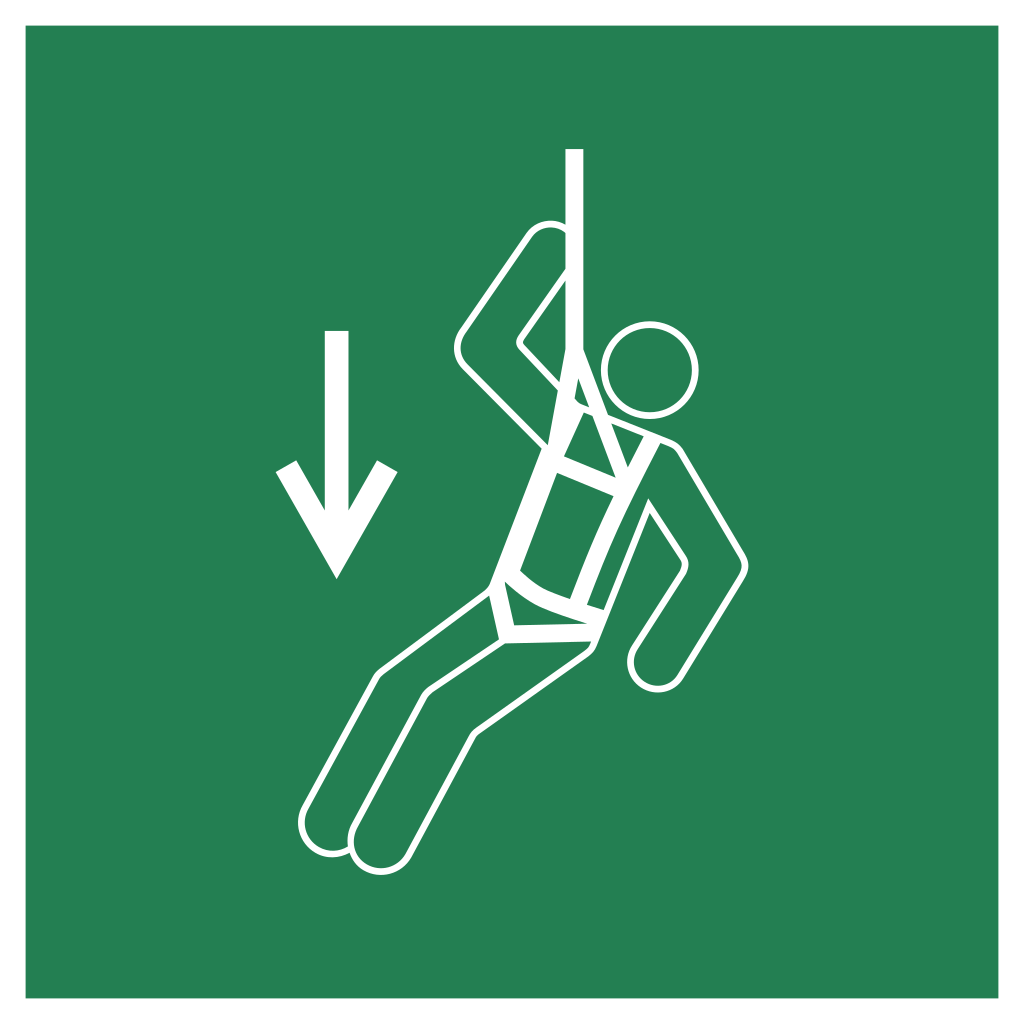
Emergency descent device
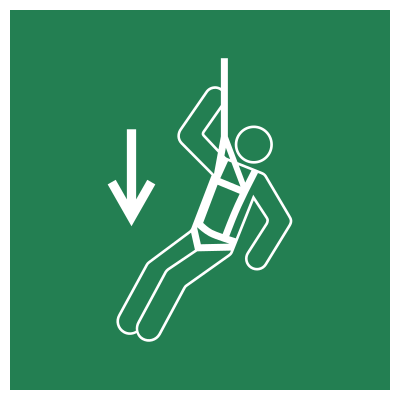
Identifies an emergency descent device.
Understanding this sign
Green square or rectangular signs identify emergency escape routes, safety facilities, and rescue equipment.
Follow the complete wayfinding system and local emergency plan. A symbol alone does not establish a safe route.
Escape by Rope, Under Control
E073 marks the stowage of an emergency descent device — a controlled descender that lowers a person from height at a governed speed when the normal way down is gone. The user dons a harness or rescue strop, connects to the device's line, commits over the edge, and the mechanism's braking regulates the descent automatically to the ground.
It is the answer to a specific nightmare: being trapped aloft. A stair or ladder can be cut off by fire, structural damage, or a jammed hoist, and for the handful of workplaces perched tens of meters up, a pre-rigged descender is the only self-contained plan B that does not depend on rescuers arriving with their own gear.
The Workplaces That Depend on It
Tower crane operators are the emblematic users — a cab fire or mast obstruction can make climbing down impossible, so descent kits ride in the cab and crews drill with them. Wind technicians face the same geometry in a nacelle above a single internal ladder or lift, and evacuation-device drills are a fixture of working-at-height training in the wind industry, including the widely adopted GWO curriculum. Automated warehouses add stacker crane cabins stranded high in racking aisles; theater grids, chimneys, silos, and telecom structures round out the list.
In each case the sign belongs at the stowage container and, where different, at the rigging point and egress hatch — the sequence a stressed user follows should be signposted step by step, with the anchorage itself carrying E072. Cabs and nacelles are cramped, cluttered environments, and a kit that migrated behind a toolbox two seasons ago is invisible in an emergency; the sign fixes the storage position as firmly as it informs the user.
Devices, Standards, and Care
Most units are automatic constant-rate descenders; some allow repeated alternating descents so several people can escape in sequence on one device. European practice covers rescue descender devices under EN 341, with personal fall protection regulation applying generally, and manufacturers certify each model for stated loads, heights, and descent counts. None of that survives neglect: heat, UV, and moisture degrade stored rope, so kits live in sealed containers, get pre-use checks, periodic competent-person inspections, and factory recertification on the maker's stated schedule.
Training carries unusual weight here because the device is used seconds after a frightening decision. Stepping backward over an edge at height contradicts every instinct, and users who have made practice descents in calm conditions perform it; users who have only watched a video hesitate, rig incorrectly, or refuse. Crews should know who descends first, who assists, and how casualties on the ground are managed.
Where you will see E073
Tower crane cabs are the emblematic placement, since a cab fire or mast obstruction can make climbing down impossible, and wind turbine nacelles carry the same kits with drills embedded in GWO working-at-height training. Automated warehouses stage them in stacker crane cabins high in racking aisles, and theater grids, chimneys, silos, and telecom structures follow, with the sign at the stowage container, rigging point, and egress hatch.
Common questions about E073
What is an emergency descent device?
A controlled-descent escape system that lowers a person from height at an automatically regulated speed — typically a rope or cable descender pre-rigged or quickly attached to a rated anchor. It provides self-rescue from workplaces like tower crane cabs and wind turbine nacelles when the normal ladder, stair, or lift is unusable. ISO 7010 E073 marks where the device is stored.
Do tower crane operators need an emergency escape device?
A secondary means of escape from the cab is widely expected by national crane safety rules, industry guidance, and site requirements, and a personal descent kit is the standard way to provide it — the operator cannot rely on climbing the mast past a fire below. Whatever the local legal detail, an unsigned or missing descent kit at height is a gap a risk assessment should catch.
How often should descent devices be inspected?
Follow three layers: a pre-use check whenever the kit could be needed, documented periodic inspection by a competent person under your fall-protection program, and return-to-manufacturer servicing or recertification at the interval the maker specifies for that model. Stored textile components age even unused, so devices also carry a maximum service life set by the manufacturer.
What is the difference between E073 and E072?
E073 locates the escape equipment — the descender kit itself. E072 marks the safe anchorage point the system connects to. At a well-signed high workstation you will often see both: the container with the device under E073, and the verified structural attachment under E072, so a user under stress can rig without guesswork.
Reference details
| Symbol code | E073 |
|---|---|
| Sign family | ISO Emergency Signs |
| Standard reference | ISO 7010:2019 / ISO 3864-1 ISO Online Browsing Platform: E073 |
| Screen color reference | #009933. Screen colors are not a production color specification. |
| Download formats | SVG reference artwork; a 1024 × 1024 pixel PNG conversion on a white canvas. |
| Record date | · How to interpret our dates |
| Page updated |
Choosing a physical sign size
Download dimensions are not installation dimensions. Select sign size, material, placement, and lighting using the applicable standard and the actual viewing conditions. Chemical label sizing follows its own rules. Read the artwork and sizing guide.
Sources and artwork credits
- Artwork source
- Wikimedia Commons file page
- Creator credited by source
- Clemenspool
- License
- CC0
- Source metadata checked
SVG files are local reference copies. PNG files are raster conversions. Check the linked file history and license terms before reuse; a source-metadata check is not certification of the artwork or a workplace installation.
Report a correction to this reference