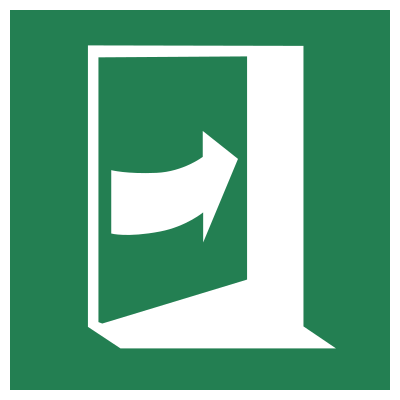
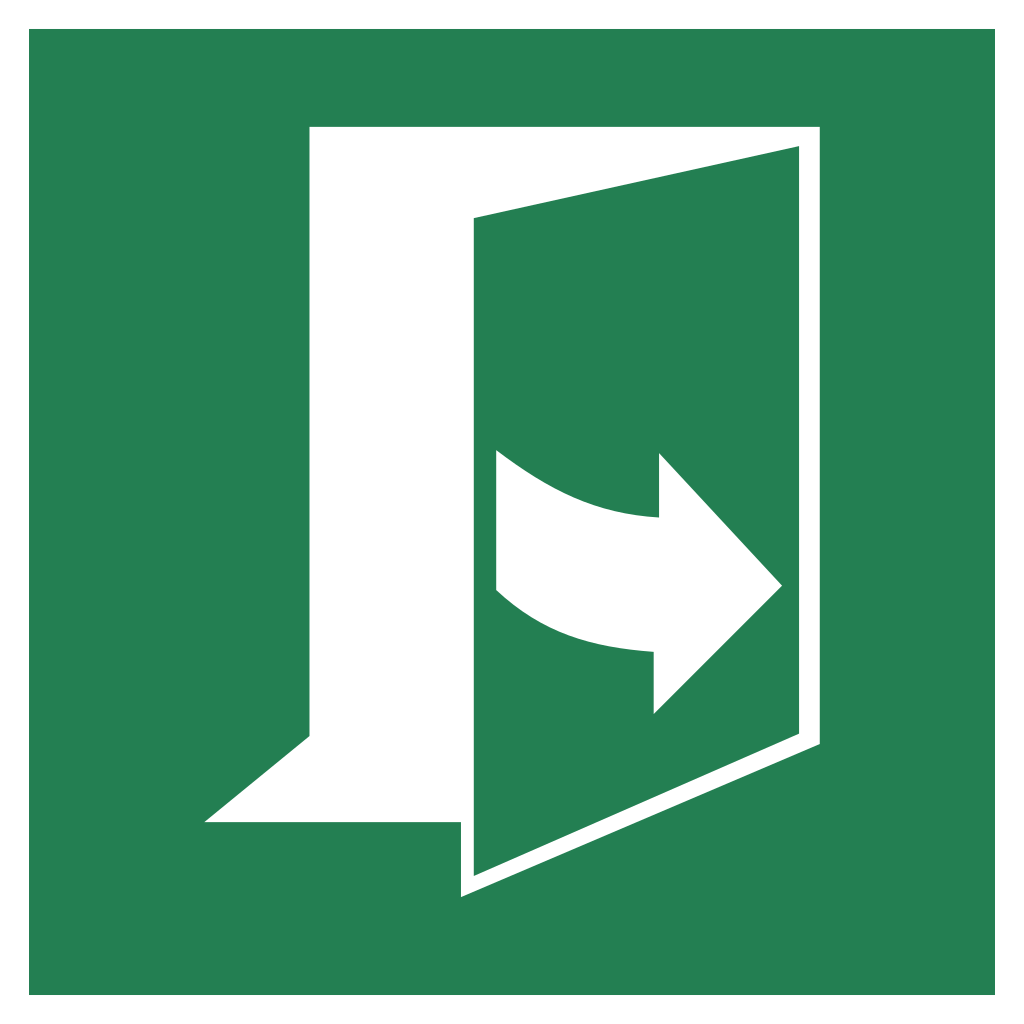
Door opens by pulling on the left-hand side
Indicates that the door opens by pulling on its left-hand side.
Understanding this sign
Green square or rectangular signs identify emergency escape routes, safety facilities, and rescue equipment.
Follow the complete wayfinding system and local emergency plan. A symbol alone does not establish a safe route.
The Door Comes Toward You, From the Left
E057 prepares a person for a door that must be drawn toward them, gripped at its left-hand edge. Standing before it, the hinges are to the right and the leaf swings out of the frame into the user's space. ISO 7010 added the pull-operation pair E057 and E058 to complement the older push signs E022 and E023, completing coverage of the four possible hinged-door operations an escape route can present.
Pulling is the operation evacuees are least prepared to perform. The near-universal instinct at an unfamiliar door, especially in a hurry, is to push — and a pushed pull-door absorbs the force in its frame and gives nothing back. E057 exists to override that instinct in advance, so the approaching hand goes to the left edge and draws rather than slams.
Where Pull-Operated Escape Doors Are Legitimate
Egress codes steer doors on well-populated routes toward opening with the flow of escape, but they leave room for inward-opening or pull-side situations: rooms with small occupant loads, individual offices, some residential and hotel doors, and doors where an outward swing would strike people in a corridor or obstruct a stair landing. In these permitted cases the person leaving the room is on the pull side, and E057 tells them so before their first shove wastes time.
There are also doors that must open against the escaping person for good reason — for instance where the swing must not block the corridor that forms the main route for everyone else. Such compromises come out of the fire strategy, and once accepted they raise the value of operation marking: the design has knowingly asked occupants to do the unintuitive thing, so the sign is the mitigation.
Putting the Sign Where the Hand Goes
Fix E057 on the leaf close to the left-hand edge, near the handle, at a height readable during the approach. The sign, the handle, and the moving edge should form one visual cluster; a pull instruction floating at the center of a wide door leaves the user to re-derive half the information. Pull-side hardware helps the sign — a vertical pull handle communicates draw me in a way a flat push plate never could — so sign and ironmongery should be specified together, not in separate exercises.
Remember the opposite face. A door pulled from this side is pushed from the other, so where both directions of passage matter, the reverse face takes the matching push sign for its own edge geometry. And because pulling needs standing room, keep the swing zone on the user's side clear of stored items; a pull door with a pallet parked in its arc is disabled even though it is unlocked, correctly signed, and mechanically perfect.
Where you will see E057
Small-occupancy rooms, individual offices, hotel and residential doors, and doors whose outward swing would block a corridor or stair landing are the legitimate pull-side cases that carry it. Installers fix it on the leaf near the left edge and handle so sign, handle, and moving edge share one sightline, giving the opposite face the matching push sign where both directions of passage matter.
Common questions about E057
What does the E057 safety sign mean?
The door it is mounted on opens toward you, and the edge that moves is the left-hand one as you face the door. Take hold near that left edge — typically at the handle — and pull. It belongs to the ISO 7010 set of green door-operation signs used along escape routes.
Are pull-to-open doors allowed on escape routes?
Yes, in defined circumstances. Codes generally require doors to swing with the direction of escape once occupant numbers are significant, but rooms with low occupancy, and doors whose outward swing would obstruct a corridor or stair, may legitimately open toward the user. Those are exactly the doors where pull-operation signs like E057 earn their keep.
What is the difference between E057 and E058?
Only the handing. E057 marks a door pulled at its left-hand edge (hinges to your right); E058 marks one pulled at the right-hand edge. Judge the side from where the user stands on the pull side of that particular door, and verify at the door itself rather than from plans.
Should a pull door also be signed on its other side?
If people pass through in both directions, yes — the reverse face is a push operation and takes E022 or E023 according to which edge moves as seen from that side. Signing both faces gives every user, whichever way they travel, the correct action for the face in front of them.
Reference details
| Symbol code | E057 |
|---|---|
| Sign family | ISO Emergency Signs |
| Standard reference | ISO 7010:2019 / ISO 3864-1 ISO Online Browsing Platform: E057 |
| Screen color reference | #009933. Screen colors are not a production color specification. |
| Download formats | SVG reference artwork; a 1024 × 1024 pixel PNG conversion on a white canvas. |
| Record date | · How to interpret our dates |
| Page updated |
Choosing a physical sign size
Download dimensions are not installation dimensions. Select sign size, material, placement, and lighting using the applicable standard and the actual viewing conditions. Chemical label sizing follows its own rules. Read the artwork and sizing guide.
Sources and artwork credits
- Artwork source
- Wikimedia Commons file page
- Creator credited by source
- Clemenspool
- License
- CC0
- Source metadata checked
SVG files are local reference copies. PNG files are raster conversions. Check the linked file history and license terms before reuse; a source-metadata check is not certification of the artwork or a workplace installation.
Report a correction to this reference