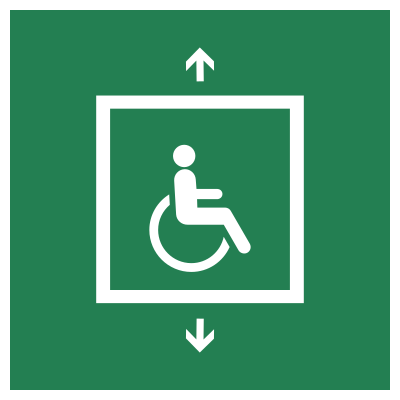
Emergency exit for people unable to walk or with walking impairment (right)
Identifies an emergency exit for people unable to walk or with a walking impairment, using the right-hand version of the pictogram.

Understanding this sign
Green square or rectangular signs identify emergency escape routes, safety facilities, and rescue equipment.
Follow the complete wayfinding system and local emergency plan. A symbol alone does not establish a safe route.
What E030 Adds to the Exit Scheme
E030 is the rightward member of the accessible-exit pair in ISO 7010: a wheelchair figure moving toward a door, on green, indicating that the egress path usable by people who cannot walk or who have a walking impairment lies to the right of someone reading the sign. The register gives it the same function as E026 — a way to a place of safety usable despite mobility impairment — with only the direction distinguishing the two codes.
Having a dedicated right-hand code sounds bureaucratic until a sign order arrives. Specifiers, printers, and installers all work from code numbers, and giving each hand its own registration is what keeps a rightward route from being marked with a leftward pictogram three subcontractors later. For the occupant, meanwhile, the message is binary and immediate: someone who cannot take the stairs turns right here, without pausing to interpret arrows or compare notes with the crowd heading the other way.
Mapping the Rightward Legs of a Route
Assigning E030 positions is an exercise in egress mapping rather than sign shopping. Walk the accessible route from each occupied zone toward its endpoint — refuge, evacuation lift, or level exit — and note every point where an occupant must decide: corridor junctions, lift lobbies, the mouth of a wing. Each decision point whose correct answer is a right turn gets an E030; ambiguous stretches between decisions get continuation signs so confidence never lapses.
Check the accessible signs against the general running-man scheme at every shared location. Where both routes turn right together, E002 and E030 agree and reinforce each other; where they split, the disagreement is intentional and should be obvious rather than subtle, ideally at a point with room for a wheelchair user to peel away from the crowd safely.
Specification and Installation Pitfalls
The recurring failure with handed signs is chirality drift after refurbishment: a wall comes down, the route reverses, and the original sign stays up pointing into the new dead end. Any layout change that touches corridors, lifts, or stair cores should trigger a re-walk of the accessible route and a reconciliation of E026 and E030 positions against the revised plan — the sign for the opposite hand is covered on its own page and cross-checks are cheap.
Mount E030 at the heights and sight lines used for the rest of the escape signage so the two systems read as one, and keep it on emergency-lit or photoluminescent stock; a person moving at wheelchair speed spends longer on the route and may finish it in smoke-dimmed light. A supplementary text panel such as ACCESSIBLE EXIT ROUTE helps visitors who have never seen the pictogram.
Where you will see E030
Corridor junctions, lift lobbies, and wing entrances where the correct accessible-route decision is a right turn each receive an E030, mapped by walking the route from every occupied zone to its refuge, evacuation lift, or level exit. It is mounted at the same heights and sight lines as the general running-man scheme, on emergency-lit or photoluminescent stock, since wheelchair users spend longer on the route and may finish it in smoke-dimmed light.
Common questions about E030
Which direction does the ISO 7010 E030 sign point?
To the right, from the perspective of a person standing in front of the sign. It tells someone who cannot use stairs that their usable escape route — toward a refuge, a lift designed for evacuation, or level ground outside — continues rightward. The left-hand equivalent is E026.
Do accessible exit signs replace the normal running-man exit signs?
No, they run alongside them. E001 and E002 mark the general escape route for everyone; E030 and E026 mark the route a wheelchair user can complete. Where the routes coincide the signs simply agree; where the accessible route diverges — typically to avoid a stairway — the wheelchair signs carry the additional instruction the general signs cannot.
Can I flip E026 artwork instead of buying E030?
You should order the correct code. The mirrored pictograms are registered separately in ISO 7010 precisely so drawings, sign schedules, and purchase orders stay unambiguous, and a hand-flipped file invites the wrong sign being reprinted at the next replacement cycle. List each position by code on the sign schedule and the problem never arises.
How often should accessible escape route signage be reviewed?
At minimum whenever the floor layout, lift designation, or refuge locations change, and as part of routine fire-safety inspections. Handed directional signs are especially vulnerable to becoming wrong rather than merely faded — a refurbishment that reverses a corridor makes an untouched E030 actively misleading, so re-walk the route after any works.
Reference details
| Symbol code | E030 |
|---|---|
| Sign family | ISO Emergency Signs |
| Standard reference | ISO 7010:2019 / ISO 3864-1 ISO Online Browsing Platform: E030 |
| Screen color reference | #009933. Screen colors are not a production color specification. |
| Download formats | SVG reference artwork; a 1024 × 1024 pixel PNG conversion on a white canvas. |
| Record date | · How to interpret our dates |
| Page updated |
Choosing a physical sign size
Download dimensions are not installation dimensions. Select sign size, material, placement, and lighting using the applicable standard and the actual viewing conditions. Chemical label sizing follows its own rules. Read the artwork and sizing guide.
Sources and artwork credits
- Artwork source
- Wikimedia Commons file page
- Creator credited by source
- Clemenspool
- License
- CC0
- Source metadata checked
SVG files are local reference copies. PNG files are raster conversions. Check the linked file history and license terms before reuse; a source-metadata check is not certification of the artwork or a workplace installation.
Report a correction to this reference