Eyewash station
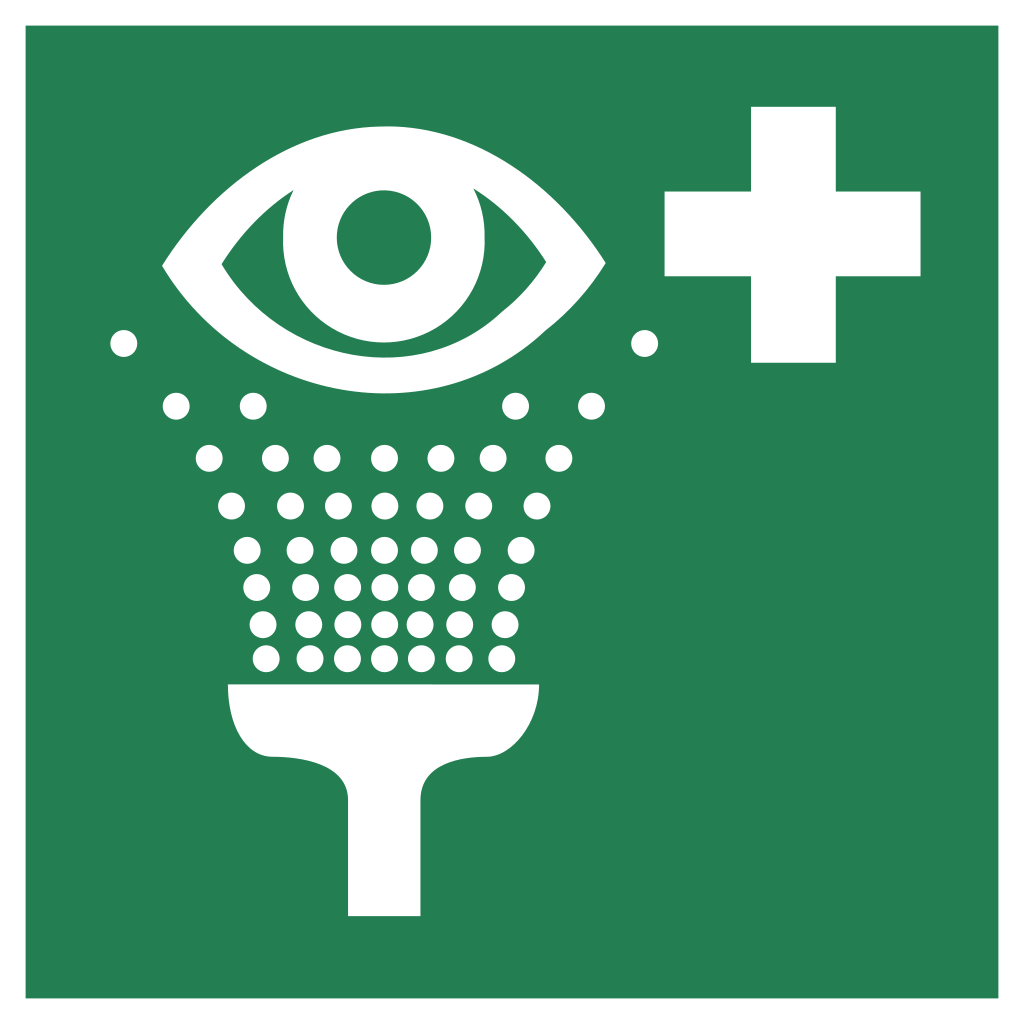
Identifies an eyewash station.
Understanding this sign
Green square or rectangular signs identify emergency escape routes, safety facilities, and rescue equipment.
Follow the complete wayfinding system and local emergency plan. A symbol alone does not establish a safe route.
What E011 Identifies
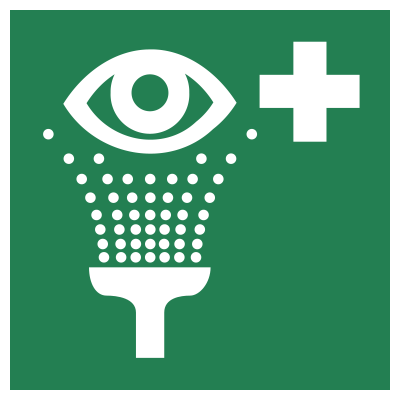
E011 marks an eyewash station: the sign shows a white figure bent over a fountain with streams of water washing the eyes, on a green square per the ISO 3864-1 safe-condition scheme. The equipment behind the sign exists for one scenario — a chemical splash, dust, or debris in the eyes — where the injured person has seconds of useful vision left and must find flushing fluid essentially by memory and color. That is why the sign's visibility is treated as part of the equipment's performance, not decoration.
The regulatory anchor in the United States is OSHA 29 CFR 1910.151(c), which requires suitable facilities for quick drenching or flushing of the eyes and body wherever employees may be exposed to injurious corrosive materials. OSHA does not define suitable in the rule itself; in practice, compliance is measured against ANSI/ISEA Z358.1, the consensus standard for emergency eyewash and shower equipment, which OSHA routinely references in interpretations and citations.
ANSI/ISEA Z358.1 Requirements
Z358.1 requires eyewash stations to be reachable within 10 seconds of the hazard, located on the same level as it, with a travel path free of obstructions — no doors that lock, no stored pallets, no step up onto a platform. The station must be in a well-lit area and, critically for this page, identified with a highly visible sign, which is exactly the role E011 fills. Plumbed eyewash units must deliver flushing fluid to both eyes simultaneously at a minimum of 0.4 gallons per minute for a full 15 minutes.
The fluid itself must be tepid, which the standard defines as 16 to 38 degrees Celsius (60 to 100 degrees Fahrenheit). The range is not comfort trivia: water cold enough to be painful cuts flushes short of the 15 minutes many corrosive exposures demand, while hot water can worsen chemical injury to the eye. Units must also activate in one second or less and stay on without the user's hands, since the casualty needs both hands to hold their eyelids open.
Weekly Activation and Annual Inspection
Z358.1 requires plumbed eyewash units to be activated weekly, long enough to verify flow and clear the supply line of sediment and stagnant water — stagnation breeds microbial growth, including organisms you do not want irrigated directly into a compromised eye. The weekly check is also when dust covers, spray patterns, and access are confirmed. A full inspection against all of the standard's requirements is required annually, and both routines should be logged with dates and initials.
Self-contained and portable units follow a different rhythm: visual inspection to confirm fluid level and condition, with fluid replaced per the manufacturer's schedule, since preserved solutions expire. The most common audit findings are not exotic — expired cartridges in personal bottle stations, weekly test tags that stopped in the spring, and eyewash bowls doubling as storage shelves. Each of them turns a signed, compliant-looking station into a failure at the moment of use.
Siting the Station and the Sign
Eyewash stations belong wherever a splash is credible: chemical dispensing and decanting areas, laboratory benches with corrosives, battery charging rooms where electrolyte is handled, and dosing points in water treatment. The 10-second rule drives placement, and the E011 sign then has to work for a person moving fast with degraded vision — mount it high enough to be seen over benches and equipment, and add directional versions where the station serves a large area or sits around a corner from the hazard.
Floor marking earns its keep here: a painted keep-clear zone under and in front of the unit defends the unobstructed access Z358.1 assumes, because in real facilities the empty space beside an eyewash is where carts and drums migrate. Pair the marking with the sign, brief the requirement in area inductions, and treat anything parked in the zone as a finding. Where the eyewash is part of a combination unit with a drench shower, display E011 and E012 together so both functions are advertised.
Where you will see E011
Eyewash stations and their signs belong wherever a splash is credible: chemical dispensing and decanting areas, laboratory benches with corrosives, battery charging rooms where electrolyte is handled, and dosing points in water treatment. The sign is mounted high enough to be seen over benches and equipment, with directional versions where the station serves a large area, and it appears alongside E012 at combination units that include a drench shower.
Common questions about E011
How far can an eyewash station be from the hazard?
ANSI/ISEA Z358.1 requires the station to be reachable within 10 seconds, on the same level as the hazard, over an unobstructed path. Guidance associated with the standard commonly interprets 10 seconds as roughly 55 feet for an able-bodied person, but for strong acids and bases the equipment should be immediately adjacent to the hazard.
How often do eyewash stations need to be tested?
Plumbed units must be activated weekly under Z358.1 to verify flow and flush stagnant water from the line, and every unit needs a full annual inspection against the standard. Self-contained units are inspected visually and their fluid replaced on the manufacturer's schedule. Keep a written or tagged log of every check.
Does OSHA require a sign at eyewash stations?
OSHA 1910.151(c) requires suitable flushing facilities where corrosives are used, and the consensus standard it is measured against, ANSI/ISEA Z358.1, requires each station to be identified with a highly visible sign in a well-lit area. The ISO 7010 E011 pictogram is the standardized way to meet that identification requirement.
What temperature should eyewash water be?
Tepid, defined by Z358.1 as 16 to 38 degrees Celsius (60 to 100 degrees Fahrenheit). Colder water discourages the full 15-minute flush that corrosive exposures require, and hotter water can aggravate the injury. Outdoor and unheated installations often need mixing valves or freeze protection to stay in range year-round.
Reference details
| Symbol code | E011 |
|---|---|
| Sign family | ISO Emergency Signs |
| Standard reference | ISO 7010:2019 / ISO 3864-1 ISO Online Browsing Platform: E011 |
| Screen color reference | #009933. Screen colors are not a production color specification. |
| Download formats | SVG reference artwork; a 1024 × 1024 pixel PNG conversion on a white canvas. |
| Record date | · How to interpret our dates |
| Page updated |
Choosing a physical sign size
Download dimensions are not installation dimensions. Select sign size, material, placement, and lighting using the applicable standard and the actual viewing conditions. Chemical label sizing follows its own rules. Read the artwork and sizing guide.
Sources and artwork credits
- Artwork source
- Wikimedia Commons file page
- Creator credited by source
- MaxxL
- License
- Public domain
- Source metadata checked
SVG files are local reference copies. PNG files are raster conversions. Check the linked file history and license terms before reuse; a source-metadata check is not certification of the artwork or a workplace installation.
Report a correction to this reference