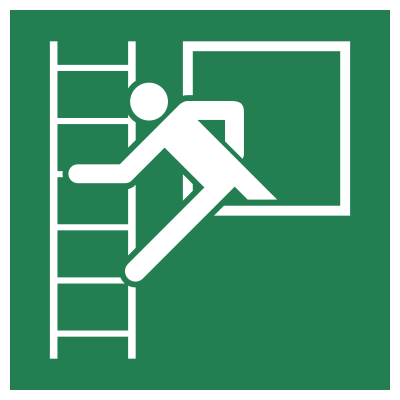
Emergency window with escape ladder
Identifies an emergency window with an escape ladder.
Understanding this sign
Green square or rectangular signs identify emergency escape routes, safety facilities, and rescue equipment.
Follow the complete wayfinding system and local emergency plan. A symbol alone does not establish a safe route.
What E016 Marks
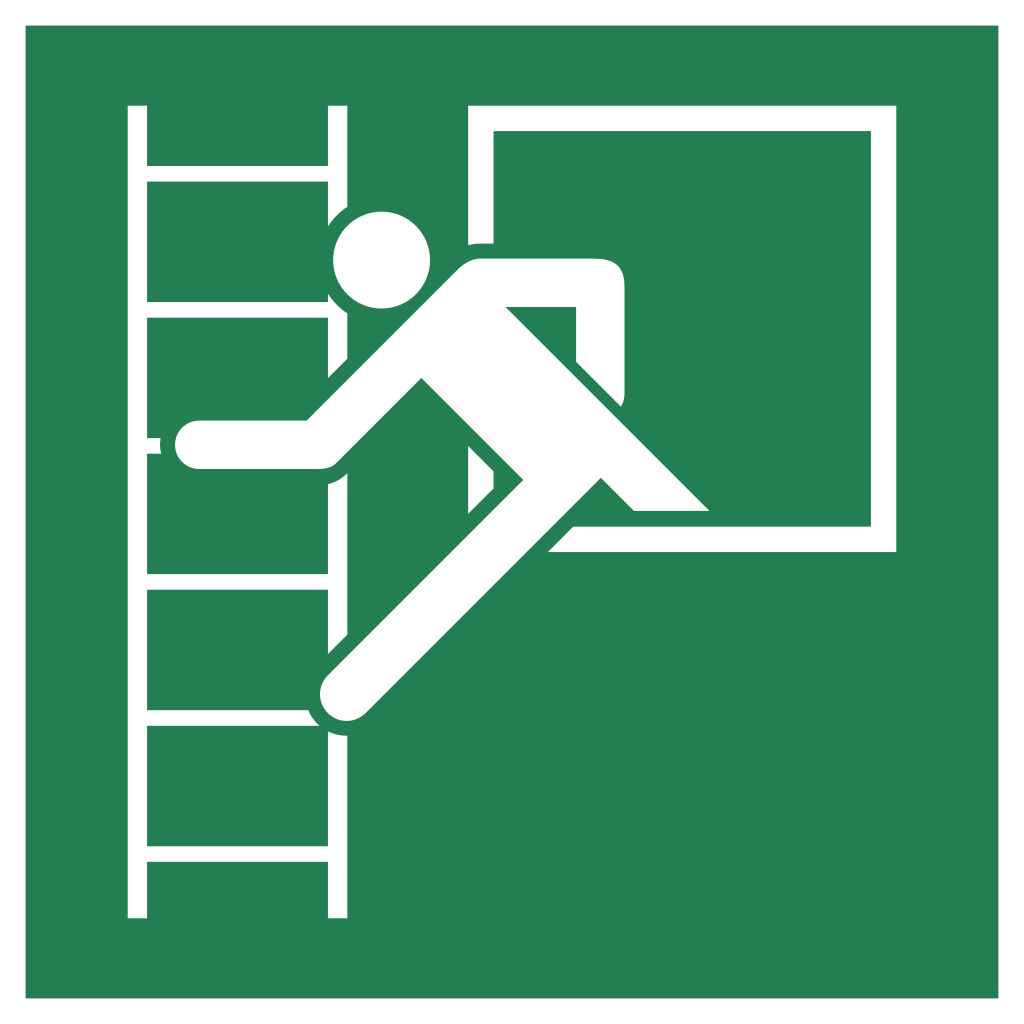
E016 identifies an emergency window that serves as an escape opening, equipped with a permanently fixed escape ladder. The ISO 7010 register defines its function as indicating the location of an emergency window for escape with a permanently fixed ladder, and the pictogram shows a window opening together with the ladder that carries the escaping person down to ground level. Like all E-series signs it uses white graphics on the green field that ISO 3864-1 reserves for safe conditions and rescue equipment.
The word permanently matters. E016 does not describe a window someone might climb out of in desperation; it designates an engineered escape provision where the descent equipment is already installed and ready. An occupant reaching this window should find the ladder in place, not a cabinet containing a rope device they must first deploy. Facilities relying on throw-out or chain ladders should confirm with their fire risk assessor whether E016 fairly describes the arrangement or whether supplementary instructions are needed.
Where Escape Windows With Ladders Appear
Escape windows are typically a secondary route, provided where a building cannot offer two independent protected stairways. Common examples include loft and attic conversions in houses, small guest accommodation, mezzanine offices inside industrial halls, elevated control rooms and plant rooms, and workspaces above workshops where the single internal stair could be blocked by a fire below. In these situations a suitably sized opening window plus a fixed external ladder gives occupants an alternative when the primary route is compromised.
Basement and semi-basement workrooms are the other recurring case: here the fixed ladder climbs upward through a light well or window pit to open ground. Because these spaces are often storage-heavy, the recurring failure is not the ladder but the approach to it — shelving, stock, or furniture drifting in front of the window until the signed escape route no longer exists in practice.
Signing, Access, and Ladder Upkeep
Mount the sign directly at the window so a person following the escape route arrives at the correct opening, and add directional signage along the approach if the window is not visible from the room entrance. Photoluminescent versions earn their cost here, since secondary escape windows frequently serve sleeping areas and spaces without emergency lighting, and the route to them must remain readable after a power failure at night.
Maintenance belongs in the same inspection regime as extinguishers and exit doors: verify the window opens fully without keys or tools, that any restrictor releases as designed, that the ladder rungs and fixings are sound and corrosion-free, and that the landing area below is clear. A signed escape window with a seized hinge or a ladder buried behind a parked forklift is worse than no provision at all, because occupants will spend critical time on a route that cannot deliver them.
E016 Compared With Neighbouring Signs
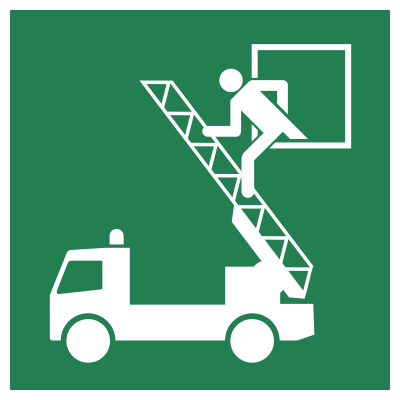
The critical distinction is with E017, the rescue window. E016 points occupants outward: it marks an opening through which people escape under their own power using the fixed ladder. E017 points rescuers inward: it marks a window designated for intervention forces to reach occupants with their own ladder equipment. Using E016 on a window that has no fixed ladder, on the assumption that the fire brigade will bring one, misdescribes the provision and can send occupants to a dead end.
Along the rest of the route, the running-man signs E001 and E002 with directional arrows guide people toward the window, while a general exit sign at the window itself would be wrong — the occupant needs to understand they are about to use a ladder, not walk through a doorway. Where the ladder is a separate device stored nearby rather than fixed, some sites pair the window marking with equipment-location signage and written instructions instead.
Where you will see E016
Common hosts are loft conversions, small guest accommodation, mezzanine offices inside industrial halls, elevated control rooms and plant rooms, and workspaces above workshops where the single internal stair could be blocked by fire below. Basement and semi-basement workrooms use it where a fixed ladder climbs through a light well to open ground, with the sign mounted directly at the window and directional signage along the approach.
Common questions about E016
What does the emergency window with escape ladder sign mean?
It marks a window designated as an emergency escape opening that has a permanently fixed ladder for climbing down to safety (or up, from a basement). Occupants who cannot reach the normal exit should go to this window, open it, and use the installed ladder. It is ISO 7010 sign E016, a white pictogram on a green safe-condition background.
What is the difference between ISO E016 and E017?
E016 is for self-rescue: occupants escape through the window using a ladder that is permanently installed. E017 marks a rescue window, where firefighters or other intervention forces bring their own ladder to reach and evacuate people. If there is no fixed ladder at the window, E016 is the wrong sign.
Do escape windows have a minimum size?
Most building codes that accept escape or egress windows set minimum clear opening dimensions and maximum sill heights so an adult can climb through unaided, but the exact figures vary by jurisdiction and building type. ISO 7010 only standardizes the sign itself, so check your national building regulations for the opening requirements.
Can a rope or chain ladder count as an escape ladder for E016?
The ISO description behind E016 refers to a permanently fixed escape ladder, which a stored deployable ladder is not. Some fire risk assessments do accept certified deployable ladders for specific low-rise situations, but the signage should then explain the device and its deployment rather than implying a fixed ladder is waiting outside the window.
Reference details
| Symbol code | E016 |
|---|---|
| Sign family | ISO Emergency Signs |
| Standard reference | ISO 7010:2019 / ISO 3864-1 ISO Online Browsing Platform: E016 |
| Screen color reference | #009933. Screen colors are not a production color specification. |
| Download formats | SVG reference artwork; a 1024 × 1024 pixel PNG conversion on a white canvas. |
| Record date | · How to interpret our dates |
| Page updated |
Choosing a physical sign size
Download dimensions are not installation dimensions. Select sign size, material, placement, and lighting using the applicable standard and the actual viewing conditions. Chemical label sizing follows its own rules. Read the artwork and sizing guide.
Sources and artwork credits
- Artwork source
- Wikimedia Commons file page
- Creator credited by source
- MaxxL
- License
- Public domain
- Source metadata checked
SVG files are local reference copies. PNG files are raster conversions. Check the linked file history and license terms before reuse; a source-metadata check is not certification of the artwork or a workplace installation.
Report a correction to this reference