Emergency Exit
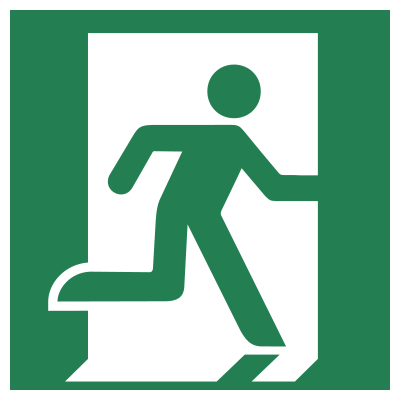
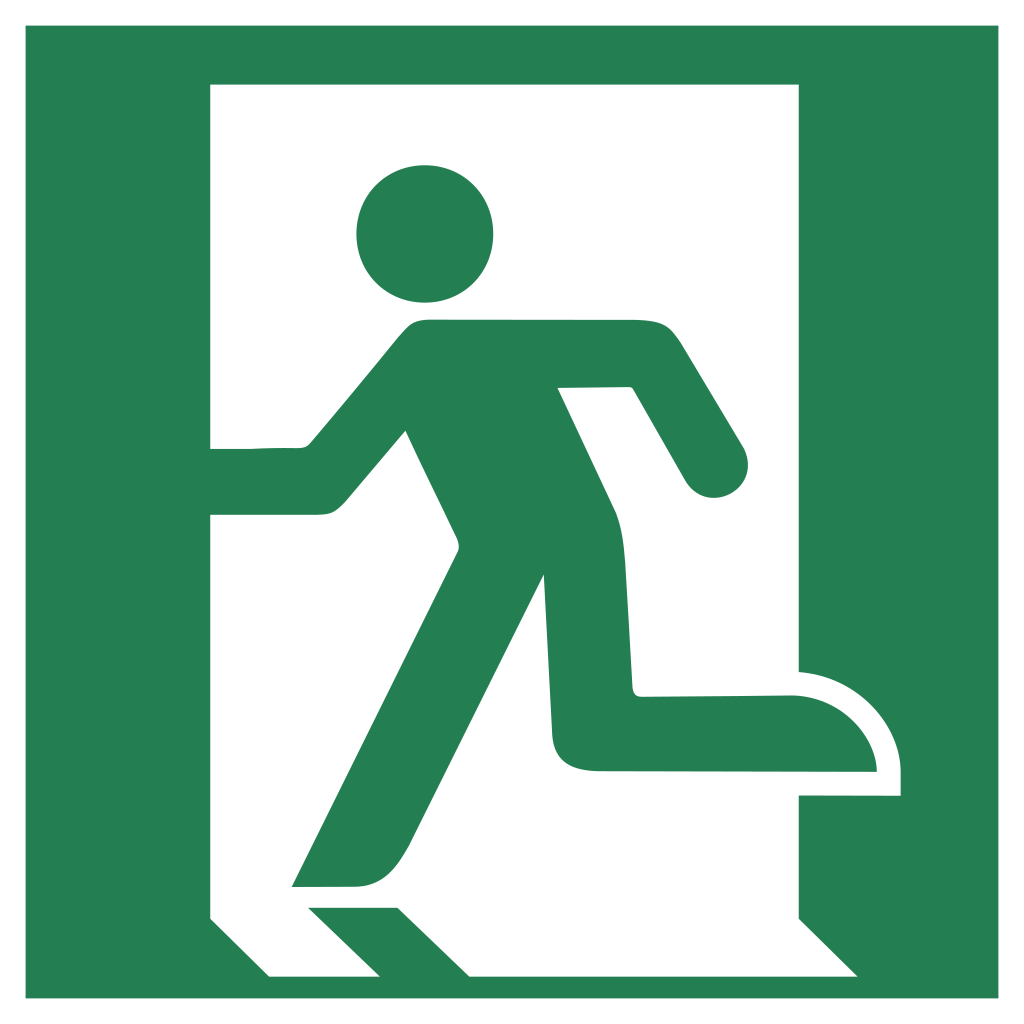
Identifies an emergency exit or escape-route reference using the left-hand version of the pictogram. Read it with the complete route signage.
Understanding this sign
Green square or rectangular signs identify emergency escape routes, safety facilities, and rescue equipment.
Follow the complete wayfinding system and local emergency plan. A symbol alone does not establish a safe route.
The Running Man: What E001 Shows
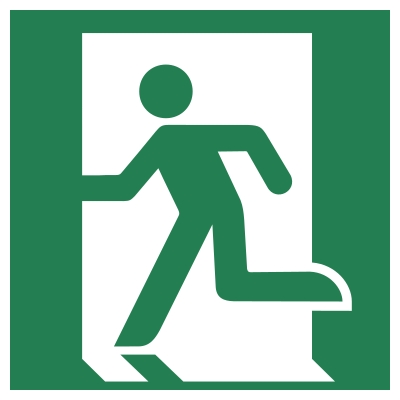
E001 depicts a white human figure running toward a doorway on a green rectangular field. It marks an emergency exit, or a point on the escape route leading to one, in the left-hand orientation: the figure moves toward a door frame on the left side of the sign. Green is the ISO 3864-1 safe-condition color, reserved for signs that show people where safety lies rather than what to avoid, and the white-on-green combination is chosen for legibility in poor visibility.
The running-man pictogram originated in Japan, where designer Yukio Ota's figure was selected through a national design competition in the early 1980s after fatal department store fires exposed how badly text-only exit marking served panicked crowds. It entered international standardization through ISO 6309 in 1987 and was carried into ISO 7010, and it is now the default exit symbol across the European Union, most of Asia, Australia, and much of the rest of the world. Its strength is language independence: it communicates the same instruction to every occupant regardless of literacy or native language.
Direction Variants and Arrow Combination
ISO 7010 provides E001 for left-hand situations and E002 as its mirror image for right-hand ones, and both combine with supplementary directional arrows to build a complete escape-route system. The governing convention is consistency: the figure should run in the direction of travel, and any arrow added to the sign must agree with it. ISO 16069, the standard for safety way guidance systems, sets out how escape route components are combined so an occupant moving along the route receives an unbroken chain of directional information.
In practice this means a sign at every point where the route could be misread: each change of direction, each corridor junction, each door that must be passed through, and the final exit itself. National application rules differ on details such as whether an upward-pointing arrow means straight ahead or through the door above, so facilities operating across borders should document one convention and apply it uniformly. A route where one junction uses an up arrow for straight-on and the next uses it for a level change will fail exactly when it is needed.
Green Running Man vs the US EXIT Sign
The United States is the major exception to the running man's dominance. NFPA 101, the Life Safety Code, and the International Building Code require exit signs bearing the word EXIT in plainly legible letters, illuminated at all times and backed by emergency power. The green pictogram is generally permitted only as supplementary marking, or as a primary sign where the authority having jurisdiction specifically approves it. A US facility that replaces its EXIT signs with ISO pictograms alone would typically be cited.
By contrast, EU member states implement Directive 92/58/EEC, which mandates the green rectangular pictogram format that E001 satisfies, and text-only exit signs there are the nonconforming option. Multinational operators commonly resolve the split by following the local code as the primary layer and adding the other format for their international workforce: ISO pictograms alongside EXIT text in American plants, and occasionally EXIT text panels beneath E001 in facilities hosting US-based visitors or auditors.
Photoluminescent and Low-Location Signage
Smoke stratifies at ceiling height, which is precisely where most exit signs hang. ISO 16069 therefore describes low-location safety way guidance: continuous markings and exit signs mounted near floor level along walls, where visibility persists longest as a space fills with smoke. Low-location systems duplicate the high-mounted E001 signs rather than replacing them, giving crawling or crouching occupants a readable path when the upper signage has disappeared into the smoke layer.
Photoluminescent versions of E001 absorb ambient light and continue glowing during a blackout without wiring or batteries, making them a common choice for low-location marking, stairwells, and areas where emergency lighting circuits could be compromised. Requirements tightened after the 2001 World Trade Center evacuation: New York City's Local Law 26 mandated photoluminescent exit path markings in high-rise office buildings, and the International Building Code now requires luminous egress path markings in the exit enclosures of high-rise buildings. Photoluminescent signs need adequate ambient light to charge, so they are unsuitable for spaces kept dark during occupancy.
Read the complete escape-route sign
E001 and E002 are the left-hand and right-hand emergency-exit variants. Use the complete installed wayfinding system, including directional arrows and local instructions. A running figure alone is not enough to infer the full route through a building.
US workplace context
OSHA 1910.37 requires each exit to be clearly visible and marked by a sign reading “Exit,” and provides further requirements for directional marking and sign visibility. Do not assume a downloaded ISO pictogram can replace required exit wording or an approved illumination system.
The application notes above were checked against the linked public sources on . Jurisdiction-specific notes are identified in the text.
Where you will see E001
Found above exit doors, along escape corridors, at route changes, in production halls, warehouses, laboratories, tunnels, parking structures, utility buildings, and public areas where evacuation direction must be obvious.
Common questions about E001
What does the green running man sign mean?
It marks an emergency exit or the escape route leading to one. The green background is the ISO 3864-1 safe-condition color, the white figure shows a person moving toward a doorway, and when combined with an arrow the sign tells occupants which way to travel to reach safety. It is the internationally standardized exit symbol under ISO 7010.
Is the ISO running man exit sign legal in the United States?
Usually only as a supplement. NFPA 101 and the International Building Code require exit signs with the word EXIT, illuminated and connected to emergency power. The running man may be added alongside, and some authorities having jurisdiction approve pictogram signs, but replacing required EXIT signage with E001 alone is generally a code violation.
Which way should the running man face?
In the direction of escape travel. Use E001 where the route or door lies to the left and E002 where it lies to the right, and make sure any supplementary arrow agrees with the figure. A sign whose figure runs left while its arrow points right is a genuine hazard, because occupants in smoke follow whichever cue they see first.
Do emergency exit signs have to work in a power failure?
Yes, in effectively every jurisdiction. US codes require exit signs to remain illuminated on emergency power, typically for at least 90 minutes. In Europe, signs must stay visible when normal lighting fails, which is achieved either with emergency-lit signs or photoluminescent materials that glow after the lights go out.
Reference details
| Symbol code | E001 |
|---|---|
| Sign family | ISO Emergency Signs |
| Standard reference | ISO 7010:2019 / ISO 3864-1 ISO Online Browsing Platform: E001 |
| Screen color reference | #009933. Screen colors are not a production color specification. |
| Download formats | SVG reference artwork; a 1024 × 1024 pixel PNG conversion on a white canvas. |
| Record date | · How to interpret our dates |
| Page updated |
Choosing a physical sign size
Download dimensions are not installation dimensions. Select sign size, material, placement, and lighting using the applicable standard and the actual viewing conditions. Chemical label sizing follows its own rules. Read the artwork and sizing guide.
Sources and artwork credits
- Artwork source
- Wikimedia Commons file page
- Creator credited by source
- MaxxL
- License
- Public domain
- Source metadata checked
SVG files are local reference copies. PNG files are raster conversions. Check the linked file history and license terms before reuse; a source-metadata check is not certification of the artwork or a workplace installation.
Report a correction to this reference