Automated external heart defibrillator
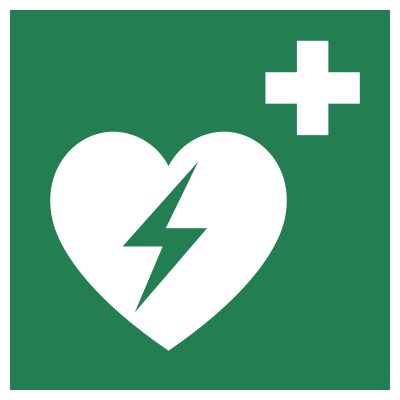
Identifies an automated external defibrillator (AED).
Understanding this sign
Green square or rectangular signs identify emergency escape routes, safety facilities, and rescue equipment.
Follow the complete wayfinding system and local emergency plan. A symbol alone does not establish a safe route.
The AED Sign and Why Seconds Matter
E010 marks the location of an automated external defibrillator: a white heart crossed by an electrical flash, with a cross indicating medical equipment, on a green square. The device it points to treats sudden cardiac arrest, where the clinical logic is brutally time-dependent — resuscitation guidance consistently emphasizes that the chance of surviving a shockable arrest falls steeply with every minute that passes before defibrillation, with figures on the order of seven to ten percent per minute widely cited in the resuscitation literature.
That time pressure is the reason the sign exists as a distinct registered symbol rather than relying on the general first aid cross. A bystander responding to a collapse is searching for one specific object, often in a building they do not know, while under extreme stress. International resuscitation bodies promoted a universal AED symbol so the device could be recognized instantly across countries, and the ISO 7010 E010 sign carries that role in standardized workplace and public signage.
Placement and Response-Time Planning
AED positioning should be worked backward from the collapse, not forward from the wall space available. A common planning target is getting the device to the patient within about three minutes, which at a brisk walk translates to placing units so that no occupied point is more than roughly ninety seconds away one-way. Lobbies, main corridors, gyms, cafeterias, and security desks beat locked offices and back rooms; an AED behind a keypad or inside a manager's office is, for most cardiac arrests, not an AED.
Signage is what converts a well-placed device into a findable one. The wall sign at the cabinet should be supplemented with projecting or flag-mounted E010 signs readable along the length of corridors, and with directional versions carrying arrows in large buildings, so a runner sent to fetch the AED is guided the whole way rather than only confirmed on arrival. Adding the device to evacuation diagrams and induction training multiplies the value of the physical signs.
Inspection and Readiness
An expired AED under a perfect sign is a liability, so readiness checks belong to the signage conversation. Modern units run self-tests and display a status indicator; a routine — commonly monthly — of verifying the ready light, checking electrode pad and battery expiration dates, and confirming the cabinet is intact and unobstructed is standard practice and typically aligned with the manufacturer's maintenance instructions, which several jurisdictions incorporate by reference into their AED laws.
Programs also need an after-use and after-alarm procedure: pads replaced, data downloaded where required, the event reported, and the unit returned to service quickly. Where local rules or medical direction call for it, registering device locations with emergency medical services allows dispatchers to direct callers to the nearest AED, effectively extending the reach of the E010 sign beyond the people who happen to walk past it. Checks should be logged, because an unrecorded inspection is indistinguishable from a skipped one after an incident.
What the Law Does and Does Not Require
There is no general OSHA standard compelling employers to install AEDs, though the agency has published guidance encouraging them in workplaces. Obligations instead come from a patchwork of state and national laws: many US states require AEDs in specific occupancies such as schools, health clubs, or public buildings, and most pair those mandates with Good Samaritan protections covering lay rescuers who use the device in good faith. Because the requirements vary sharply by jurisdiction and occupancy type, program owners should verify their specific obligations locally.
Public-access defibrillation programs in Europe and elsewhere follow the same pattern of local mandates layered over voluntary deployment, and signage requirements travel with them: an AED that a mandate forced into the building still saves no one if it cannot be found. The defensible position for any facility is the same regardless of legal minimums — devices placed against a response-time target, marked with E010 at the unit and along approach routes, inspected on a logged schedule, and written into the emergency plan.
Where you will see E010
AEDs marked with E010 sit in lobbies, main corridors, gyms, cafeterias, and at security desks, placed so no occupied point is more than roughly ninety seconds away. Large buildings add projecting or flag-mounted signs readable along corridors and arrowed directional versions guiding a runner the whole way, with the device also drawn onto evacuation diagrams and covered in induction training.
Common questions about E010
What does the AED sign symbol mean?
The ISO 7010 E010 sign shows a heart broken by an electrical flash with a cross, in white on a green background. The heart and flash represent an electrical shock delivered to the heart, the cross marks it as medical equipment, and green is the safe-condition color. It indicates the location of an automated external defibrillator.
Where should AEDs and their signs be placed?
Place devices so one can reach any occupied area quickly — a common target is delivering the AED to the patient within about three minutes of collapse — in visible, unlocked, high-traffic locations. Mark each unit with E010 at the cabinet, add projecting signs readable along corridors, and use directional arrow versions in large buildings.
How often should an AED be checked?
Follow the manufacturer's maintenance instructions, which typically means routinely verifying the ready-status indicator — monthly checks are common practice — plus tracking electrode pad and battery expiration dates and inspecting the cabinet and signage. Log every check, and return the unit to service promptly after any use.
Is there a law requiring AEDs in the workplace?
Not a general one in the US: OSHA encourages workplace AEDs but does not mandate them. Requirements come from state and local laws covering specific settings such as schools, fitness centers, and some public buildings, usually alongside Good Samaritan protection for users. Check the rules for your jurisdiction and occupancy type.
Reference details
| Symbol code | E010 |
|---|---|
| Sign family | ISO Emergency Signs |
| Standard reference | ISO 7010:2019 / ISO 3864-1 ISO Online Browsing Platform: E010 |
| Screen color reference | #009933. Screen colors are not a production color specification. |
| Download formats | SVG reference artwork; a 1024 × 1024 pixel PNG conversion on a white canvas. |
| Record date | · How to interpret our dates |
| Page updated |
Choosing a physical sign size
Download dimensions are not installation dimensions. Select sign size, material, placement, and lighting using the applicable standard and the actual viewing conditions. Chemical label sizing follows its own rules. Read the artwork and sizing guide.
Sources and artwork credits
- Artwork source
- Wikimedia Commons file page
- Creator credited by source
- M!dgard
- License
- CC0
- Source metadata checked

SVG files are local reference copies. PNG files are raster conversions. Check the linked file history and license terms before reuse; a source-metadata check is not certification of the artwork or a workplace installation.
Report a correction to this reference