Emergency Exit (Right Hand)
Identifies an emergency exit or escape-route reference using the right-hand version of the pictogram. Read it with the complete route signage.
Understanding this sign
Green square or rectangular signs identify emergency escape routes, safety facilities, and rescue equipment.
Follow the complete wayfinding system and local emergency plan. A symbol alone does not establish a safe route.
E002: The Right-Hand Exit Variant
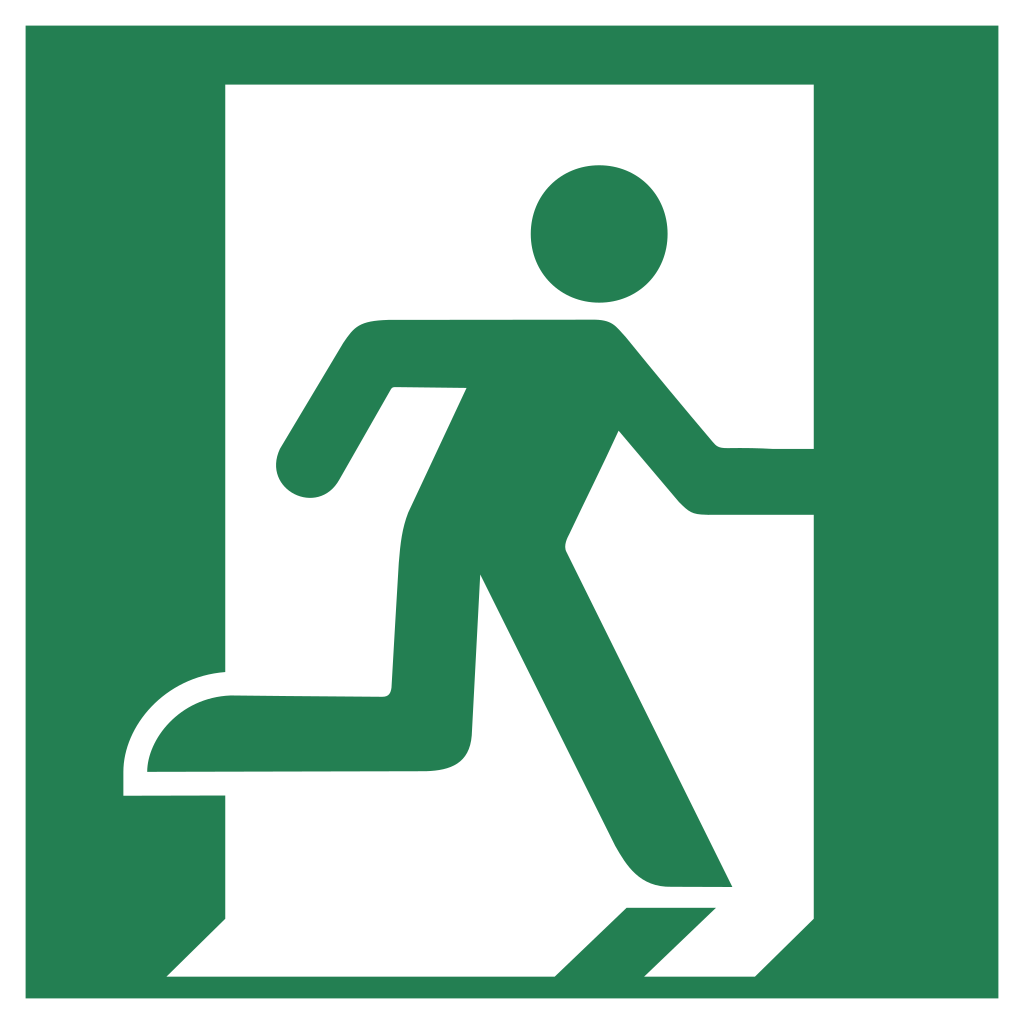
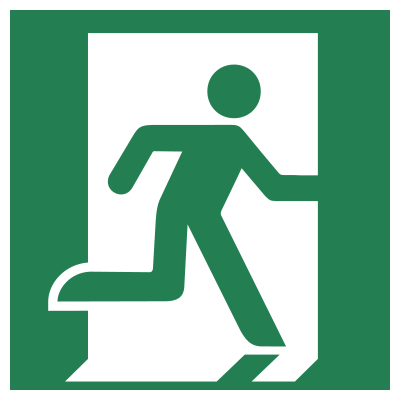
E002 is the mirror image of E001: the same white running figure on a green field, but heading toward a door frame on the right side of the sign. ISO 7010 registers the two orientations as separate signs because direction is the entire message of escape-route signage. Where the door, stairway, or next leg of the route lies to an occupant's right, E002 is the correct choice; installing the left-hand version there sends people the wrong way at the moment they can least afford it.
Like all safe-condition signs, E002 follows the ISO 3864-1 design rules for the green category: a white graphical symbol on a green rectangle, with the safety color required to cover at least half the sign's area. The format was written for degraded viewing conditions, and the solid green field remains recognizable at distances and light levels where finer detail has already been lost, which is why route signs rely on the color block rather than text to be found in the first place.
Placing E002 at Decision Points
The value of a directional exit sign is realized before the turn, not at it. Mount E002 where an approaching occupant can read it while still moving, far enough ahead of a right-hand junction, aisle end, or corridor branch that the turn requires no hesitation. In long warehouse aisles and production halls, flag-mounted or suspended signs installed perpendicular to the line of travel are read far earlier than flat wall-mounted ones, which are nearly invisible until the viewer is beside them.
Sign size is driven by the longest sight line on the route segment. ISO 3864-1 ties minimum sign height to observation distance, and for escape routes the working assumption should be the farthest point from which someone might need to spot the sign, not the average one. A 150 mm sign that reads comfortably in an office corridor disappears in a 40-meter racking aisle; high-bay spaces routinely need 400 mm formats or larger, mounted below the level where luminaires and ductwork cause glare or obstruction.
Keeping Figure and Arrow in Agreement
E002 is normally installed as a combination sign with a supplementary arrow, and ISO 16069's safety way guidance principles demand that the two elements never contradict each other. The defensible pattern is simple: figure runs right, arrow points right, route goes right. Problems arise during piecemeal replacements, when a maintenance team reorders a left-hand sign for a right-hand location or pairs old stock arrows with new pictograms. Escape-route signage should be audited as a chain, walking each route in the direction of travel, rather than checked sign by sign.
A second common failure is orphaned direction changes. If E002 points occupants right at a junction, the next sightline must contain the following sign, or the route effectively ends there for anyone unfamiliar with the building. ISO 16069 treats the guidance system as continuous: from any point on an escape route, at least one route component should be visible. During layout changes, new racking, partitions, or stored product frequently break sightlines that were compliant at handover, so route walks belong in the change-management checklist, not just the annual audit.
Regional Rules and Common Errors
In the EU, E002 and its arrow combinations sit squarely within Directive 92/58/EEC's required green rectangular format, and the mirrored variants are the normal tool for marking directional egress. In the United States, directional egress information is instead carried by chevrons on the code-required EXIT sign itself, and the ISO pictogram serves as optional reinforcement. Facilities importing European signage into US buildings should treat E002 as an addition to, never a substitute for, the illuminated EXIT signs that NFPA 101 and the IBC demand.
The errors inspectors find most often with right-hand exit signs are mundane: signs left pointing at doors that were relocated in a refit, mirrored stock installed interchangeably because purchasing treated E001 and E002 as the same product, and mixed generations of pictograms along a single route after partial upgrades. None of these requires new hardware to fix, only a route-by-route reconciliation of what each sign says against where the route actually goes today.
Read the complete escape-route sign
E001 and E002 are the left-hand and right-hand emergency-exit variants. Use the complete installed wayfinding system, including directional arrows and local instructions. A running figure alone is not enough to infer the full route through a building.
US workplace context
OSHA 1910.37 requires each exit to be clearly visible and marked by a sign reading “Exit,” and provides further requirements for directional marking and sign visibility. Do not assume a downloaded ISO pictogram can replace required exit wording or an approved illumination system.
The application notes above were checked against the linked public sources on . Jurisdiction-specific notes are identified in the text.
Where you will see E002
Installed above right-turn route changes, escape-corridor junctions, door approaches, warehouse aisles, laboratories, public buildings, and plant interiors where directional egress information must be visible before occupants reach the decision point.
Common questions about E002
When should I use E002 instead of E001?
Use E002 whenever the exit, stairway, or next section of the escape route lies to the right of a person facing the sign, and E001 when it lies to the left. The two are mirror images registered as separate ISO 7010 signs precisely because the orientation carries the directional message. Order and stock them as distinct items to avoid mix-ups.
Does the arrow go before or after the running man?
Place the arrow on the side the figure is running toward, so the eye reads figure, then arrow, then the actual direction as one continuous motion. For E002 that means the arrow sits to the right of the pictogram, pointing right. Whatever layout convention you adopt, apply it identically along the whole route.
How big does an escape route sign need to be?
Size it from the longest distance at which it must be readable, using the observation-distance guidance in ISO 3864-1. Small-format signs around 150 mm suit short office corridors, while long warehouse aisles and high-bay halls typically need 300 to 400 mm formats or larger, ideally flag-mounted so they face approaching traffic.
Is a mismatched figure and arrow actually a compliance problem?
Yes. A sign whose figure runs one way while the arrow points the other gives contradictory escape information, which defeats the purpose of directional signage and will be flagged in fire risk assessments and workplace inspections. It typically happens after partial sign replacements, and the fix is to audit routes in the direction of travel.
Reference details
| Symbol code | E002 |
|---|---|
| Sign family | ISO Emergency Signs |
| Standard reference | ISO 7010:2019 / ISO 3864-1 ISO Online Browsing Platform: E002 |
| Screen color reference | #009933. Screen colors are not a production color specification. |
| Download formats | SVG reference artwork; a 1024 × 1024 pixel PNG conversion on a white canvas. |
| Record date | · How to interpret our dates |
| Page updated |
Choosing a physical sign size
Download dimensions are not installation dimensions. Select sign size, material, placement, and lighting using the applicable standard and the actual viewing conditions. Chemical label sizing follows its own rules. Read the artwork and sizing guide.
Sources and artwork credits
- Artwork source
- Wikimedia Commons file page
- Creator credited by source
- MaxxL
- License
- Public domain
- Source metadata checked
SVG files are local reference copies. PNG files are raster conversions. Check the linked file history and license terms before reuse; a source-metadata check is not certification of the artwork or a workplace installation.
Report a correction to this reference