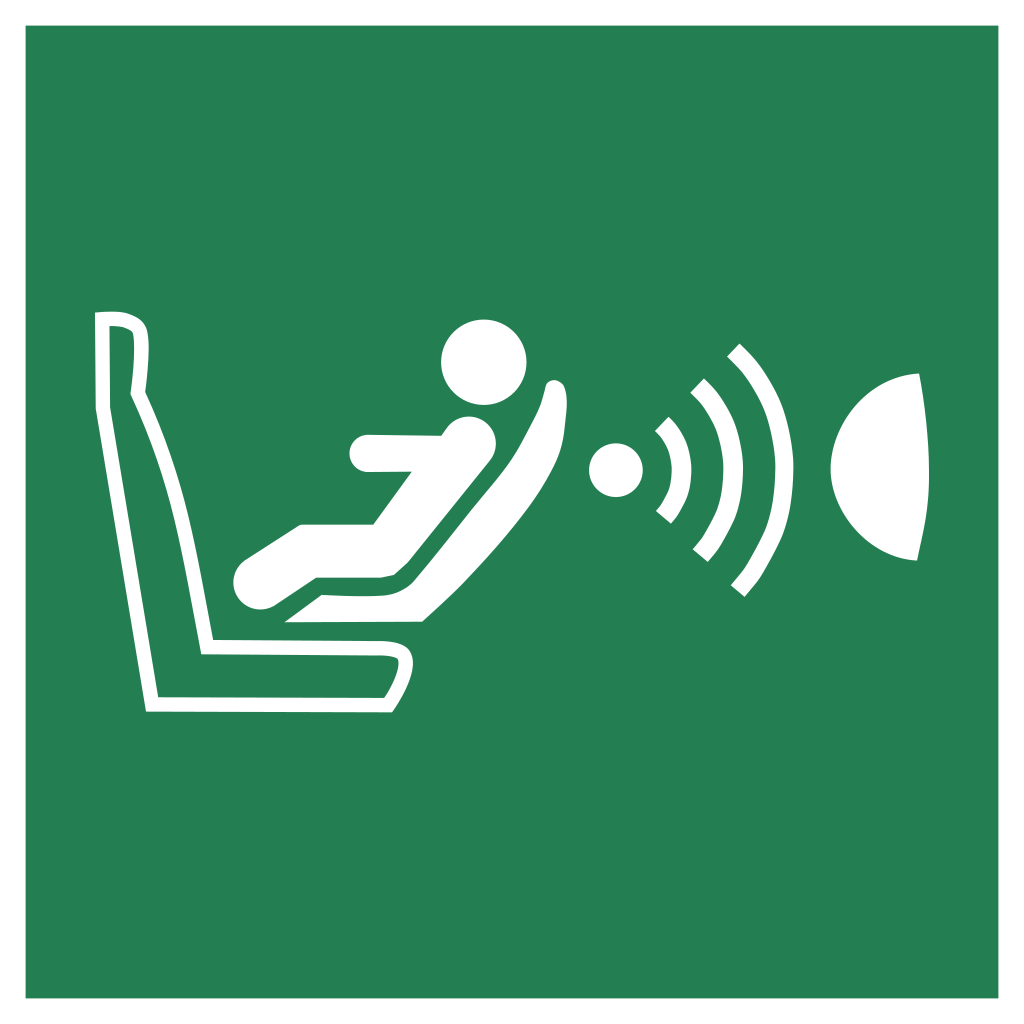
Child seat presence and orientation detection system (CPOD)
Identifies a child seat presence and orientation detection system (CPOD).
Understanding this sign
Green square or rectangular signs identify emergency escape routes, safety facilities, and rescue equipment.
Follow the complete wayfinding system and local emergency plan. A symbol alone does not establish a safe route.
An Automotive Outlier in ISO 7010
E014 is unlike almost everything else in the emergency sign family: its home is a car interior, not a workplace wall. The ISO register defines it as indicating that a CPOD-equipped child seat can safely be used on a CPOD-equipped passenger seat protected by a frontal airbag. CPOD — child seat presence and orientation detection — is a vehicle system that senses when a compatible child restraint is installed on the front passenger seat, recognizes which way it faces, and manages the frontal airbag accordingly.
The label typically appears near the passenger seating position of vehicles fitted with the system, alongside the compatibility information for the specific child restraints the detection works with. Its message is a conditional clearance: with matched equipment on both sides — an enabled seat and a compatible restraint — the normally forbidden combination becomes acceptable because the car itself removes the hazard.
The Hazard CPOD Addresses
Installed up front, a rearward-facing carrier leaves only a small gap between its shell and the airbag module in the dash — and the infant's head lies immediately behind that shell. A frontal airbag is calibrated to arrest an adult torso in a crash; firing into the back of a baby carrier at point-blank distance, the same device becomes a hammer. Vehicle labeling rules worldwide therefore demand a permanent warning against the combination, and ISO 7010 supplies the corresponding prohibition sign, P074.
CPOD closes the gap between prohibition and practicality. Detection typically works through transponders or sensors in the compatible child seat and receiving equipment in the vehicle seat: when a rear-facing restraint is recognized, the system automatically suppresses the front passenger airbag and usually confirms the deactivation with an indicator light. The automation removes the failure mode that plagues manual airbag switches — a caregiver forgetting to toggle the switch in either direction, leaving an infant exposed or an adult passenger unprotected.
Reading the Sign Correctly
E014 authorizes a narrow, specific situation and nothing beyond it. The clearance holds only when both halves of the system are present and functional: a vehicle seat equipped with detection and a child restraint carrying the matching technology. A standard child seat without the transponder is invisible to the system, so the airbag stays live and the general prohibition applies exactly as it would in any other car. Owners should verify compatibility through the vehicle handbook and the restraint manufacturer rather than inferring it from the label alone.
Two behaviors keep the system trustworthy in daily use. First, confirm the airbag-off indicator actually illuminates each time a rear-facing seat is installed — the light is the system reporting success, and its absence means stop and investigate. Second, even where detection permits front seat installation, the rear seat generally remains the recommended location for child restraints, so E014 is best understood as enabling an exception, not endorsing it as the default.
Where you will see E014
Automakers place the label near the front passenger seating position of vehicles fitted with the detection system, alongside compatibility information for the specific child restraints the sensors recognize. It appears in vehicle handbooks and child restraint documentation, and functions as a conditional clearance: a standard seat without the matching transponder leaves the airbag live, so the general P074 prohibition on rear-facing carriers applies exactly as in any other car.
Common questions about E014
What does CPOD mean on a car label?
Child seat presence and orientation detection — a vehicle system that senses a compatible child restraint on the front passenger seat, detects whether it is rear-facing, and automatically suppresses the frontal airbag when needed. The E014 label indicates the seat is equipped with this system and can accept a matching CPOD child seat.
Why do rear-facing baby seats and front airbags not mix?
The geometry is unforgiving: the carrier shell ends up a hand's width from the airbag module, and a device sized to catch an adult torso detonates straight into it. Crashes in the early years of universal airbags showed the consequence — fatal head injuries to the infants the restraints were meant to protect — which is why the pairing is banned unless the bag is suppressed.
Does E014 mean any child seat can go on the front passenger seat?
No. The clearance applies only to child restraints equipped with the matching CPOD technology, installed on the equipped seat, with the system confirming airbag deactivation. An ordinary child seat is not detected, the airbag remains active, and the standard prohibition on rear-facing installation still applies in full.
How do I know the airbag is actually off when using a CPOD child seat?
The vehicle should confirm suppression with a dedicated passenger-airbag-off indicator when the compatible restraint is detected. Check that light on every installation; if it fails to appear, treat the airbag as live, move the child seat to the rear, and have the system inspected. The vehicle handbook describes the exact confirmation behavior.
Reference details
| Symbol code | E014 |
|---|---|
| Sign family | ISO Emergency Signs |
| Standard reference | ISO 7010:2019 / ISO 3864-1 ISO Online Browsing Platform: E014 |
| Screen color reference | #009933. Screen colors are not a production color specification. |
| Download formats | SVG reference artwork; a 1024 × 1024 pixel PNG conversion on a white canvas. |
| Record date | · How to interpret our dates |
| Page updated |
Choosing a physical sign size
Download dimensions are not installation dimensions. Select sign size, material, placement, and lighting using the applicable standard and the actual viewing conditions. Chemical label sizing follows its own rules. Read the artwork and sizing guide.
Sources and artwork credits
- Artwork source
- Wikimedia Commons file page
- Creator credited by source
- Clemenspool
- License
- CC0
- Source metadata checked
SVG files are local reference copies. PNG files are raster conversions. Check the linked file history and license terms before reuse; a source-metadata check is not certification of the artwork or a workplace installation.
Report a correction to this reference