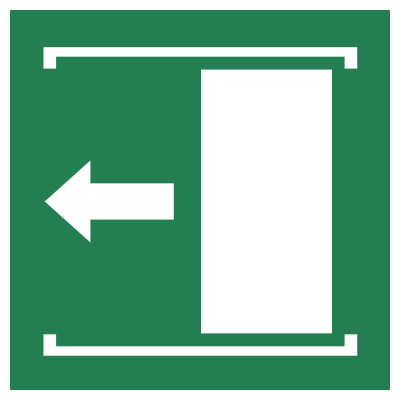
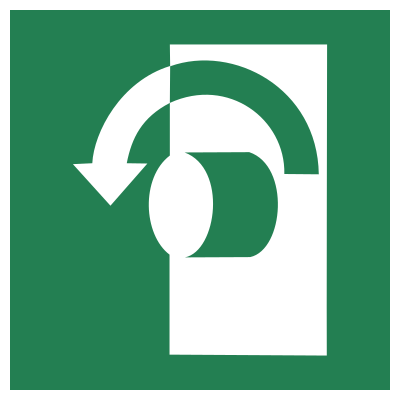
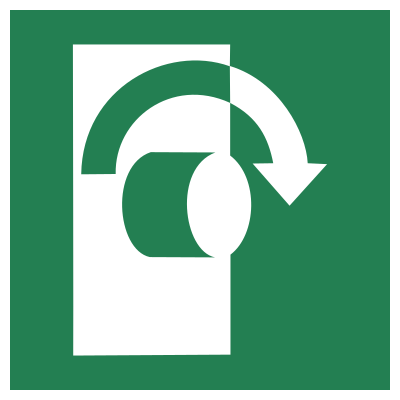
Door opens by pushing on the left-hand side
Indicates that the door opens by pushing on its left-hand side.

Understanding this sign
Green square or rectangular signs identify emergency escape routes, safety facilities, and rescue equipment.
Follow the complete wayfinding system and local emergency plan. A symbol alone does not establish a safe route.
Push Here, On the Left
E022 tells the person facing a door two things at once: this door opens away from you, and the moving edge is on your left. The hinges sit on the right as you stand before it, so force applied at the left-hand edge swings the leaf open with the least effort. It is one of the ISO 7010 door-operation signs, drawn in white on green because it delivers escape-route information rather than a warning or a rule.
The sign lives on the door leaf itself, at the point where the hand should land. That placement is deliberate: unlike an exit sign overhead, E022 is read in the final second before contact, when a person committed to the doorway needs to know where to push without breaking stride. On a flush fire door or a fully glazed leaf with no visible hardware, it may be the only cue the door offers.
Push Doors Are the Egress Default
Building and fire codes broadly converge on one principle: doors serving substantial occupant loads or high-hazard areas should swing in the direction people flee, which for the escaping crowd means a push. The reasoning is grim and well documented — a crowd pressing against a door that must be pulled toward them cannot back up to let it open. A push-operated escape door is therefore the compliant norm, and E022 or its right-hand twin E023 completes it by resolving the last ambiguity: which edge moves.
That ambiguity is real. Symmetrical double doors, unfamiliar buildings, darkness, and smoke all conspire to make people shove the hinge side, where the same effort produces almost no movement and reads as a locked door. Panic hardware mitigates this by spanning the leaf, but plenty of escape-route doors have no crash bar, and visitors, contractors, and the public cannot be assumed to know any particular door's handing.
Specifying and Positioning E022
Survey each door from the side people escape from — handing is always judged from the approach direction, and the identical leaf viewed from the other face would take the opposite sign. Fit E022 on the leaf near the left edge at roughly hand-to-eye height; where a push bar or push plate exists, the sign should agree with and sit close to that hardware rather than contradicting it from across the door.
Double-leaf openings deserve particular care: if both leaves are active, each carries its own sign matched to its own edge, and if one leaf is normally bolted, signing it as pushable invites a pile-up against a fixed panel. Photoluminescent versions keep the instruction legible in smoke and power loss, and a periodic check should confirm re-hung or reversed doors still match the sign — refurbishments flip door handing more often than anyone audits.
Where you will see E022
It is fitted on the door leaf itself, near the left edge at roughly hand-to-eye height, where a person committed to the doorway reads it in the final second before contact — especially valuable on flush fire doors and fully glazed leaves with no visible hardware. Escape-route doors, symmetrical double-leaf openings where each active leaf needs its own sign, and buildings full of unfamiliar visitors and contractors are its natural placements.
Common questions about E022
What does the ISO E022 sign mean?
It means the door in front of you opens by being pushed, and the side that swings away is the left-hand side as you face it. Apply your push near the left edge — the hinges are on the right — and the door opens in your direction of travel.
Where should a push-to-open sign be placed on the door?
On the door leaf itself, close to the left-hand edge where the push should be applied, at a height where an approaching person's eyes and hand naturally fall. Placing it centrally or on the frame weakens the message, because half its content is showing which edge of the leaf actually moves.
Why do exit doors have to open outward?
Codes such as the International Building Code and NFPA 101 generally require doors to swing in the direction of egress travel once occupant loads are significant or the area is high-hazard, because a crowd pressing forward physically cannot pull a door open against itself. Push operation is the safe geometry for evacuation, and signs like E022 make that operation explicit.
When do I use E022 rather than E023?
Stand on the escape side of the door and look at it. If the opening edge is on your left and the hinges on your right, use E022; if the mirror is true, use E023. Judge every door from its approach side and re-check after any work that could reverse the hanging.
Reference details
| Symbol code | E022 |
|---|---|
| Sign family | ISO Emergency Signs |
| Standard reference | ISO 7010:2019 / ISO 3864-1 ISO Online Browsing Platform: E022 |
| Screen color reference | #009933. Screen colors are not a production color specification. |
| Download formats | SVG reference artwork; a 1024 × 1024 pixel PNG conversion on a white canvas. |
| Record date | · How to interpret our dates |
| Page updated |
Choosing a physical sign size
Download dimensions are not installation dimensions. Select sign size, material, placement, and lighting using the applicable standard and the actual viewing conditions. Chemical label sizing follows its own rules. Read the artwork and sizing guide.
Sources and artwork credits
- Artwork source
- Wikimedia Commons file page
- Creator credited by source
- Clemenspool
- License
- CC0
- Source metadata checked
SVG files are local reference copies. PNG files are raster conversions. Check the linked file history and license terms before reuse; a source-metadata check is not certification of the artwork or a workplace installation.
Report a correction to this reference