First Aid
Identifies first-aid facilities or equipment.

Understanding this sign
Green square or rectangular signs identify emergency escape routes, safety facilities, and rescue equipment.
Follow the complete wayfinding system and local emergency plan. A symbol alone does not establish a safe route.
A White Cross on Green: What E003 Marks
E003 identifies the location of first aid provision: a first aid kit or cabinet, a treatment room, or the station where trained first aiders can be found. The pictogram is a plain white cross centered on a green square, using the same safe-condition green that ISO 3864-1 assigns to emergency exits, eyewash stations, and every other sign pointing toward help rather than away from harm. Its job is speed — cutting the time between an injury and the person or equipment that can treat it.
The cross is deliberately white on green, not red on white. The red cross emblem is protected under the Geneva Conventions and national implementing laws as a marker of medical services in armed conflict, and its commercial or workplace use is restricted in most countries. Standardized safety signage therefore adopted the green-and-white cross for first aid, and suppliers still occasionally selling red-cross first aid signage are trading in a legally problematic design as well as a nonstandard one.
Where Regulations Sit
In the United States, OSHA's medical services rule (29 CFR 1910.151) requires adequate first aid supplies to be readily available, and personnel trained to render first aid where no infirmary, clinic, or hospital is in near proximity to the workplace. The rule does not prescribe a sign, but supplies that employees cannot find are not readily available in any meaningful sense, so marking kit locations with E003 is the standard way facilities demonstrate the requirement is met. Kit contents are commonly specified by reference to ANSI/ISEA Z308.1, which defines Class A and Class B assortments.
In the EU, Directive 92/58/EEC requires green-and-white signage for first aid facilities, making E003 the conforming implementation, and UK employers under the Health and Safety (First-Aid) Regulations 1981 are expected to make first aid arrangements known to employees, with signage the accepted mechanism. Whatever the jurisdiction, the practical test an inspector applies is the same: can a worker who has never needed first aid before locate it quickly from anywhere in their work area?
Placement and Wayfinding
Mount E003 directly at each first aid point — above the cabinet, on the treatment room door, at the nurse station — high enough to be seen over intervening people and equipment. In large facilities the sign also works as wayfinding: combined with supplementary arrows, it guides someone escorting a bleeding colleague through a plant they may not know well. Density should follow risk, with workshops, kitchens, laboratories, and loading areas signed more generously than low-hazard offices.
Two placement details are frequently missed. First, the sign should survive the situation it serves: a panicked person with an injured hand and chemical on their sleeve will not read small text, so the symbol needs to dominate and text panels naming the nearest first aider or extension number should be secondary. Second, keep the signed location honest. A green cross over an empty bracket, or over a cabinet whose kit migrated to a supervisor's office, is worse than no sign, because it burns response time exactly when it matters.
E003 Within the Green Sign Family
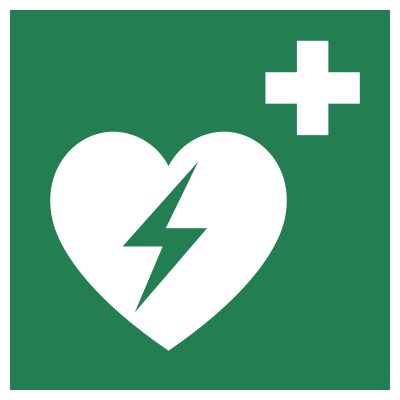
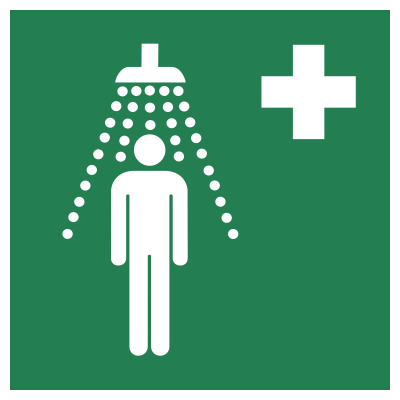
E003 is the general-purpose medical marker; ISO 7010 assigns dedicated signs to specific emergency equipment. An automated external defibrillator gets E010, an eyewash station E011, a safety shower E012, an emergency telephone E004, and a stretcher E013. Using E003 alone over an AED cabinet or eyewash unit is a downgrade in information, since a responder scanning for a defibrillator is looking for the heart symbol specifically. The general cross belongs where the provision is genuinely general: kits, rooms, and trained people.
Composite first aid points are common in industrial buildings — a wall bay holding a kit, an eyewash bottle rack, a defibrillator, and an incident report station. The clean approach is a large E003 identifying the point as a whole, with the specific pictograms marking each item within it. That layering matches how people search under stress: green tells them help is here, and the individual symbols tell them which piece of help is which.
Where you will see E003
Mounted at first aid cabinets, medical rooms, eyewash clusters with supporting medical supplies, nurse stations, incident response points, training centers, and large facilities where personnel need fast direction to treatment resources.
Common questions about E003
Why is the first aid sign green instead of red?
In the ISO 3864-1 color system, green means safe condition and is used on every sign that points toward help — exits, first aid, emergency equipment — while red is reserved for prohibition and fire equipment signs. Additionally, the red cross emblem is legally protected under the Geneva Conventions, so workplace first aid signage uses a white cross on green instead.
Does OSHA require first aid signs?
OSHA 1910.151 requires adequate first aid supplies to be readily available and trained personnel where no clinic or hospital is nearby, but it does not name a specific sign. Marking kit and station locations with the green cross is the accepted way to make supplies genuinely findable, and inspectors treat unmarked, unfindable kits as a readiness failure.
What is the difference between the first aid sign and the AED sign?
E003, the white cross, marks general first aid provision such as kits, treatment rooms, and trained first aiders. E010 marks an automated external defibrillator specifically, using a heart symbol with an electrical flash. Where both exist at one location, display both signs so a responder searching for a defibrillator recognizes it instantly.
Where should first aid signs be placed in a workplace?
At every first aid kit, cabinet, and treatment room, mounted high enough to be visible across the work area, plus directional versions with arrows in large or complex buildings. Concentrate coverage where injuries are likely — workshops, kitchens, labs, loading docks — and keep signage synchronized with where the kits actually are after any reorganization.
Reference details
| Symbol code | E003 |
|---|---|
| Sign family | ISO Emergency Signs |
| Standard reference | ISO 7010:2019 / ISO 3864-1 ISO Online Browsing Platform: E003 |
| Screen color reference | #009933. Screen colors are not a production color specification. |
| Download formats | SVG reference artwork; a 1024 × 1024 pixel PNG conversion on a white canvas. |
| Record date | · How to interpret our dates |
| Page updated |
Choosing a physical sign size
Download dimensions are not installation dimensions. Select sign size, material, placement, and lighting using the applicable standard and the actual viewing conditions. Chemical label sizing follows its own rules. Read the artwork and sizing guide.
Sources and artwork credits
- Artwork source
- Wikimedia Commons file page
- Creator credited by source
- This vector image was created with Inkscape by MaxxL , and then manually edited by AnonMoos . The SVG code is valid . This icon was created with a text editor . Previous version had been created with Inkscape (1019 bytes) i now 19.53% of previous size Please do not replace the simplified code of this file with a version created with Inkscape or any other graphical vector graphics editor
- License
- Public domain
- Source metadata checked
SVG files are local reference copies. PNG files are raster conversions. Check the linked file history and license terms before reuse; a source-metadata check is not certification of the artwork or a workplace installation.
Report a correction to this reference