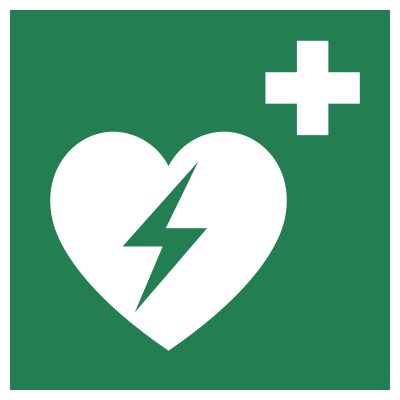
Doctor
Identifies the location of a doctor.

Understanding this sign
Green square or rectangular signs identify emergency escape routes, safety facilities, and rescue equipment.
Follow the complete wayfinding system and local emergency plan. A symbol alone does not establish a safe route.
What the Doctor Sign Promises
E009 combines the white cross with a human figure and marks the place where a doctor is available for emergencies. That is a materially stronger claim than the plain cross of E003: a first aid cabinet promises supplies, E003 with a trained colleague promises basic intervention, but E009 announces physician-level care — someone who can diagnose, administer prescription medicines, suture, and make clinical decisions about evacuation. The distinction changes behavior in an emergency, because a responder deciding where to carry a casualty will bypass a kit for a clinic if the sign tells them one exists.
For exactly that reason, honesty is the governing rule for this sign. It belongs on occupational health centers, staffed medical rooms, ship hospitals, and event medical posts where a physician or equivalent clinician genuinely attends. Posting it on a room that holds only a kit, or where the doctor visits one afternoon a week, misdirects casualties during the hours that matter. Where cover is part-time, supplementary text stating attendance hours keeps the sign truthful.
Workplaces That Use E009
Staffed medical facilities cluster where workforces are large, hazards are serious, or hospitals are far away. Refineries, steelworks, and major manufacturing campuses often operate an occupational health unit; mines and offshore installations station medics or doctors because external help is hours distant; passenger ships carry medical staff for the same reason; and large construction projects, airports, and stadium events set up physician-led medical posts. On all of these sites, E009 on the door and on directional signage lets any worker or visitor route a casualty correctly without knowing the site.
In the United States, the general principle behind such provision appears in OSHA's medical services requirements: where there is no infirmary, clinic, or hospital in near proximity, the employer must ensure personnel are trained to render first aid and that supplies are readily available. Larger or remote operations frequently exceed that baseline with an on-site clinician, and once they do, marking the clinic clearly becomes part of making the provision usable rather than merely existent.
Choosing Between the Medical Signs
The green medical family scales with the level of care. Use E003 for kits, cabinets, and general first aid points; E064 to identify individual trained first aiders; E009 for the room or station where a doctor can be found; and dedicated pictograms such as E010 for a defibrillator or E013 for a stretcher on the specific equipment. A site medical center commonly carries E009 at the entrance with the equipment signs distributed inside, so escalation paths stay legible under stress.
Directional use deserves attention on big sites. A doctor is only findable if corridors and roadways carry E009 with arrows from the main circulation routes, gatehouse, and high-risk areas. Emergency response plans should reference the signed route explicitly — the instruction take the casualty to the medical center works only when the signage makes that sentence executable by someone on their first day.
Where you will see E009
Refineries, steelworks, and major manufacturing campuses operating occupational health units post it on the clinic door and on directional signage from main routes, gatehouses, and high-risk areas. Mines and offshore installations station clinicians because external help is hours away, passenger ships mark their medical facilities the same way, and large construction projects, airports, and stadium events use it on physician-led medical posts, adding attendance hours where cover is part-time.
Common questions about E009
What is the difference between the E009 doctor sign and the E003 first aid sign?
E003 marks general first aid provision — kits, cabinets, and treatment points staffed by trained lay responders. E009 specifically indicates where a doctor is available for emergencies, meaning physician-level assessment and treatment. Use E009 only where a clinician genuinely attends; otherwise E003 is the correct and honest sign.
Does displaying the doctor sign mean a doctor is present at all times?
It should mean a doctor is available whenever the area it serves is occupied. If medical cover is limited to certain shifts or days, add supplementary text stating the attendance hours and make clear where help comes from outside them. A sign that overstates availability sends casualties to a locked door.
Which workplaces typically have an on-site doctor?
Sites that combine serious hazards with distance from external care: mines, offshore platforms, refineries, large industrial campuses, major construction projects, ships, and big public events. Many jurisdictions require employers far from a clinic or hospital to arrange first aid capability, and remote or high-risk operations often meet that duty with an on-site medic or physician.
Can E009 be used for a nurse or paramedic station instead of a doctor?
The ISO referent is a doctor, but in practice many facilities apply it to their staffed medical room regardless of whether the clinician is a physician, nurse, or offshore medic. The safer approach is to pair the pictogram with text naming the actual provision, such as occupational health or site medic, so expectations match reality.
Reference details
| Symbol code | E009 |
|---|---|
| Sign family | ISO Emergency Signs |
| Standard reference | ISO 7010:2019 / ISO 3864-1 ISO Online Browsing Platform: E009 |
| Screen color reference | #009933. Screen colors are not a production color specification. |
| Download formats | SVG reference artwork; a 1024 × 1024 pixel PNG conversion on a white canvas. |
| Record date | · How to interpret our dates |
| Page updated |
Choosing a physical sign size
Download dimensions are not installation dimensions. Select sign size, material, placement, and lighting using the applicable standard and the actual viewing conditions. Chemical label sizing follows its own rules. Read the artwork and sizing guide.
Sources and artwork credits
- Artwork source
- Wikimedia Commons file page
- Creator credited by source
- MaxxL
- License
- Public domain
- Source metadata checked
SVG files are local reference copies. PNG files are raster conversions. Check the linked file history and license terms before reuse; a source-metadata check is not certification of the artwork or a workplace installation.
Report a correction to this reference