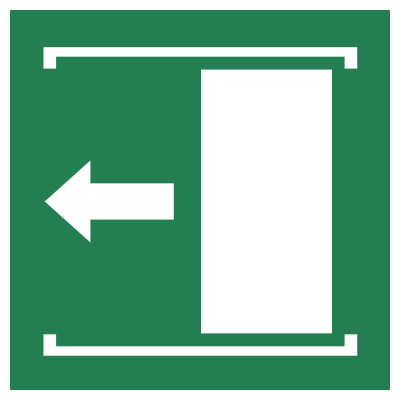
Door slides right to open
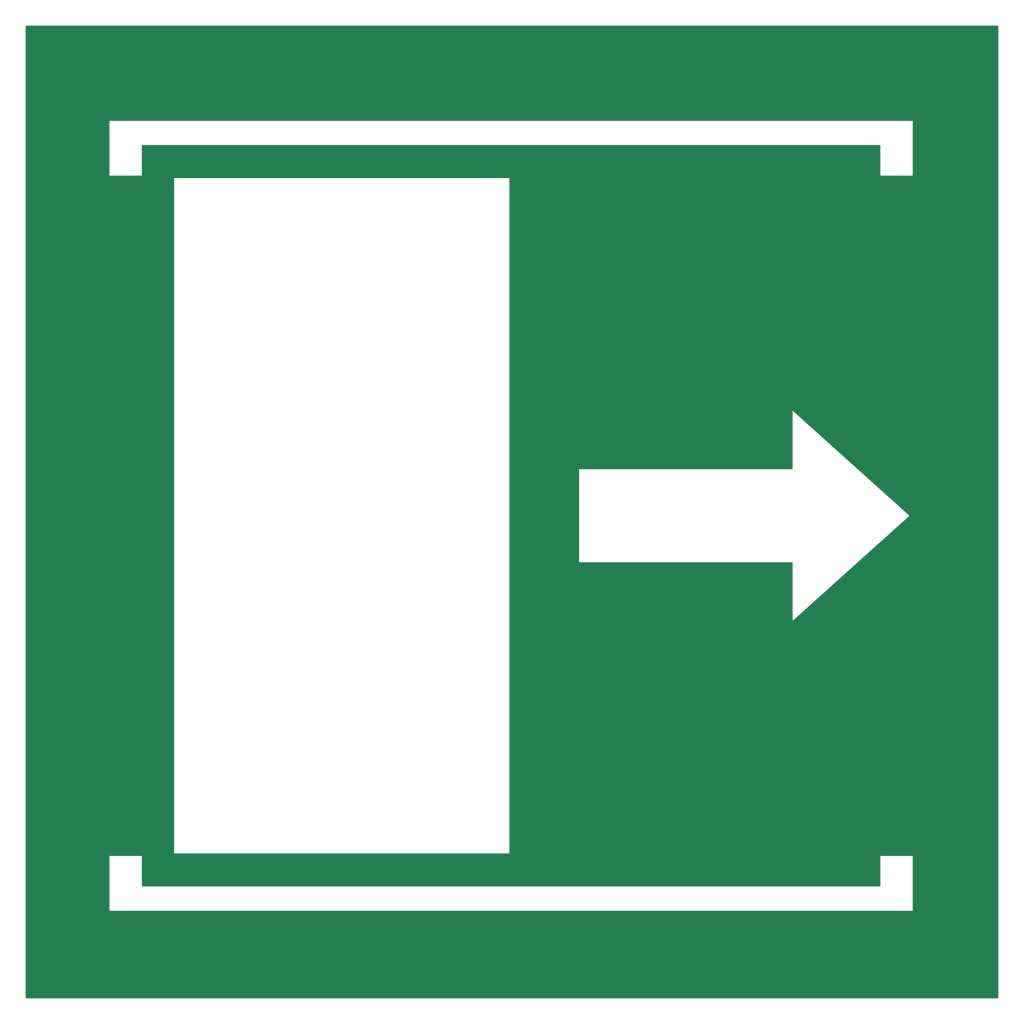
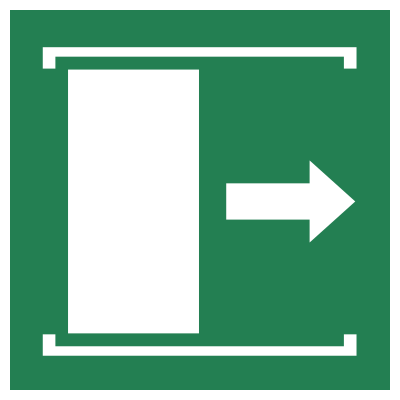
Indicates that the door slides to the right to open.
Understanding this sign
Green square or rectangular signs identify emergency escape routes, safety facilities, and rescue equipment.
Follow the complete wayfinding system and local emergency plan. A symbol alone does not establish a safe route.
A Sliding Door, and Which Way It Travels
E033 covers a case the hinged-door signs cannot: a door that opens by translating sideways along a track, moving to the right as the user faces it. The white-on-green pictogram shows the leaf and an arrow giving its direction of travel, and ISO 7010 assigns the sign the function of indicating which way a sliding door opens. Its mirror twin for leftward travel is E034.
Sliding doors defeat intuition twice over. First, nothing about a closed sliding leaf announces that it slides — people push it, then hunt for hinges that do not exist. Second, even a user who recognizes the type has a coin-flip guess on direction, and shoving a sliding panel against its stop feels identical to shoving a locked door. E033 answers both questions in one symbol at the moment of contact.
Where Rightward-Sliding Doors Meet Escape Routes
Mainstream egress design prefers side-hinged swinging doors, and codes generally restrict sliding types on required escape routes to specific permitted cases. The sliding doors that legitimately carry E033 cluster in particular environments: machinery enclosures and large test cells where a swinging leaf would sweep a work zone, cold stores and cleanrooms, agricultural and warehouse buildings with hung sliding gates, and the transport world — train and tram doors, ship and offshore accommodation doors, and vehicle cargo compartments where staff may need to exit through a slid-open panel.
In several of these settings the door is operated rarely and by people who did not install it. A maintenance fitter inside a machine enclosure at shutdown, or a driver unfamiliar with a particular trailer, meets the door cold. Marking the travel direction on the leaf, at the handle or grab rail, is a cheap control against the seconds lost dragging a heavy panel the wrong way.
Fitting E033 So It Works
Handing is judged from the side the escaping person occupies, and a sliding leaf reverses apparent direction depending on which face you view: the panel that travels right from inside travels left as seen from outside. Each face that serves as an escape approach therefore needs its own assessment, and possibly the opposite sign. Place E033 on the leaf beside the handle so the arrow and the pulling hand share one sightline.
Sliding hardware fails differently from hinges — tracks collect debris and ice, rollers seize, and a door parked half-open for months can corrode in place — so escape-route sliding doors deserve an operational test at realistic effort, not just a visual check. Where the door is power-operated, confirm and mark the manual release, since the sign's promise that the door slides right must hold with the power off.
Where you will see E033
Machinery enclosures and large test cells where a swinging leaf would sweep a work zone, cold stores, cleanrooms, and agricultural or warehouse buildings with hung sliding gates all use it, fixed on the leaf beside the handle. Transport applications include train and tram doors, ship and offshore accommodation doors, and vehicle cargo compartments staff may need to exit through.
Common questions about E033
What does the E033 sign on a door mean?
It tells you the door is a sliding type and opens by moving the leaf to the right as you face it. Grip the handle and slide rightward rather than pushing or pulling. It is an ISO 7010 escape-route information sign, white on green.
Are sliding doors allowed on emergency exit routes?
Only in limited situations. Most building codes make side-hinged swinging doors the default for required egress and permit sliding doors as exceptions — for example certain special-purpose horizontal sliding assemblies, small-occupancy situations, or industrial and transport applications outside ordinary building rules. Where a compliant sliding door does serve an escape path, its travel direction should be marked with E033 or E034.
Which sign do I need if the door slides right from one side but left from the other?
That is every sliding door — the direction of travel flips with your viewpoint. Assess each face separately from where an escaping person would stand: the face where the leaf moves rightward takes E033, and the opposite face, if it also serves an escape approach, takes E034.
Why sign the direction of a sliding door at all?
Because a sliding leaf pushed against its end stop feels exactly like a locked door, and under evacuation stress people abandon doors that resist them. The arrow converts a two-way guess into one correct movement, which matters most for heavy manual doors and for users meeting the door for the first time in smoke or darkness.
Reference details
| Symbol code | E033 |
|---|---|
| Sign family | ISO Emergency Signs |
| Standard reference | ISO 7010:2019 / ISO 3864-1 ISO Online Browsing Platform: E033 |
| Screen color reference | #009933. Screen colors are not a production color specification. |
| Download formats | SVG reference artwork; a 1024 × 1024 pixel PNG conversion on a white canvas. |
| Record date | · How to interpret our dates |
| Page updated |
Choosing a physical sign size
Download dimensions are not installation dimensions. Select sign size, material, placement, and lighting using the applicable standard and the actual viewing conditions. Chemical label sizing follows its own rules. Read the artwork and sizing guide.
Sources and artwork credits
- Artwork source
- Wikimedia Commons file page
- Creator credited by source
- Clemenspool
- License
- CC0
- Source metadata checked
SVG files are local reference copies. PNG files are raster conversions. Check the linked file history and license terms before reuse; a source-metadata check is not certification of the artwork or a workplace installation.
Report a correction to this reference