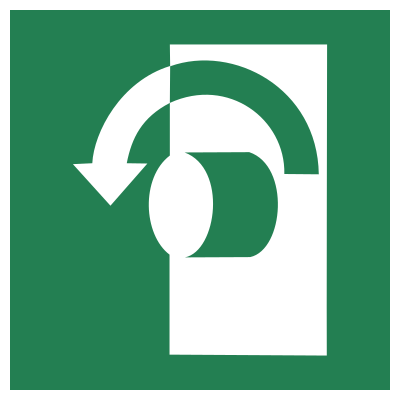
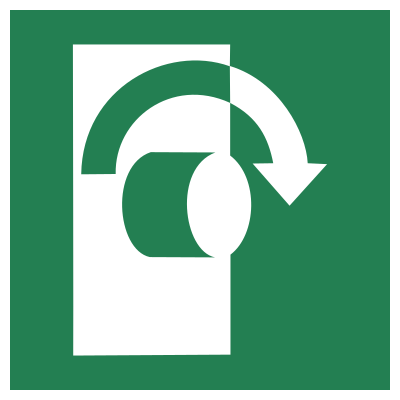
Door opens by pulling on the right-hand side
Indicates that the door opens by pulling on its right-hand side.

Understanding this sign
Green square or rectangular signs identify emergency escape routes, safety facilities, and rescue equipment.
Follow the complete wayfinding system and local emergency plan. A symbol alone does not establish a safe route.
Grip Right, Draw Back
E058 describes one specific door geometry: hinged along its left side as you face it, opening toward you when drawn back at the right-hand edge. It closes out the quartet of ISO 7010 hinged-door operation signs — two push variants, two pull variants — each committing to a side because the useful instruction is not merely pull but pull here. As escape-route information it takes the standard white pictogram on green.
The value of pre-announcing a pull lies in body mechanics as much as comprehension. Opening a door toward yourself requires stepping back to make room for the swing, something a person can do smoothly if warned during the approach and awkwardly if surprised at the threshold with others arriving behind. Reading E058 a few paces out lets the first user position themselves, clear the arc, and keep the doorway throughput up.
The Case Against Pull Doors, and Its Exceptions
Crowd disasters at inward-opening doors are the reason modern codes push high-occupancy egress doors outward: a mass of people compressed against a leaf that must swing back through them cannot retreat to free it. That history makes the pull-operated escape door a carefully rationed exception — acceptable for lightly occupied rooms and for doors whose outward swing would itself endanger a corridor or stairway — rather than a free design choice.
Where the exception applies, the residual risk is an individual one: a single occupant losing seconds pushing, rattling, and concluding the door is locked. E058 addresses precisely that failure. It is also worth pairing the sign with hardware that reinforces the message, since a lever handle or pull bar at the right-hand edge and a sign beside it deliver one coherent instruction, while push-style furniture on a pull door actively sabotages it.
Selection, Siting, and Ongoing Truthfulness
Confirm the handing at the door, standing on the side from which it is pulled: moving edge to the right selects E058, to the left E057, and a mistake at this step instructs users to grab the hinge line. Site the sign on the leaf adjacent to the handle so instruction and grip point read as one unit, sized and lit for the worst visibility the route can plausibly offer — photoluminescent material where emergency lighting is thin.
Treat the sign as a claim the building must keep true. Door replacements, re-hangs, and the fitting of self-closers or access-control hardware can all change how a door operates, and a legacy pull sign on a converted powered door misleads at the worst moment. Fold a does-the-sign-match-the-door check into routine fire-door inspections, and keep the pull-side swing zone free of furniture and deliveries so the promised operation remains physically possible.
Where you will see E058
Buildings fit it on the leaf beside the handle of pull-operated escape doors — the rationed exception codes allow for lightly occupied rooms and doors whose outward swing would endanger a corridor or stairway. Pairing it with a lever handle or pull bar at the right-hand edge delivers one coherent instruction, with photoluminescent material where emergency lighting is thin and a handing re-check after door replacements, re-hangs, or new hardware.
Common questions about E058
What does the ISO E058 sign tell me to do?
Open the door by pulling it toward you, gripping at the right-hand edge; the hinge side is on your left. Fitted on the door leaf, this ISO 7010 sign gives you the correct action before your hand reaches the handle.
Why do some emergency route doors open toward you instead of away?
Usually because the outward swing would cause a different hazard, such as sweeping into a busy corridor or blocking a stair, or because the room served holds too few people for crowd pressure to be a concern. Codes accept pull-side operation in those cases, and marking the door with E058 or E057 compensates for the unintuitive action.
How do I choose between E058 and E057 for a door?
Stand on the pull side and note which vertical edge swings free: right-hand edge means E058, left-hand edge means E057. The determination is per door and per face, so check physically on site and re-check whenever the door is re-hung, replaced, or has its hardware changed.
Where on the door should the pull sign go?
On the leaf itself, next to the handle at the right-hand edge, at a height visible throughout the approach. Keeping instruction, grip point, and moving edge grouped in one place lets the user read the operation and execute it in a single motion, which is the entire point of door-operation marking.
Reference details
| Symbol code | E058 |
|---|---|
| Sign family | ISO Emergency Signs |
| Standard reference | ISO 7010:2019 / ISO 3864-1 ISO Online Browsing Platform: E058 |
| Screen color reference | #009933. Screen colors are not a production color specification. |
| Download formats | SVG reference artwork; a 1024 × 1024 pixel PNG conversion on a white canvas. |
| Record date | · How to interpret our dates |
| Page updated |
Choosing a physical sign size
Download dimensions are not installation dimensions. Select sign size, material, placement, and lighting using the applicable standard and the actual viewing conditions. Chemical label sizing follows its own rules. Read the artwork and sizing guide.
Sources and artwork credits
- Artwork source
- Wikimedia Commons file page
- Creator credited by source
- Clemenspool
- License
- CC0
- Source metadata checked
SVG files are local reference copies. PNG files are raster conversions. Check the linked file history and license terms before reuse; a source-metadata check is not certification of the artwork or a workplace installation.
Report a correction to this reference