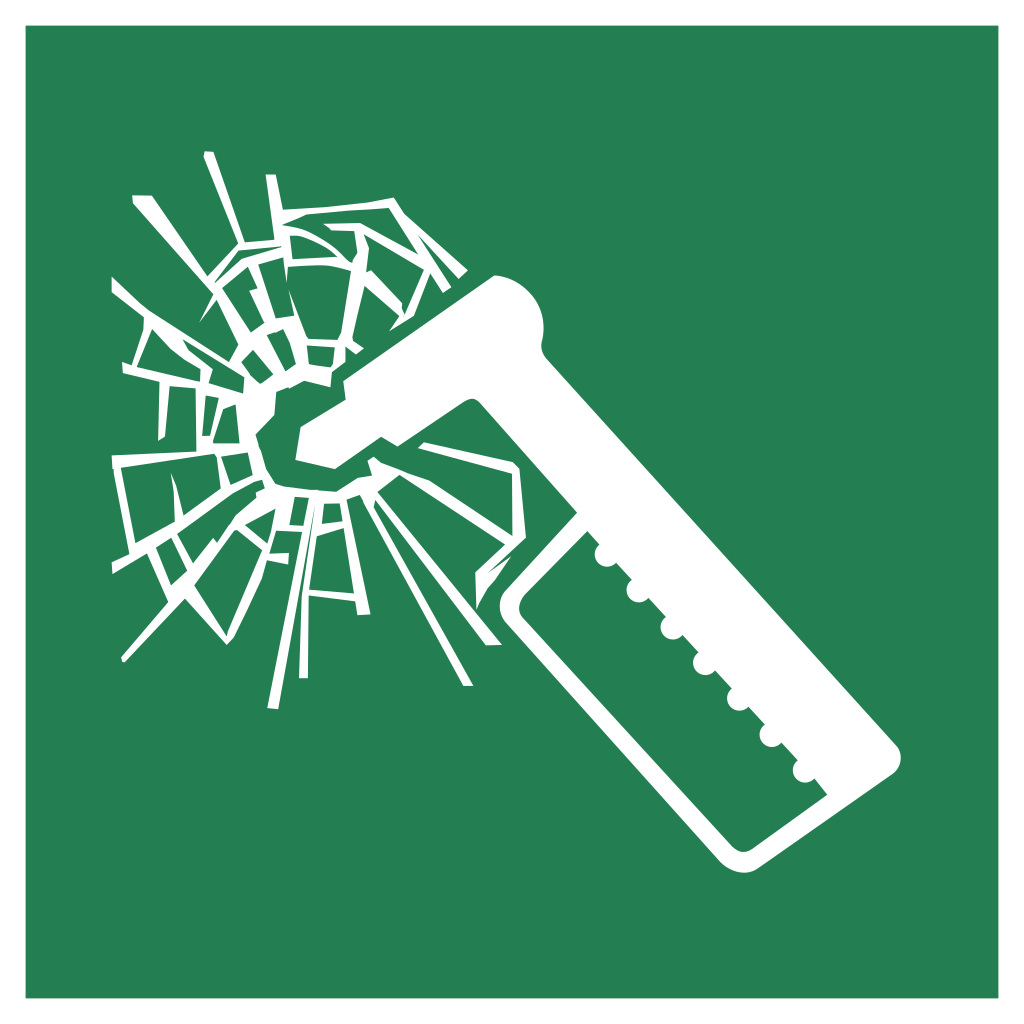
Emergency hammer
Identifies an emergency hammer.
Understanding this sign
Green square or rectangular signs identify emergency escape routes, safety facilities, and rescue equipment.
Follow the complete wayfinding system and local emergency plan. A symbol alone does not establish a safe route.
Locating the Glass-Breaking Tool
E025 marks where an emergency hammer is kept. The pictogram — a hammer in white on the green emergency-equipment field — is most familiar from public transport: buses, coaches, trains, trams, and ferries carry these small pointed hammers so that occupants can break out through window glass when doors are jammed, submerged, or blocked by fire or collision damage. The sign also appears in cable cars, lifts in some installations, and vehicles operating in flood-prone or remote areas.
Because the hammer is small and mounted among grab rails, luggage racks, and advertising panels, the sign carries most of the findability burden. A passenger who has never looked at the interior of the vehicle until the emergency begins must be able to spot the storage clip from their seat, in poor light, possibly with the vehicle on its side. Every hammer position gets its own E025, adjacent to the clip rather than somewhere on the same wall.
How an Emergency Hammer Defeats a Window
Vehicle side windows are typically tempered glass, engineered to hold enormous distributed loads yet shatter into granular fragments when a hard point concentrates force on a small area. The hammer's hardened conical tip supplies exactly that concentration; a modest swing succeeds where kicking or shoulder charges fail. Standard guidance is to strike near a corner of the pane, where the glass is stiffest and least able to flex away from the blow, then clear the crumbs from the frame before climbing through.
Windshields are a different problem: they are laminated, with a plastic interlayer that holds the cracked glass together, so a hammer star-cracks them without producing an opening. The same caveat increasingly applies to side glazing, as some modern vehicles fit laminated side windows for acoustic and anti-ejection reasons. Operators should designate and mark break-out windows that are actually breakable, and match the hammer positions to those panes. Many emergency hammers also integrate a seat-belt cutter, covering the two actions a trapped occupant must perform in sequence.
Mounting, Theft, and Inspection
The chronic operational problem with emergency hammers is that they disappear. Transit operators respond with tethers, alarmed holders that sound when the hammer leaves its clip, breakable-seal cabinets, and simply carrying spares, accepting some loss as the cost of keeping stations stocked. Whatever the anti-theft approach, it must not defeat the purpose — a hammer secured so well that a panicking passenger cannot free it one-handed has already failed.
Inspection rounds should confirm each signed position actually holds a hammer, that tethers reach the designated windows, and that the E025 sign itself survives interior refits and re-branding wraps, which routinely cover or remove safety signage. Pairing the hammer sign with marking on the break-out windows themselves closes the loop: the passenger finds the tool at one green sign and the correct pane at the next.
E025 Alongside Related Emergency Signs
ISO 7010 separates the tool from the action. E025 locates the hammer; E008, break to obtain access, marks a panel or enclosure that must itself be broken to reach an escape route or emergency device behind it. On a coach, the hammer clip carries E025 while the designated windows may carry text or markings identifying them as emergency exits; in a building, E008 might mark a glass panel over an escape key with no hammer involved at all.
The distinction keeps instructions honest under stress. A green sign bearing a hammer means pick this up and carry it to the glass; a break-to-access sign means the breaking happens here. Vehicles and vessels that mix the two — hammers in one place, frangible covers elsewhere — rely on the pictograms staying distinct, which is a reason not to improvise hybrid or home-made versions of either sign.
Where you will see E025
Buses, coaches, trains, trams, and ferries mount it at each hammer position among grab rails and luggage racks so a passenger can spot the storage clip from their seat in poor light. It also appears in cable cars, some lift installations, and vehicles operating in flood-prone or remote areas, ideally paired with markings on the designated break-out windows themselves.
Common questions about E025
What does the emergency hammer sign mean?
It marks the storage point of an emergency hammer, a pointed tool for shattering tempered glass windows so occupants can escape when normal exits are unusable. It is ISO 7010 sign E025, shown in white on green, and is most common in buses, coaches, trains, and other passenger transport.
Where do you hit a window with an emergency hammer?
Strike close to a corner of the pane with the pointed tip, not the middle. Tempered glass resists blows at the center where it can flex, but a sharp point near a corner concentrates the force and shatters the whole pane into small granules. Clear the remaining fragments from the frame edge before climbing out.
Why can't you break a windshield with an emergency hammer?
Windshields are laminated: two glass layers bonded to a plastic interlayer that holds the sheet together even when cracked, so a hammer produces a star crack rather than an opening. Emergency hammers are intended for tempered side windows, which is why operators mark specific designated break-out panes. Note that some newer vehicles use laminated side glass too, so follow the marked windows.
What is the difference between E025 and E008?
E025 shows where the hammer is kept — you take the tool to a window. E008, break to obtain access, marks the thing you break, such as a frangible panel in front of an escape route or emergency equipment. One locates a tool, the other designates a breakable barrier.
Reference details
| Symbol code | E025 |
|---|---|
| Sign family | ISO Emergency Signs |
| Standard reference | ISO 7010:2019 / ISO 3864-1 ISO Online Browsing Platform: E025 |
| Screen color reference | #009933. Screen colors are not a production color specification. |
| Download formats | SVG reference artwork; a 1024 × 1024 pixel PNG conversion on a white canvas. |
| Record date | · How to interpret our dates |
| Page updated |
Choosing a physical sign size
Download dimensions are not installation dimensions. Select sign size, material, placement, and lighting using the applicable standard and the actual viewing conditions. Chemical label sizing follows its own rules. Read the artwork and sizing guide.
Sources and artwork credits
- Artwork source
- Wikimedia Commons file page
- Creator credited by source
- Clemenspool
- License
- CC0
- Source metadata checked
SVG files are local reference copies. PNG files are raster conversions. Check the linked file history and license terms before reuse; a source-metadata check is not certification of the artwork or a workplace installation.
Report a correction to this reference