Line-throwing appliance
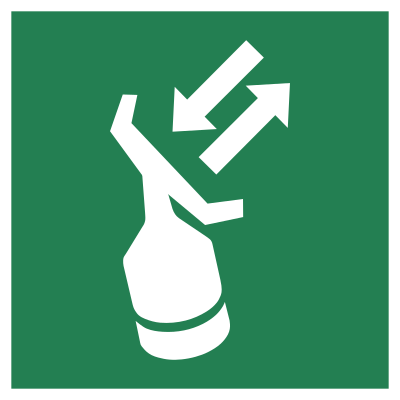
Identifies a line-throwing appliance.

Understanding this sign
Green square or rectangular signs identify emergency escape routes, safety facilities, and rescue equipment.
Follow the complete wayfinding system and local emergency plan. A symbol alone does not establish a safe route.
What ISO 7010 E050 Marks
E050 shows crew where the ship's line-throwing appliance is stowed. The device is a rocket (or in some designs a pneumatic launcher) that carries a light messenger line several hundred metres — the LSA Code performance standard calls for well over 200 metres of throw in favourable conditions — so that two ships, or a ship and the shore, can establish a physical line connection without a boat transfer.
The pictogram depicts the projectile in flight trailing its line, on the standard white-on-green safe-condition square of ISO 3864-1. It is one of the less familiar E-series maritime signs precisely because the equipment is used rarely; that rarity is the argument for marking its stowage unmistakably, since few crew members could point to it from memory.
Why Ships Carry a Line Thrower
The messenger line the rocket carries is deliberately thin — its job is to be the first link in a chain. Once caught, it hauls across a heavier line, and then whatever the operation needs: a towing hawser to take a disabled vessel under tow, a pump hose, or historically the block and tackle of a breeches buoy rig for evacuating people from a stranded ship to shore. Coastal rescue services used shore-based line-throwing gear for exactly that purpose for over a century.
SOLAS requires ships to carry a line-throwing appliance with multiple rockets and lines, reflecting the reality that a first shot across a rolling deck in strong wind often misses. Firing procedure matters too: aiming upwind of the target lets the wind blow the falling line down across it, and the printed instructions on the container assume the operator has never fired one before.
Signage Placement and Related Symbols
Mount E050 on the container or locker where the appliance is kept — commonly on or near the bridge or at a forward mooring station — and keep the sign with the equipment if stowage moves after a refit, since the ship's fire and safety plan must match reality. As with the rest of the survival-equipment set, IMO Resolution A.1116(30) points shipboard signage to the ISO 7010 symbols, and photoluminescent versions suit compartments without emergency lighting.
E050 sits alongside the distress and rescue cluster rather than the evacuation cluster: E047 (SART), E051 (portable VHF), and E052 (EPIRB) get help to the ship, E048 and E049 make the ship or craft visible, and the line thrower is unique in being the sign for equipment that physically connects rescuer and rescued. A signage audit should verify each of these against the vessel's approved equipment inventory.
Where you will see E050
The sign is mounted on the container or locker where the appliance is kept, commonly on or near the bridge or at a forward mooring station, and must move with the equipment after any refit so the fire and safety plan matches reality. SOLAS vessels carry it as part of the distress and rescue signage cluster alongside SART, portable VHF, and EPIRB markings, with photoluminescent versions suiting compartments without emergency lighting.
Common questions about E050
What is a line-throwing appliance on a ship?
A rocket-powered (or pneumatic) launcher that fires a thin messenger line well over 200 metres to another vessel or to shore. The light line is then used to haul across progressively heavier lines for towing, transferring equipment, or rigging a rescue system. SOLAS ships carry one with several rockets and lines because first shots frequently miss in bad weather.
Where is the E050 sign posted?
Directly on the stowage container or locker holding the appliance, which on most ships is on or near the navigation bridge or a mooring station. If the stowage is not visible from the working deck, an arrowed version of the sign along the approach helps crew who have never needed the device find it quickly.
How do you aim a line-throwing rocket in wind?
The standard technique is to fire upwind of the target so the wind carries the falling line down across the other vessel's deck, and to allow for the line's drag pulling the rocket's trajectory low. Manufacturers print firing instructions on the container, and drills should include at least a dry-run walkthrough because real use is rare and usually happens in poor conditions.
Reference details
| Symbol code | E050 |
|---|---|
| Sign family | ISO Emergency Signs |
| Standard reference | ISO 7010:2019 / ISO 3864-1 ISO Online Browsing Platform: E050 |
| Screen color reference | #009933. Screen colors are not a production color specification. |
| Download formats | SVG reference artwork; a 1024 × 1024 pixel PNG conversion on a white canvas. |
| Record date | · How to interpret our dates |
| Page updated |
Choosing a physical sign size
Download dimensions are not installation dimensions. Select sign size, material, placement, and lighting using the applicable standard and the actual viewing conditions. Chemical label sizing follows its own rules. Read the artwork and sizing guide.
Sources and artwork credits
- Artwork source
- Wikimedia Commons file page
- Creator credited by source
- Clemenspool
- License
- CC0
- Source metadata checked
SVG files are local reference copies. PNG files are raster conversions. Check the linked file history and license terms before reuse; a source-metadata check is not certification of the artwork or a workplace installation.
Report a correction to this reference