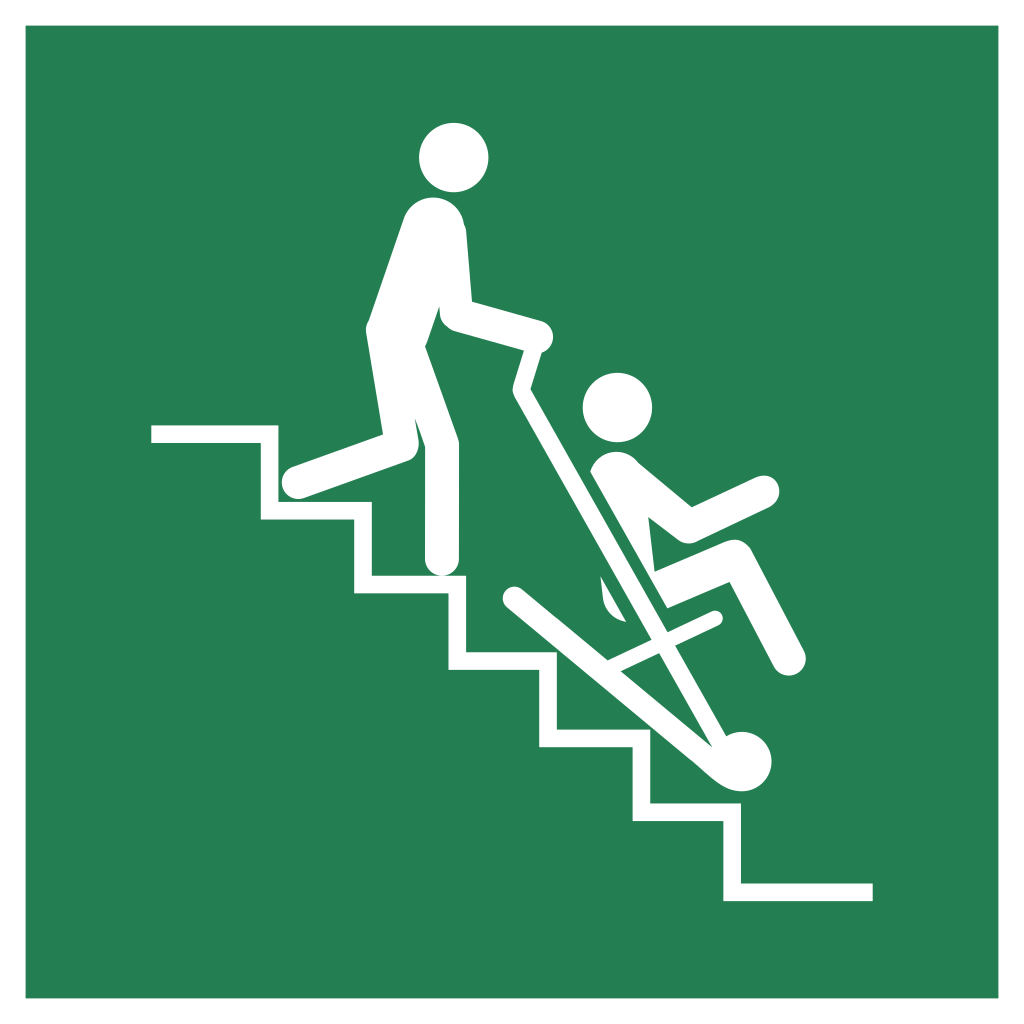
Evacuation chair
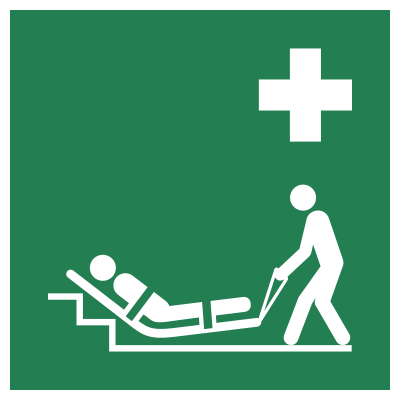
Identifies an evacuation chair.
Understanding this sign
Green square or rectangular signs identify emergency escape routes, safety facilities, and rescue equipment.
Follow the complete wayfinding system and local emergency plan. A symbol alone does not establish a safe route.
What the Evacuation Chair Sign Locates
E060 marks where an evacuation chair is stored. The device itself is a stair-descent chair: a lightweight seat on a braked track or wheel system that lets one or two operators bring a seated person down flights of stairs in a controlled glide, without lifting or carrying. It converts a stairway — the single biggest obstacle in accessible egress — into a route a person with a mobility impairment can complete with help.
Because the chair is useless if nobody can find it under stress, the sign matters as much as the bracket. E060 should sit directly above or beside the wall cabinet or mounting, visible along the corridor approach, so that a floor warden arriving at a refuge in smoke haze does not have to remember which alcove the chair lives in.
Where Chairs Are Positioned
Standard practice puts evacuation chairs at the head of each protected stairway on upper floors, and inside or immediately beside temporary refuges marked with E024, since the refuge is where the person needing the chair will be waiting. Multi-storey offices, hotels, hospitals, universities, and public venues typically repeat the position identically on every floor so staff who train on level three can perform on level seven.
The count of chairs follows the building's personal emergency evacuation plans, not a formula: each PEEP that relies on chair descent needs a chair reachable from that person's refuge, plus sensible provision for visitors. Keeping the device on its designated bracket — not borrowed for patient transport or events — is a discipline worth writing into the fire logbook.
Training Is the Hidden Dependency
An unstaffed evacuation chair is wall decoration. Manufacturers design the descent to be manageable, but the load transfer at the stair edge, speed control on long flights, and landings with turns all require practiced hands, and most suppliers offer operator courses for exactly this reason. Buildings should nominate and train enough operators to cover every shift, absence, and floor — a single trained hero on day shift is not a plan.
Practice descents belong in the drill calendar, on the building's real stairs, with a willing volunteer in the seat. PEEP documents should name the trained assistants assigned to each user, and refresher sessions keep skills alive between the drills; the first live use of an evacuation chair should never also be the operator's first use.
Chair, Mattress, or Lift
The chair is one member of a family. An evacuation mattress — marked by its own sign, E067 — wraps the person and slides them horizontally and down stairs, suiting hospital patients, people who cannot transfer into a seated position, and some bariatric cases; it trades the chair's speed and dignity for broader applicability. Choosing between them is a clinical and ergonomic decision made in the PEEP, not at the stair head.
Where the building has a genuine evacuation lift (E070), the lift is normally the preferred means and the chair is the fallback for lift failure or fire-affected shafts. Signage should reflect that hierarchy: the accessible route signs lead to the refuge and lift, while E060 quietly guarantees that plan B is hanging on the wall next to them.
Where you will see E060
Multi-storey offices, hotels, hospitals, universities, and public venues place chairs at the head of each protected stairway on upper floors and beside E024-marked refuges, repeating the position identically floor to floor. The sign sits directly above or beside the wall cabinet or mounting bracket, visible along the corridor approach, and the number of chairs follows the building's personal emergency evacuation plans.
Common questions about E060
What is an evacuation chair used for?
It carries a person who cannot manage stairs down (and out of) a building during an emergency. The chair rides on a braked track or wheels so trained operators control the descent without lifting the occupant. It is the standard assisted-escape device for upper floors when lifts cannot be used, and ISO 7010 E060 marks where one is stored.
Do you need training to operate an evacuation chair?
Yes, in practical terms. The devices are designed for straightforward operation, but controlling speed on long flights, negotiating landings, and transferring a person safely at the stair edge all need hands-on practice, and manufacturers run operator training for this purpose. Employers should train enough staff to cover every occupied shift and rehearse descents during drills.
Where should evacuation chairs be located in a building?
At the top of each protected stairway on floors above (or below) ground, and at or beside the temporary refuges where people needing assistance will wait — repeated in the same position on every floor. Each chair position gets an E060 sign visible from the approach, and personal emergency evacuation plans determine how many chairs the building actually needs.
What is the difference between an evacuation chair and an evacuation mattress?
The chair (sign E060) descends stairs with the person seated and is fast for people who can sit safely. The mattress (sign E067) wraps the person and is dragged flat, which suits patients who cannot transfer to a seated position, some medical evacuations, and hospital settings. Buildings choose per person in the evacuation plan; the two signs mark different devices.
Reference details
| Symbol code | E060 |
|---|---|
| Sign family | ISO Emergency Signs |
| Standard reference | ISO 7010:2019 / ISO 3864-1 ISO Online Browsing Platform: E060 |
| Screen color reference | #009933. Screen colors are not a production color specification. |
| Download formats | SVG reference artwork; a 1024 × 1024 pixel PNG conversion on a white canvas. |
| Record date | · How to interpret our dates |
| Page updated |
Choosing a physical sign size
Download dimensions are not installation dimensions. Select sign size, material, placement, and lighting using the applicable standard and the actual viewing conditions. Chemical label sizing follows its own rules. Read the artwork and sizing guide.
Sources and artwork credits
- Artwork source
- Wikimedia Commons file page
- Creator credited by source
- Clemenspool
- License
- CC0
- Source metadata checked
SVG files are local reference copies. PNG files are raster conversions. Check the linked file history and license terms before reuse; a source-metadata check is not certification of the artwork or a workplace installation.
Report a correction to this reference