Shipboard general alarm
Identifies a shipboard general alarm.

Understanding this sign
Green square or rectangular signs identify emergency escape routes, safety facilities, and rescue equipment.
Follow the complete wayfinding system and local emergency plan. A symbol alone does not establish a safe route.
Meaning of ISO 7010 E031
E031 shows where a general emergency alarm can be activated on board a ship. The pictogram — a hand pressing a button beneath radiating sound waves, on a green safe-condition square — marks the manual activation points of the ship's general alarm system, the signal that summons everyone on board to their emergency stations. It is one of the shipboard signs brought into ISO 7010 when IMO's escape route and equipment location markings were harmonized with the international standard, so vessels can carry one consistent symbol set instead of parallel IMO and ISO versions.
The sign marks an activation point, not the alarm sounders themselves. Bells, klaxons, and public address speakers do not need E031; the button or switch a crew member would run to does. In practice that is usually a protected push-button or key-operated switch on a console or bulkhead panel, and the sign sits immediately at it, leaving no doubt about which control raises the whole ship.
The Signal Behind the Button
Pressing the marked button initiates the SOLAS general emergency alarm: seven or more short blasts followed by one long blast, sounded on the ship's whistle or siren and repeated on electrically operated bells or klaxons throughout the vessel. The pattern is deliberately unmistakable and is standardized worldwide, so a passenger who has sailed on one ship recognizes it on any other.
What the signal demands depends on who hears it. Passengers proceed to their assembly stations, collect lifejackets as instructed, and wait for direction. Crew members go to the duties assigned to them on the muster list — closing fire doors, preparing survival craft, managing passengers — rather than simply gathering. The alarm does not by itself mean abandon ship; that order is given separately by the master.
E031 Versus a Fire Alarm Call Point
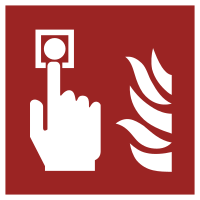
Ships also carry manual fire alarm call points, marked with the red F005 sign from the fire equipment series. The two systems serve different escalation levels: a call point reports a fire to the bridge and fire detection panel, while the general alarm mobilizes the entire ship for a major emergency of any kind — fire beyond first response, collision, flooding, grounding, or preparation to abandon. Confusing the two wastes minutes, so the green square and red square should never be interchanged.
Because activation is a bridge-level decision on most vessels, general alarm switches are concentrated where command is exercised: the navigation bridge above all, and often the engine control room and other continuously manned stations. The system runs on the emergency source of power so the signal survives a main blackout.
Posting and Familiarization
Fit E031 directly at each activation switch, sized for the compartment and, where practical, in photoluminescent material consistent with the vessel's low-location lighting scheme. On passenger ships the symbol also appears in cabin safety cards and muster station plans so that guests learn it during the pre-departure safety briefing, even though activating the alarm will almost never be a passenger's job.
Crew familiarization should pair the sign with the sound. New joiners are taught the seven-short-one-long pattern during induction, and weekly or voyage drills exercise the full chain: activation, alarm sounding, muster, and the reporting of each station as closed up. A correctly signed activation point is the first link in that chain.
Where you will see E031
Activation switches concentrate where command is exercised, so the sign appears above all on the navigation bridge and often in the engine control room and other continuously manned stations, fitted directly at each protected push-button or key switch. Passenger ships also reproduce the symbol on cabin safety cards and muster station plans so guests learn it during the pre-departure briefing.
Common questions about E031
What does seven short blasts and one long blast mean on a ship?
That is the SOLAS general emergency alarm. Sounded on the ship's whistle and internal alarm bells, it orders passengers to their assembly stations and crew to their muster list duties. It signals a serious emergency but is not itself the order to abandon ship, which the master gives separately.
What is the difference between the E031 sign and a fire alarm call point sign?
E031 is green and marks a button that triggers the ship-wide general emergency alarm. F005 is red and marks a manual call point that reports a fire to the detection system. A fire report may lead the bridge to sound the general alarm, but the buttons, systems, and responses are separate.
Who is allowed to sound the general alarm on board?
Normally the master or the officer of the watch orders it from the bridge, which is why activation points cluster in manned control stations. Company procedures define who may activate it and when; any crew member discovering a major emergency reports it immediately so the bridge can sound the alarm without delay.
Does the general alarm mean abandon ship?
No. It means go to your emergency station and await instructions. Abandonment is ordered explicitly by the master, typically by voice over the public address system, after the situation has been assessed at the muster stations.
Reference details
| Symbol code | E031 |
|---|---|
| Sign family | ISO Emergency Signs |
| Standard reference | ISO 7010:2019 / ISO 3864-1 ISO Online Browsing Platform: E031 |
| Screen color reference | #009933. Screen colors are not a production color specification. |
| Download formats | SVG reference artwork; a 1024 × 1024 pixel PNG conversion on a white canvas. |
| Record date | · How to interpret our dates |
| Page updated |
Choosing a physical sign size
Download dimensions are not installation dimensions. Select sign size, material, placement, and lighting using the applicable standard and the actual viewing conditions. Chemical label sizing follows its own rules. Read the artwork and sizing guide.
Sources and artwork credits
- Artwork source
- Wikimedia Commons file page
- Creator credited by source
- Maxi123ID
- License
- Public domain
- Source metadata checked
SVG files are local reference copies. PNG files are raster conversions. Check the linked file history and license terms before reuse; a source-metadata check is not certification of the artwork or a workplace installation.
Report a correction to this reference