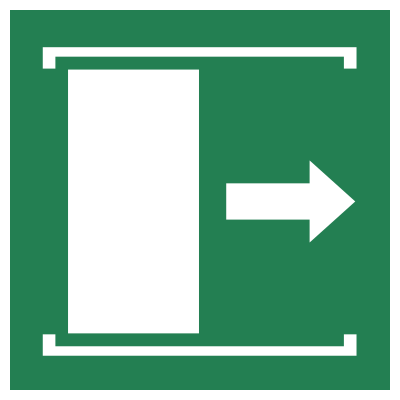
Door opens by pushing on the right-hand side
Indicates that the door opens by pushing on its right-hand side.

Understanding this sign
Green square or rectangular signs identify emergency escape routes, safety facilities, and rescue equipment.
Follow the complete wayfinding system and local emergency plan. A symbol alone does not establish a safe route.
E023 in One Glance: Right Edge Swings Away
A person reading E023 learns the door ahead is hinged on their left and yields to pressure at its right-hand edge. It is the mirror image of E022 within the ISO 7010 family of door-operation signs, rendered white-on-green as escape-route information. The two signs exist as a pair because a pictogram cannot say push the free edge in the abstract; it has to commit to a side, and the side must match the physical door.
What the sign buys is time at the doorway. Pushing at the hinge edge of a heavy fire door moves it barely a few degrees for the same effort that would throw it open at the latch edge, and a person in smoke interprets that resistance as locked and turns back. By steering the first touch to the working edge, E023 keeps the flow of evacuees moving through the opening instead of stalling in front of it.
Doors That Need Their Handing Spelled Out
The strongest candidates for E023 are doors that give no mechanical hint: flush leaves in corridors, frameless glass doors in offices and retail, blank fire doors in stairwells, and wide single leaves whose latch side cannot be judged at a distance. Public-facing buildings amplify the need, since hotel guests, hospital visitors, and event crowds encounter each door for the first time already moving toward it. Even where a horizontal push bar exists, the bar says push but stays silent about which end does the work.
Because national egress rules generally make high-occupancy escape doors swing outward with the flow of travel, push-side marking covers the majority of doors along a typical evacuation route. A coherent scheme signs them all consistently — same size, same height, same position relative to the moving edge — so that after the first door, occupants have been trained by the building itself and read every subsequent sign faster.
Choosing and Checking the Mirror Variant
Selection is a site verification task, not a desk exercise. Face the door from the direction of escape: right edge free means E023, left edge free means E022. The same physical leaf viewed from the room behind it would pull rather than push, so the opposite face is a candidate for the pull-operation signs E057 or E058 where that side also serves a route. Ordering signs from a floor plan without a walk-through is how mismatches happen.
Once installed, the pairing must survive the building's life. Re-hanging a door to fix clearance, reversing it during refurbishment, or replacing a leaf like-for-like from stock with opposite handing all silently falsify the sign. Adding a handing check to the fire-door inspection round costs seconds per door and catches the drift; a door whose sign points occupants at the hinges is worse signed than bare.
Where you will see E023
The strongest candidates are doors giving no mechanical hint of their handing: flush leaves in corridors, frameless glass doors in offices and retail, blank fire doors in stairwells, and wide single leaves in hotels, hospitals, and event venues where crowds meet each door for the first time. Selection requires facing the actual door from the escape direction, and fire-door inspections should recheck the handing after any re-hang or leaf replacement.
Common questions about E023
What does the door opens by pushing on the right-hand side sign mean?
It means the door swings away from you when pushed, with the movement happening at the right-hand edge as you face it — the hinges are on the left. It is ISO 7010 sign E023, posted on the door leaf so an approaching person pushes the edge that actually opens.
How do I know whether my door needs E023 or E022?
Stand where escaping people would approach and look at which vertical edge is free to swing. Free edge on the right calls for E023; on the left, E022. Never decide from drawings alone — verify at the door, and again whenever the leaf is re-hung or replaced, since handing reversals are a common refurbishment side effect.
Is a push sign necessary if the door has a panic bar?
Often it still helps. A crash bar communicates push, but on a wide leaf it does not show where the effort is effective, and on double doors it does not reveal which leaf is active. E023 adds the missing edge information; many operators fit both so the door reads correctly from any distance.
What color is the E023 door sign?
White pictogram on a green background. Green is the ISO 3864-1 safety color for escape, rescue, and safe-condition information, which is the category door-operation instructions on evacuation routes fall into. Photoluminescent green-and-white versions remain visible during power failure and in smoke.
Reference details
| Symbol code | E023 |
|---|---|
| Sign family | ISO Emergency Signs |
| Standard reference | ISO 7010:2019 / ISO 3864-1 ISO Online Browsing Platform: E023 |
| Screen color reference | #009933. Screen colors are not a production color specification. |
| Download formats | SVG reference artwork; a 1024 × 1024 pixel PNG conversion on a white canvas. |
| Record date | · How to interpret our dates |
| Page updated |
Choosing a physical sign size
Download dimensions are not installation dimensions. Select sign size, material, placement, and lighting using the applicable standard and the actual viewing conditions. Chemical label sizing follows its own rules. Read the artwork and sizing guide.
Sources and artwork credits
- Artwork source
- Wikimedia Commons file page
- Creator credited by source
- Clemenspool
- License
- CC0
- Source metadata checked
SVG files are local reference copies. PNG files are raster conversions. Check the linked file history and license terms before reuse; a source-metadata check is not certification of the artwork or a workplace installation.
Report a correction to this reference