Turn clockwise to open
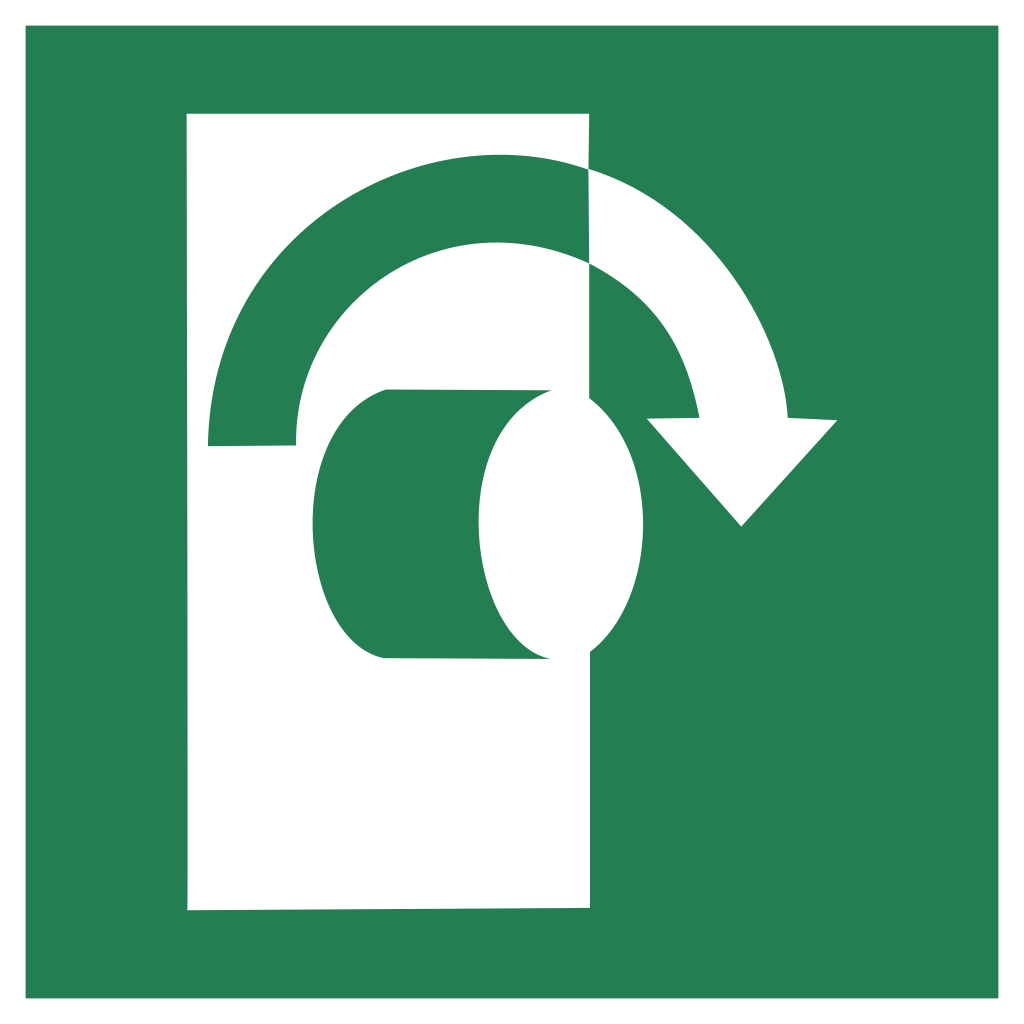
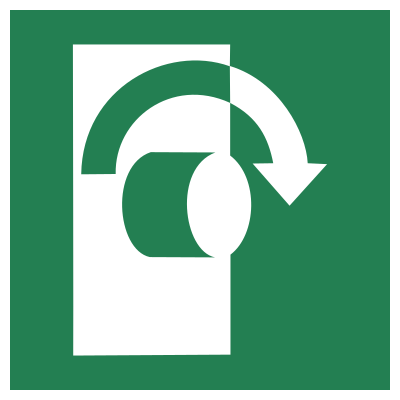
Indicates that the control is turned clockwise to open.
Understanding this sign
Green square or rectangular signs identify emergency escape routes, safety facilities, and rescue equipment.
Follow the complete wayfinding system and local emergency plan. A symbol alone does not establish a safe route.
Reading E019: Clockwise Releases This Door
E019 shows a curved white arrow on a green field, sweeping in the clockwise sense, and it carries one instruction: rotate this device clockwise and it will open. In the ISO 7010 register the sign exists for escape-route security doors whose knob must be turned clockwise before the opening mechanism engages, and it belongs at the point of operation, not merely somewhere on the door.
Of the two rotation signs, E019 arguably works harder. Clockwise-to-open contradicts the habit most adults carry from taps, valves, and screw threads, where clockwise means closing or tightening. A mechanism built that way is precisely the kind that defeats first-time users, so a door needing E019 is a door where the sign is doing real safety work rather than restating the obvious.
Mechanisms That Open the Unexpected Way
Clockwise-release hardware turns up in security-focused installations — cell-type doors, cash rooms, data centers, and retrofitted locking systems where the gearbox orientation dictated the handing — as well as in hatches and dogged closures whose linkage happens to run in the tightening sense of ordinary fittings. Left-hand threaded spindles and mirrored mechanisms are legitimate engineering choices; the obligation they create is simply to tell the user, and E019 is the standardized way of doing so.
Ships and offshore installations use rotation marking systematically. A watertight door or escape-hatch handwheel may sit between a crew member and breathable air, operated in darkness, at an angle, with the vessel moving. Rehearsed crews learn their own hardware, but passengers, contractors, and pilots have not, and mixed fleets rarely standardize handing across vessels. The arrow beside the wheel is the only briefing such a user will ever get.
Getting the Installation Right
Two errors account for most E019 failures in the field. The first is fitting it to hardware that actually releases the other way — often after a lock swap that reversed the mechanism while the old label stayed put. The second is mounting the label rotated a quarter-turn or applying it to a transparent surface read from both sides, either of which can flip the apparent direction. A commissioning check that physically operates the device against the printed arrow catches both.
Keep the sign within the user's sightline at the moment their hand is on the knob or wheel, and size it for the darkest condition the route can present; photoluminescent stock is a sensible default on escape routes. During drills, station an observer at each rotation-signed door and log first-attempt failures — a cheap, direct measurement of whether the sign, its position, and its lighting are actually communicating.
Where you will see E019
Security installations such as cell-type doors, cash rooms, data centers, and retrofitted locking systems use it where gearbox orientation dictates clockwise release. Ships and offshore installations apply it systematically beside watertight door and escape-hatch handwheels, where passengers, contractors, and pilots operating unfamiliar hardware in darkness get their only briefing from the arrow.
Common questions about E019
What does ISO 7010 E019 mean?
E019 means the device it accompanies — typically the knob of an escape-route security door, or a handwheel on a hatch — opens when turned clockwise. It is a green safe-condition sign with a white curved arrow indicating the release direction, standardized in ISO 7010.
Why would a door open clockwise instead of anticlockwise?
Because of how its lock or linkage is engineered: gearbox orientation, left-hand threads, mirrored mechanisms, and certain dogging arrangements all produce clockwise release. There is nothing wrong with such hardware, but since it contradicts the common expectation that clockwise tightens, the direction must be marked where the user grips the device.
Where should the turn clockwise to open sign be mounted?
Directly at the knob, handle, or wheel it refers to, oriented exactly as printed and visible while the user's hand is on the mechanism. Mounting it elsewhere on the door, or rotating the label during installation, degrades or reverses the instruction. Re-verify the direction whenever the lock hardware is serviced or replaced.
Do I use E019 or E018 on my door?
Operate the mechanism and watch which rotation releases it: clockwise means E019, anticlockwise means E018. Never choose from the door schedule alone — retrofits and replacement locks frequently reverse the handing, and a mismatched sign instructs people to jam the very door they need.
Reference details
| Symbol code | E019 |
|---|---|
| Sign family | ISO Emergency Signs |
| Standard reference | ISO 7010:2019 / ISO 3864-1 ISO Online Browsing Platform: E019 |
| Screen color reference | #009933. Screen colors are not a production color specification. |
| Download formats | SVG reference artwork; a 1024 × 1024 pixel PNG conversion on a white canvas. |
| Record date | · How to interpret our dates |
| Page updated |
Choosing a physical sign size
Download dimensions are not installation dimensions. Select sign size, material, placement, and lighting using the applicable standard and the actual viewing conditions. Chemical label sizing follows its own rules. Read the artwork and sizing guide.
Sources and artwork credits
- Artwork source
- Wikimedia Commons file page
- Creator credited by source
- Bloody666
- License
- CC0
- Source metadata checked
SVG files are local reference copies. PNG files are raster conversions. Check the linked file history and license terms before reuse; a source-metadata check is not certification of the artwork or a workplace installation.
Report a correction to this reference