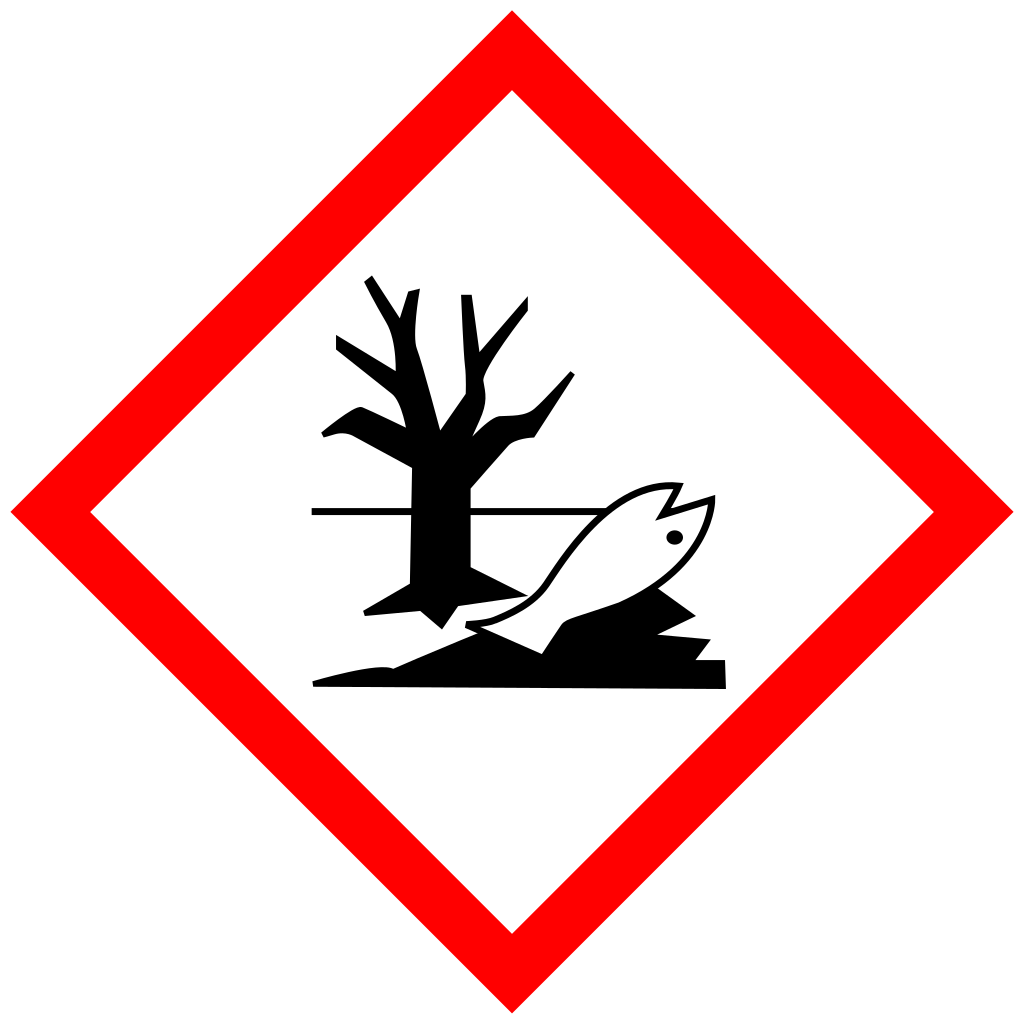
Environment
The environment pictogram identifies specified hazards to the aquatic environment. Its required use depends on the applicable GHS implementation.
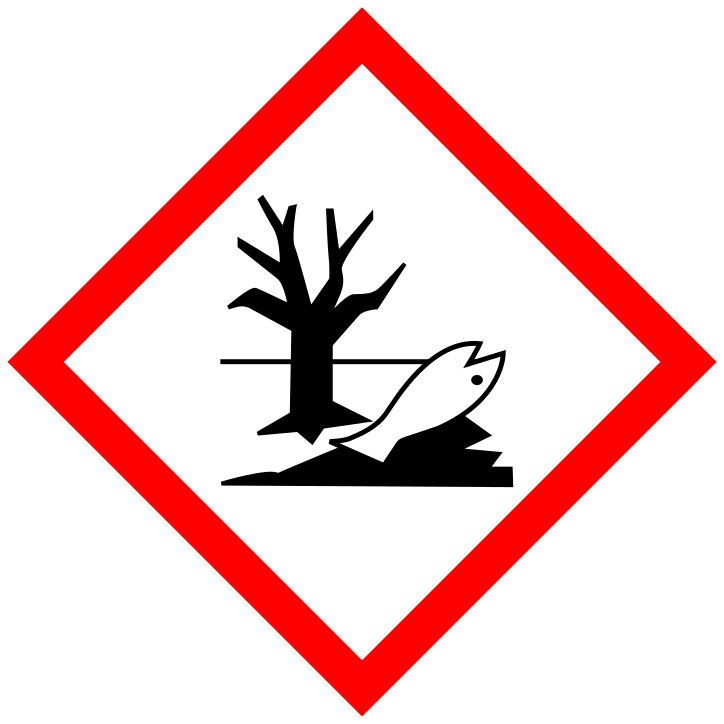
Understanding this sign
GHS pictograms use a black symbol on white within a red diamond border to communicate chemical hazard classes.
Read the whole label and safety data sheet. A pictogram can cover several hazards and does not specify controls by itself.
Aquatic Hazard Classes That Assign GHS09
The dead fish and bare tree of GHS09 mark one thing: classified hazard to the aquatic environment. The pictogram is assigned to aquatic acute toxicity Category 1 (H400, very toxic to aquatic life) and to aquatic chronic toxicity Categories 1 and 2 (H410, very toxic to aquatic life with long lasting effects, and H411, toxic to aquatic life with long lasting effects). Chronic Categories 3 and 4 exist in the classification scheme but carry the H412 and H413 statements without any pictogram.
Classification draws on three strands of data: toxicity to fish, aquatic invertebrates such as Daphnia, and algae; environmental fate, meaning whether the substance degrades rapidly; and bioaccumulation potential, typically screened through the octanol-water partition coefficient. That is why persistence can push a moderately toxic but non-degradable substance into a chronic category, while a highly toxic but rapidly degrading material may classify less severely. Pyrethroid insecticides, copper compounds, and many biocides are archetypal GHS09 chemicals.
Signal Words — and the Absence of One
GHS09 has an unusual signal-word pattern. Aquatic acute Category 1 and chronic Category 1 take Warning; chronic Category 2 takes no signal word at all, displaying the pictogram with H411 alone. No environmental classification ever takes Danger. This reflects the system's human-safety orientation: signal words rank immediacy of danger to the label reader, and a stream three drains away is not an immediate threat to the person holding the container.
The precautionary statements do the operational work: P273 (avoid release to the environment), P391 (collect spillage), and P501 disposal instructions. For a warehouse or workshop, those three statements translate into bunded storage, sealed drainage or drain covers in chemical-handling areas, spill kits sized to the largest container, and a waste route through a licensed handler. An environmental classification also flags the product for attention in fire-water runoff planning, since firefighting can flush large volumes of GHS09 material into watercourses at once.
A Sharp US-EU Difference in Legal Status
GHS09 exposes the biggest jurisdictional split in GHS implementation. OSHA's Hazard Communication Standard (29 CFR 1910.1200) does not require environmental classification, because environmental protection sits with the EPA rather than OSHA; the standard treats the environmental pictogram as a permitted, non-mandatory label element. US suppliers frequently include it anyway to keep one label valid for global markets, which is why the fish-and-tree appears on American containers despite having no OSHA enforcement behind it.
In the European Union, the position is reversed: the CLP Regulation (EC) No 1272/2008 makes aquatic hazard classification and GHS09 labeling fully mandatory, with harmonized environmental classifications for many substances in Annex VI. The classification also propagates through EU law — it feeds Seveso III inventory thresholds for environmentally hazardous substances and influences waste classification when the product is discarded. An importer relabeling US-supplied chemicals for the EU market must therefore add environmental classification, not merely translate the existing label.
GHS09, the Marine Pollutant Mark, and Common Misreadings
Transport regulations use the same dead fish and tree symbol as the environmentally hazardous substance mark — often called the marine pollutant mark — applied to packages of UN 3077 and UN 3082 and other environmentally hazardous goods. The transport mark sits in a black-and-white diamond without the red GHS frame, and under both GHS and CLP an outer packaging bearing it need not repeat the GHS09 pictogram. Inside the workplace, the red-framed supply pictogram remains the operative label element.
Two misreadings recur. First, GHS09 is not a general eco-unfriendliness badge: it reflects specific aquatic toxicity criteria, so a product can be environmentally damaging in other ways — high carbon footprint, ozone-depleting — without carrying it; ozone-layer hazards are labeled with GHS07 and H420 instead. Second, absence of GHS09 does not authorize drain disposal. Chronic Category 3 and 4 products carry H412 or H413 with no pictogram, and sewer discharge rules apply to many unclassified chemicals regardless of the label.
Reading the environment pictogram
The dead tree and fish communicate hazards to the aquatic environment under GHS implementations that adopt those classifications. This is distinct from a chemical being harmful to people.
What to check alongside it
OSHA does not require the environmental pictogram because environmental hazards are outside its jurisdiction. Other systems, including EU CLP, have their own classification and labeling requirements; check the rules for the market in which the product is supplied.
The application notes above were checked against the linked public sources on . Jurisdiction-specific notes are identified in the text.
Where you will see GHS09
Used on pesticides, biocides, specialty coatings, oils, water-treatment products, laboratory chemicals, and waste streams where drains, soil, waterways, and spill-response planning must be considered alongside worker-protection controls.
Common questions about GHS09
What does the dead fish and tree pictogram mean?
It means the product is classified as hazardous to the aquatic environment — aquatic acute toxicity Category 1 (H400) or aquatic chronic toxicity Category 1 or 2 (H410, H411). In practice it warns that spills, washwater, and disposal must be kept out of drains, soil, and watercourses, and that spillage should be contained and collected rather than flushed away.
Is the GHS09 environmental pictogram required in the United States?
Not by OSHA. The Hazard Communication Standard (29 CFR 1910.1200) covers physical and health hazards; environmental hazards fall under EPA jurisdiction, so the environmental pictogram is a non-mandatory label element under HazCom. Many US labels carry it voluntarily for consistency with export markets. In the EU, by contrast, CLP makes aquatic-hazard classification and GHS09 labeling compulsory.
Why do some environmentally hazardous products have no pictogram at all?
Because the pictogram stops at aquatic chronic Category 2. Products classified in chronic Categories 3 or 4 carry only the statements H412 (harmful to aquatic life with long lasting effects) or H413 (may cause long lasting harmful effects to aquatic life), with no symbol and no signal word. They still warrant controlled disposal and spill containment despite the visually quieter label.
Is GHS09 the same as the marine pollutant mark on shipping packages?
The symbol is the same — a dead fish and tree — but the frames and legal bases differ. GHS09 is the red-diamond supply pictogram under GHS and CLP; the marine pollutant (environmentally hazardous substance) mark is a black-and-white transport mark under the UN Model Regulations, IMDG Code, and ADR. When the transport mark is already on the outer packaging, the GHS09 pictogram may be omitted there.
Reference details
| Symbol code | GHS09 |
|---|---|
| Sign family | GHS Chemical Pictograms |
| Standard reference | UN GHS Revision 11 (2025); local implementation varies UN GHS Revision 11 (2025) |
| Screen color reference | #FF0000. Screen colors are not a production color specification. |
| Download formats | SVG reference artwork; a 1024 × 1024 pixel PNG conversion on a white canvas. |
| Record date | · How to interpret our dates |
| Page updated |
Choosing a physical sign size
Download dimensions are not installation dimensions. Select sign size, material, placement, and lighting using the applicable standard and the actual viewing conditions. Chemical label sizing follows its own rules. Read the artwork and sizing guide.
Sources and artwork credits
- UN GHS Revision 11 (2025)
- OSHA hazard communication pictograms
- OSHA 1910.1200 Appendix C: allocation of label elements (US)
- Artwork source
- Wikimedia Commons file page
- Creator credited by source
- Unknown author
- License
- Public domain
- Source metadata checked
SVG files are local reference copies. PNG files are raster conversions. Check the linked file history and license terms before reuse; a source-metadata check is not certification of the artwork or a workplace installation.
Report a correction to this reference