Corrosion
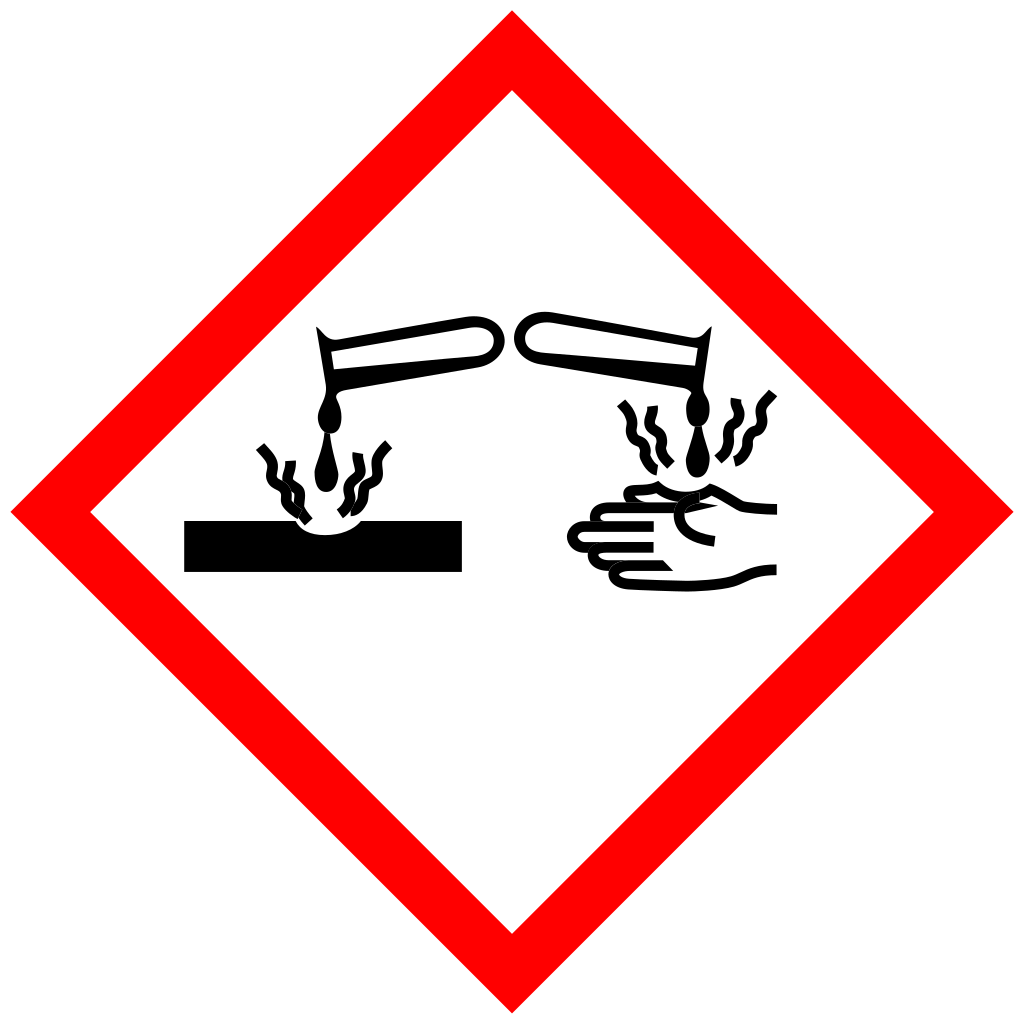
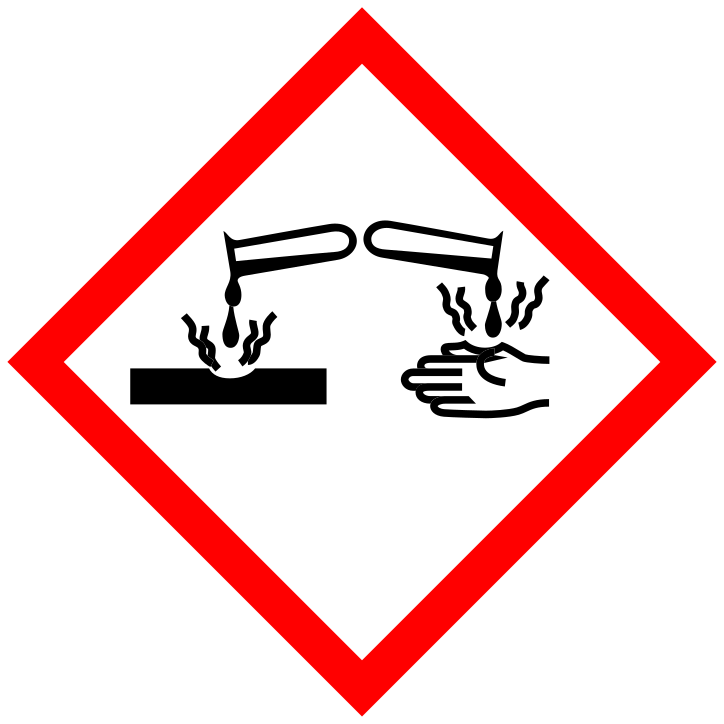
The corrosion pictogram identifies skin corrosion, serious eye damage, or corrosivity to metals in the specified hazard categories.
Understanding this sign
GHS pictograms use a black symbol on white within a red diamond border to communicate chemical hazard classes.
Read the whole label and safety data sheet. A pictogram can cover several hazards and does not specify controls by itself.
Three Distinct Hazards Behind One Pictogram
The GHS05 image — liquid pouring from two test tubes onto a hand and a metal bar — encodes exactly what the pictogram covers: skin corrosion Category 1 (with subcategories 1A, 1B, and 1C by speed of tissue destruction), serious eye damage Category 1, and corrosive to metals Category 1. A label can earn GHS05 through any of the three, which means the pictogram alone does not tell you whether the contents will burn skin, destroy eyes, eat through a steel container, or all of these at once.
Reading the H-statements resolves the ambiguity. H314 (causes severe skin burns and eye damage) signals tissue corrosivity, H318 (causes serious eye damage) signals a material that can blind without necessarily burning skin, and H290 (may be corrosive to metals) signals attack on containers, racking, and fittings. Sulfuric acid and sodium hydroxide typically carry H314 and H290 together; some surfactant concentrates carry H318 alone, which surprises workers who assume the pictogram always means acid-strength burns.
Signal Words and Classification Boundaries
Skin corrosion Category 1 and serious eye damage Category 1 both take the signal word Danger. Corrosive to metals takes Warning, a reminder that H290 on its own is a property-damage classification, not a personal-injury one. The subcategory matters for emergency planning: a 1A material produces irreversible skin destruction after exposures as short as three minutes, which is why immediate, prolonged flushing and nearby emergency showers are non-negotiable where 1A corrosives are handled.
The boundary below GHS05 is drawn at irritation. Skin irritation Category 2 and eye irritation Category 2 cause reversible effects and are assigned the GHS07 exclamation mark instead. pH is a screening clue — extreme pH at or below 2 or at or above 11.5 suggests corrosivity — but classification ultimately rests on test data and bridging principles, so dilution can move a product from H314 to H315 or out of classification entirely. The label on the working dilution, not the concentrate, governs.
HazCom 2012, CLP, and the Precedence Rule
Both OSHA's 29 CFR 1910.1200 and the EU CLP Regulation (EC) No 1272/2008 apply an explicit precedence rule to this pictogram: where GHS05 appears for skin or eye effects, the GHS07 exclamation mark must not also appear for skin irritation or eye irritation. The severe hazard subsumes the milder one, keeping labels legible. GHS05 can and does co-appear with other pictograms — GHS07 for a separate hazard such as acute oral toxicity Category 4, or GHS03 on oxidizing acids like nitric acid.
In the US, a GHS05 classification pulls in related OSHA duties: suitable eye and skin protection under 29 CFR 1910.132 and 1910.133, and emergency eyewash and shower facilities under 29 CFR 1910.151(c) wherever the eyes or body may be exposed to injurious corrosive materials. Under CLP, corrosive classifications also trigger child-resistant fastening and tactile warning requirements for certain consumer-supplied products, and the harmonized entries in Annex VI fix the classification for many common acids and bases.
Supply Label Versus the Class 8 Transport Diamond
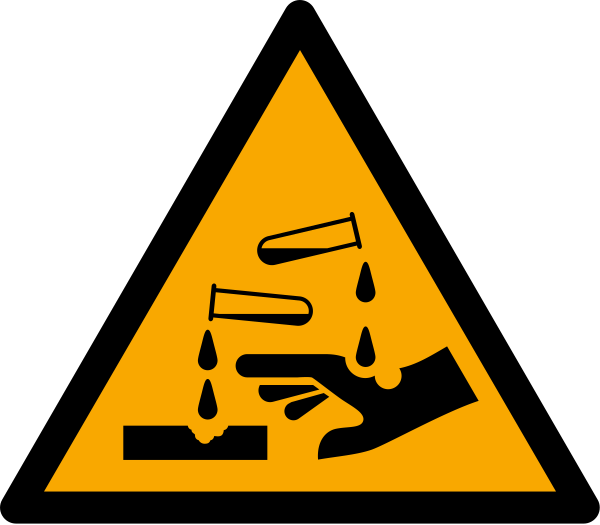
Transport regulations use an almost identical symbol for Class 8 corrosives — same test tubes, hand, and metal bar, rendered in black and white on a black-and-white diamond instead of GHS's red frame. The visual overlap is intentional, and the systems interlock: outer packagings already bearing the Class 8 transport label may omit the duplicate GHS05 pictogram under both GHS and CLP rules. But classification criteria differ at the margins, so a metal-corrosive product can be Class 8 for carriage while its supply label emphasis differs.
The most consequential misreading of GHS05 runs in the other direction: a product labeled only with H290 is corrosive to metals but may be harmless to intact skin, while a product with H318 can cause permanent blindness despite handling gently on skin. Battery acid, drain cleaners, plating baths, and alkaline degreasers all carry the same pictogram for different reasons. Site training should teach workers to pair the symbol with its H-statements rather than treating every GHS05 container as identical.
Reading the corrosion pictogram
The corrosion pictogram can communicate skin corrosion, serious eye damage, or corrosion of metals, depending on the classification. A label can therefore use it for different reasons.
What to check alongside it
Read the hazard statement to distinguish damage to people from damage to metals. OSHA precedence rules suppress the exclamation mark where it would otherwise indicate skin or eye irritation when the corrosion pictogram is present.
The application notes above were checked against the linked public sources on . Jurisdiction-specific notes are identified in the text.
Where you will see GHS05
Placed on acid and caustic containers, plating chemicals, battery electrolytes, cleaning concentrates, transfer stations, corrosive waste containers, and dosing systems where metal attack or serious tissue damage is a foreseeable hazard.
Common questions about GHS05
Does the GHS05 pictogram always mean the chemical burns skin?
No. GHS05 covers three classifications: skin corrosion (H314), serious eye damage (H318), and corrosivity to metals (H290). A product carrying only H290 attacks steel and aluminium but may not injure skin, while a product with only H318 threatens eyes more than skin. Always read the hazard statements next to the pictogram to know which of the three applies.
What is the difference between GHS05 and the GHS07 exclamation mark for irritation?
Severity and reversibility. GHS05 marks corrosion — irreversible tissue destruction (H314) or serious eye damage (H318). GHS07 marks irritation — reversible redness, swelling, or discomfort (H315, H319). The two never appear together for the same skin or eye endpoint: both OSHA HazCom and EU CLP require the exclamation mark to be dropped for irritation when the corrosion pictogram is present.
Do I need an emergency eyewash station for GHS05 chemicals?
In the US, almost certainly yes where exposure is possible: 29 CFR 1910.151(c) requires suitable facilities for quick drenching or flushing of the eyes and body wherever a person may be exposed to injurious corrosive materials, and ANSI Z358.1 is the accepted design benchmark, including its 10-second reach guideline. Comparable duties exist in the EU through workplace risk-assessment obligations. The classification on the label is the trigger for assessing the need.
Why do some corrosive products show GHS05 for metals only?
Because corrosive to metals is its own Category 1 classification with the statement H290 and signal word Warning. Products such as certain descalers and brine-based formulations can degrade metal containers and equipment without meeting the criteria for skin corrosion. The pictogram protects storage integrity: H290 materials need compatible containers, drip containment, and separation from unprotected steel racking.
Reference details
| Symbol code | GHS05 |
|---|---|
| Sign family | GHS Chemical Pictograms |
| Standard reference | UN GHS Revision 11 (2025); local implementation varies UN GHS Revision 11 (2025) |
| Screen color reference | #FF0000. Screen colors are not a production color specification. |
| Download formats | SVG reference artwork; a 1024 × 1024 pixel PNG conversion on a white canvas. |
| Record date | · How to interpret our dates |
| Page updated |
Choosing a physical sign size
Download dimensions are not installation dimensions. Select sign size, material, placement, and lighting using the applicable standard and the actual viewing conditions. Chemical label sizing follows its own rules. Read the artwork and sizing guide.
Sources and artwork credits
- UN GHS Revision 11 (2025)
- OSHA hazard communication pictograms
- OSHA 1910.1200 Appendix C: allocation of label elements (US)
- Artwork source
- Wikimedia Commons file page
- Creator credited by source
- Unknown author
- License
- Public domain
- Source metadata checked
SVG files are local reference copies. PNG files are raster conversions. Check the linked file history and license terms before reuse; a source-metadata check is not certification of the artwork or a workplace installation.
Report a correction to this reference