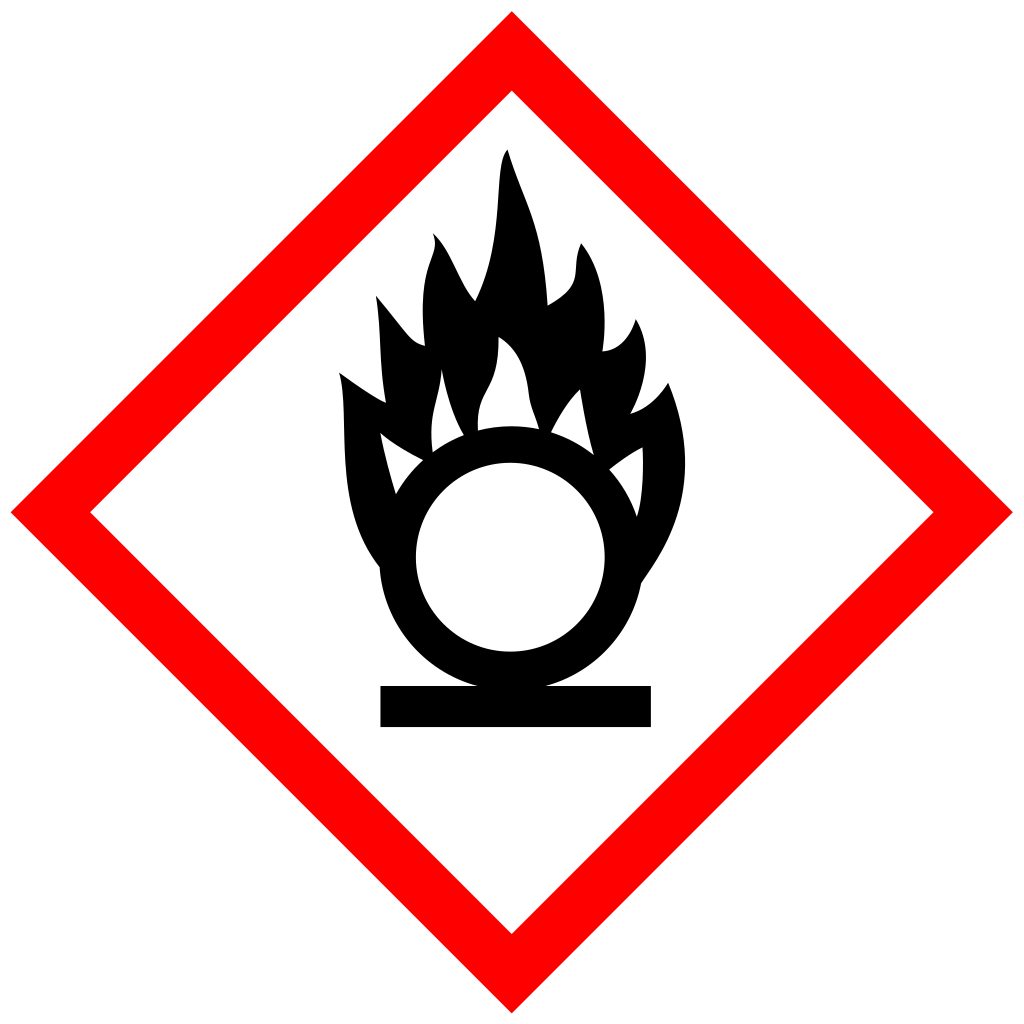
Oxidizer
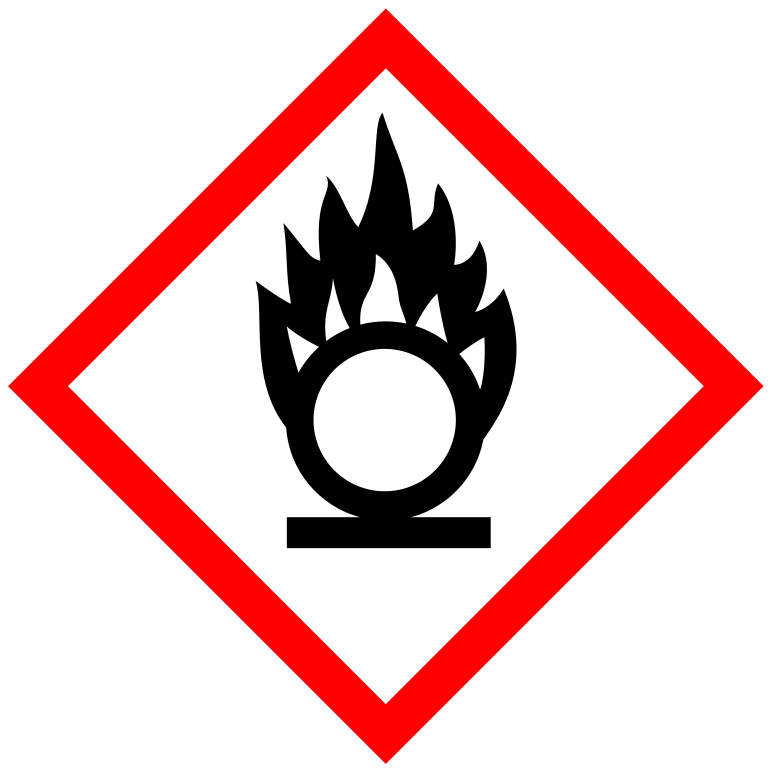
The flame over circle pictogram identifies an oxidizing hazard. Oxidizers can cause or intensify a fire.
Understanding this sign
GHS pictograms use a black symbol on white within a red diamond border to communicate chemical hazard classes.
Read the whole label and safety data sheet. A pictogram can cover several hazards and does not specify controls by itself.
What the Flame Over Circle Identifies
GHS03 — a flame burning above a circle — is reserved for three hazard classes: oxidizing gases (Category 1), oxidizing liquids (Categories 1 to 3), and oxidizing solids (Categories 1 to 3). These are materials that supply oxygen or otherwise support combustion, so they can cause or intensify a fire in surrounding material even when they cannot burn themselves. Oxygen, concentrated hydrogen peroxide, nitric acid above certain concentrations, ammonium nitrate, calcium hypochlorite, and potassium permanganate are typical carriers of this pictogram.
The circle in the artwork represents an oxygen source feeding the flame, which captures the operational problem precisely: an oxidizer defeats the fire-prevention logic that most workplaces rely on. Removing ignition sources is not enough, because oxidizers can ignite combustibles on contact, and fires involving them burn hotter, spread faster, and resist smothering. Some incidents, such as pool-chemical warehouse fires involving hypochlorites, start with nothing more exotic than contamination by organic material.
Categories, Signal Words, and Hazard Statements
Oxidizing gases have a single category, signal word Danger, and H270 (may cause or intensify fire; oxidiser). Oxidizing liquids and solids split into three categories by test performance: Category 1 takes Danger with H271 (may cause fire or explosion; strong oxidiser), Category 2 takes Danger with H272 (may intensify fire; oxidiser), and Category 3 takes Warning with the same H272 statement. All six assignments display GHS03; the category changes only the signal word and statement, not the pictogram.
Classification rests on comparative burning tests from the UN Manual of Tests and Criteria: candidate liquids and solids are mixed with cellulose and their burning behavior compared against reference oxidizers. This matters for mixtures and dilutions — hydrogen peroxide at 60 percent is a markedly different classification case than at 8 percent — so the same chemical name can appear with or without GHS03 depending on concentration. The label on the specific container, not the substance name, is the authoritative signal.
OSHA HazCom, EU CLP, and Storage Consequences
OSHA's Hazard Communication Standard (29 CFR 1910.1200) requires GHS03 on shipped containers of classified oxidizers, and the classification connects to NFPA 400 and fire-code storage requirements: maximum allowable quantities, segregation distances, and sprinkler design all key off the oxidizer class. Under the EU CLP Regulation (EC) No 1272/2008, the same pictogram applies, with Annex VI providing harmonized classifications for common oxidizers and the Seveso III Directive imposing site-level duties once oxidizer inventories cross tonnage thresholds.
The single most important control the pictogram should trigger is segregation. Oxidizers must be stored apart from flammable and combustible materials, reducing agents, and organic matter — including incidental combustibles such as wooden pallets, cardboard, and spilled oils. Housekeeping is a real control here: a GHS03-labeled drum standing on an oil-stained wooden pallet is an ignition scenario, not just poor practice. Spill response also changes, because absorbing an oxidizer into sawdust or standard organic absorbent can start the fire the label warns about.
Common Confusions Around GHS03
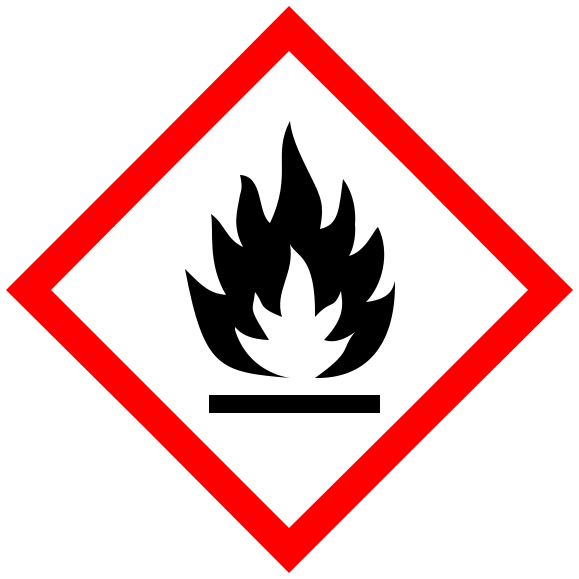
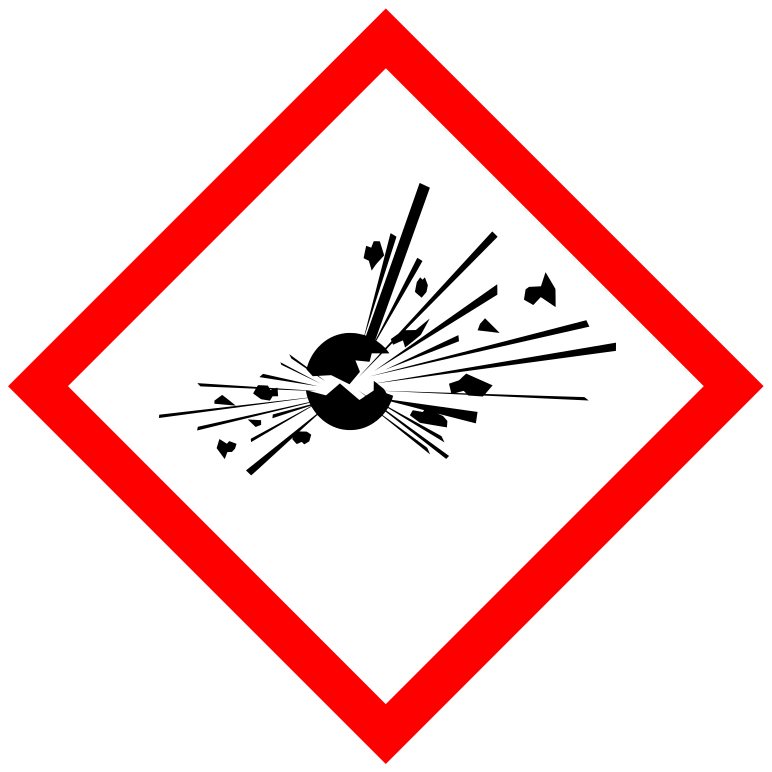
The flame over circle is routinely confused with the plain GHS02 flame. The difference is causal direction: GHS02 materials burn; GHS03 materials make other things burn. Some substances genuinely warrant related pictograms — certain organic peroxides have both oxidizing and self-reactive character but are classified in the organic peroxides class, which assigns GHS01 or GHS02 rather than GHS03. If GHS01 already appears on a label, GHS and CLP make GHS03 optional in most cases to avoid redundant symbols.
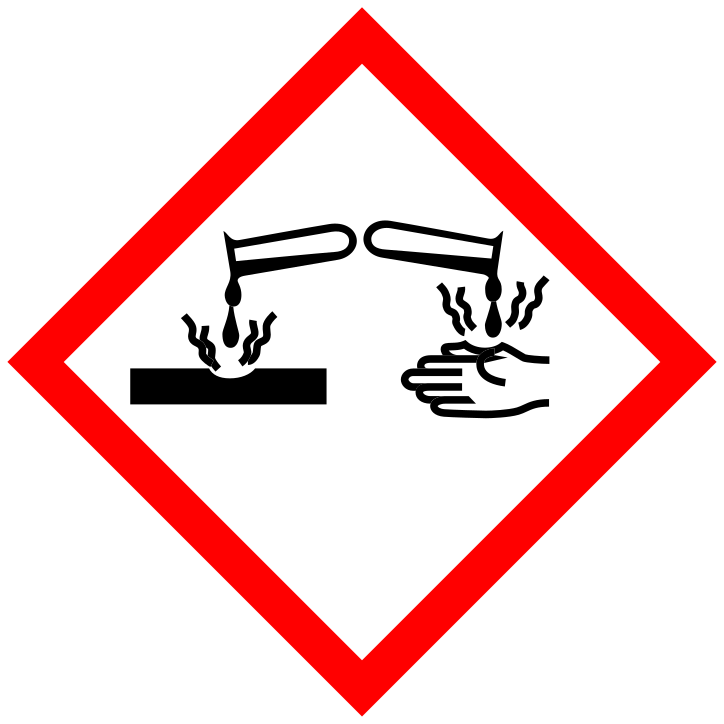
In transport, oxidizers travel as Class 5.1 under a yellow diamond bearing the same flame-over-circle symbol, and oxygen cylinders carry the oxidizer label alongside the non-flammable gas Class 2.2 label. GHS allows outer packagings already bearing the transport oxidizer diamond to omit the duplicate supply pictogram. One further trap: oxidizing does not mean corrosive, and vice versa — nitric acid earns both GHS03 and GHS05, but sodium hypochlorite bleach at household strength is typically labeled corrosive or irritant without any oxidizer pictogram.
Reading the flame over circle pictogram
The flame over a circle identifies oxidizing hazards in applicable gas, liquid, and solid classifications. An oxidizer can cause or intensify combustion; this is different from saying that the substance itself is flammable.
What to check alongside it
Do not substitute the ordinary flame pictogram. Use the product label and safety data sheet to establish incompatible materials and handling conditions.
The application notes above were checked against the linked public sources on . Jurisdiction-specific notes are identified in the text.
Where you will see GHS03
Applied to oxidizing chemical containers, oxygen-enriched process materials, water-treatment chemicals, oxidizer stores, laboratory reagent bottles, gas cabinets, and process areas where incompatible combustible materials must be strictly segregated.
Common questions about GHS03
What does the flame over circle pictogram mean?
It marks oxidizing gases, liquids, and solids — chemicals that release oxygen or otherwise cause and intensify fires in other materials. The material itself may be non-combustible; the hazard is that it feeds combustion, ignites organics on contact in severe cases, and makes any fire involving it much harder to control. Typical examples are oxygen gas, concentrated hydrogen peroxide, and ammonium nitrate.
Can a chemical carry both the oxidizer and flammable pictograms?
Rarely, because strong oxidizing and flammable character seldom coexist in one stable substance. Materials with both tendencies, such as many organic peroxides, are classified in dedicated classes that assign GHS01 or GHS02 instead of GHS03. What you will commonly see is GHS03 combined with GHS05 on strong acids like nitric acid, or GHS03 with GHS04 on oxygen and nitrous oxide cylinders.
How should GHS03-labeled chemicals be stored?
Segregated from flammables, combustibles, reducing agents, and organic materials, in a cool area away from acids that could trigger decomposition. Follow the quantity and separation requirements of your fire code — in the US, NFPA 400 and the International Fire Code set limits by oxidizer class. Avoid wooden shelving and pallets, keep packaging intact to prevent contamination, and stock inert, oxidizer-compatible absorbents for spills.
Is oxygen labeled with the GHS03 pictogram?
Yes. Oxygen is the canonical Category 1 oxidizing gas and carries GHS03 with the signal word Danger and H270, together with GHS04 as a gas under pressure. This is why oxygen enrichment is treated so seriously: at concentrations only modestly above the atmospheric 21 percent, materials such as clothing and grease ignite far more easily and burn far more violently.
Reference details
| Symbol code | GHS03 |
|---|---|
| Sign family | GHS Chemical Pictograms |
| Standard reference | UN GHS Revision 11 (2025); local implementation varies UN GHS Revision 11 (2025) |
| Screen color reference | #FF0000. Screen colors are not a production color specification. |
| Download formats | SVG reference artwork; a 1024 × 1024 pixel PNG conversion on a white canvas. |
| Record date | · How to interpret our dates |
| Page updated |
Choosing a physical sign size
Download dimensions are not installation dimensions. Select sign size, material, placement, and lighting using the applicable standard and the actual viewing conditions. Chemical label sizing follows its own rules. Read the artwork and sizing guide.
Sources and artwork credits
- UN GHS Revision 11 (2025)
- OSHA hazard communication pictograms
- OSHA 1910.1200 Appendix C: allocation of label elements (US)
- Artwork source
- Wikimedia Commons file page
- Creator credited by source
- Unknown author
- License
- Public domain
- Source metadata checked
SVG files are local reference copies. PNG files are raster conversions. Check the linked file history and license terms before reuse; a source-metadata check is not certification of the artwork or a workplace installation.
Report a correction to this reference