No Smoking
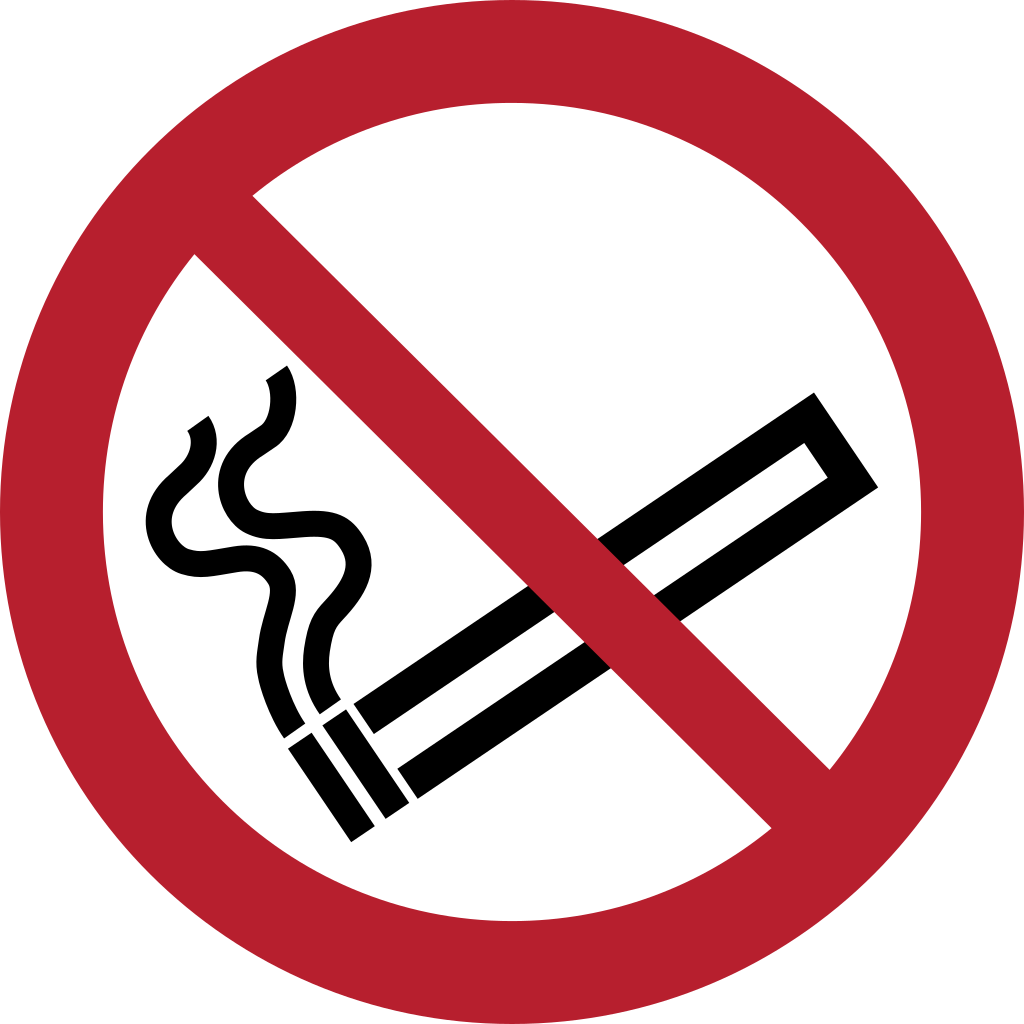
Smoking is prohibited in the marked area.
Understanding this sign
Red circular signs with a diagonal bar identify an action that must not be taken in the marked area.
Check what object or action the symbol prohibits. A prohibition sign does not identify all the hazards in an area.
What ISO 7010 P002 Prohibits
P002 prohibits the act of smoking in the area where the sign is displayed. It applies to lit tobacco products of every kind — cigarettes, cigars, and pipes — and, in most site rules, to the act of lighting them. It uses the general prohibition format defined in ISO 3864-1: a red circular band and diagonal bar over a black pictogram of a lit cigarette on a white field.
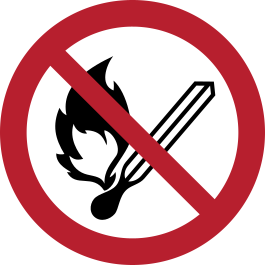
P002 is a behavioral prohibition, not a hazard warning. It does not tell the viewer why smoking is banned in that location; that is deliberate, because the reason can be fire risk, product contamination, hygiene, or law. Where the specific danger is ignition of flammable material, the stronger P003 sign (no open flame, no ignition source, no smoking) is usually the correct choice instead.
When Regulations Require It
Most jurisdictions have two independent legal routes to a mandatory no-smoking sign. The first is smoke-free workplace legislation: many countries and states require premises open to workers or the public to display no-smoking signage at entrances, and some prescribe the exact wording or size. The second is fire safety law: where flammable liquids, gases, or combustible dusts are stored or handled, fire codes and standards such as NFPA 30 and OSHA's flammable liquids rule (29 CFR 1910.106) require ignition sources to be controlled, and posting no-smoking signs at those locations is the standard control measure.
In the European Union, workplace safety signage falls under Directive 92/58/EEC, which requires prohibition signs to follow the round red-and-white format that ISO 7010 P002 implements. In the United States, an ISO-style symbol sign is acceptable, but many facilities pair the symbol with an ANSI Z535 text panel (for example, a NO SMOKING header with supplementary text) so the sign also satisfies text-based state and local posting requirements.
Placement That Actually Works
Post P002 at the point where the prohibited behavior becomes possible: building and site entrances, fuel transfer points, solvent and chemical storage rooms, battery charging areas, oxygen-enriched environments such as healthcare oxygen therapy areas, and vehicle cabs. At fuel dispensing and flammable storage areas, place the sign so it is visible before a person enters the controlled zone, not only on the hazard itself.
Repetition matters more for P002 than for most signs because smoking is habitual behavior. A single sign at a main entrance rarely controls a large yard, roof area, or loading dock. Where a facility designates smoking areas, signage should communicate both halves of the rule: P002 where smoking is banned and clear wayfinding to the permitted area, which measurably improves compliance.
P002 and Related Signs
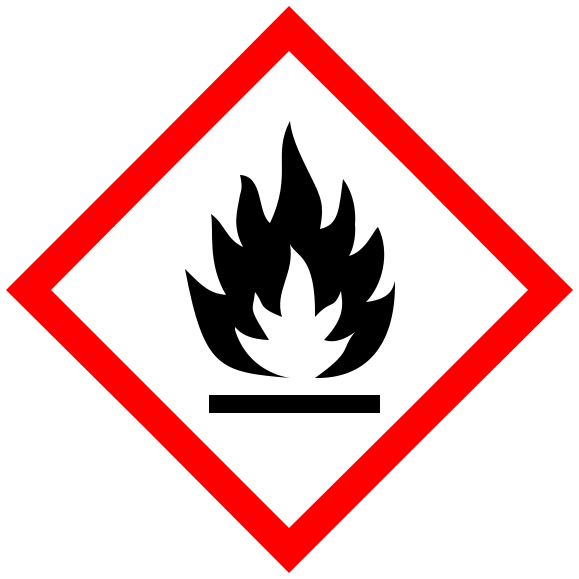
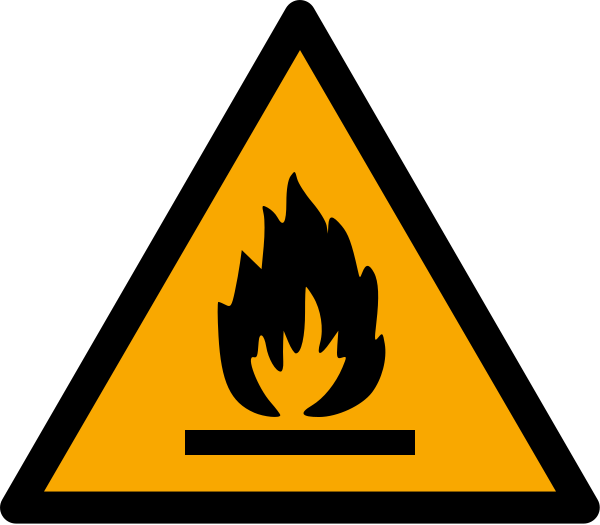
Choose P002 when smoking alone is the issue. Choose P003 when any ignition source is dangerous — it prohibits open flames, sparks, and smoking in one sign and is the standard choice for flammable liquid stores, paint shops, and gas installations. Where the underlying hazard should also be communicated, W021 (flammable material warning) or the GHS02 flame pictogram on container labels complements the prohibition rather than replacing it.
Electronic cigarettes are not covered by the P002 pictogram by default. Some jurisdictions extend smoke-free laws to vaping and some do not, so facilities that intend to ban vaping should say so explicitly with supplementary text or a dedicated vaping-prohibition sign rather than assuming P002 alone communicates the rule.
Where you will see P002
Installed at tank farms, fuel transfer zones, solvent rooms, gas-cylinder stores, warehouses, healthcare entrances, clean production areas, battery rooms, loading docks, and any controlled boundary where smoking would create risk.
Common questions about P002
Is a no-smoking sign legally required in my workplace?
In most jurisdictions, yes, at least at some locations. Smoke-free workplace laws commonly require signage at entrances to enclosed workplaces and public premises, and fire regulations separately require no-smoking signs wherever flammable liquids, gases, or explosive atmospheres are present. Check both your local smoke-free legislation and your fire code, because they impose independent requirements and sometimes prescribe specific wording or dimensions.
What is the difference between ISO 7010 P002 and P003?
P002 prohibits smoking only. P003 prohibits smoking and all other ignition sources, including open flames and sparks. If the reason for the ban is a flammable or explosive atmosphere, use P003; P002 alone would still permit other ignition sources that are just as dangerous.
Does the P002 sign cover e-cigarettes and vaping?
Not reliably. The pictogram shows a lit cigarette, and courts and inspectors in many places treat vaping as a separate activity. If your site policy or local law bans vaping, add explicit supplementary text or a dedicated no-vaping sign rather than relying on P002.
What size should a no-smoking sign be?
Size the sign to the intended viewing distance. As a general planning rule from ISO 3864-1's sizing guidance, a 100 mm diameter sign works to roughly 5 m, 200 mm to roughly 10 m, and 400 mm to roughly 20 m. Entrance and yard signs typically need the larger formats; signs inside small rooms can use the smaller ones.
Reference details
| Symbol code | P002 |
|---|---|
| Sign family | ISO Prohibition Signs |
| Standard reference | ISO 7010:2019 / ISO 3864-1 ISO Online Browsing Platform: P002 |
| Screen color reference | #FF0000. Screen colors are not a production color specification. |
| Download formats | SVG reference artwork; a 1024 × 1024 pixel PNG conversion on a white canvas. |
| Record date | · How to interpret our dates |
| Page updated |
Choosing a physical sign size
Download dimensions are not installation dimensions. Select sign size, material, placement, and lighting using the applicable standard and the actual viewing conditions. Chemical label sizing follows its own rules. Read the artwork and sizing guide.
Sources and artwork credits
- Artwork source
- Wikimedia Commons file page
- Creator credited by source
- ISO
- License
- Public domain
- Source metadata checked
SVG files are local reference copies. PNG files are raster conversions. Check the linked file history and license terms before reuse; a source-metadata check is not certification of the artwork or a workplace installation.
Report a correction to this reference