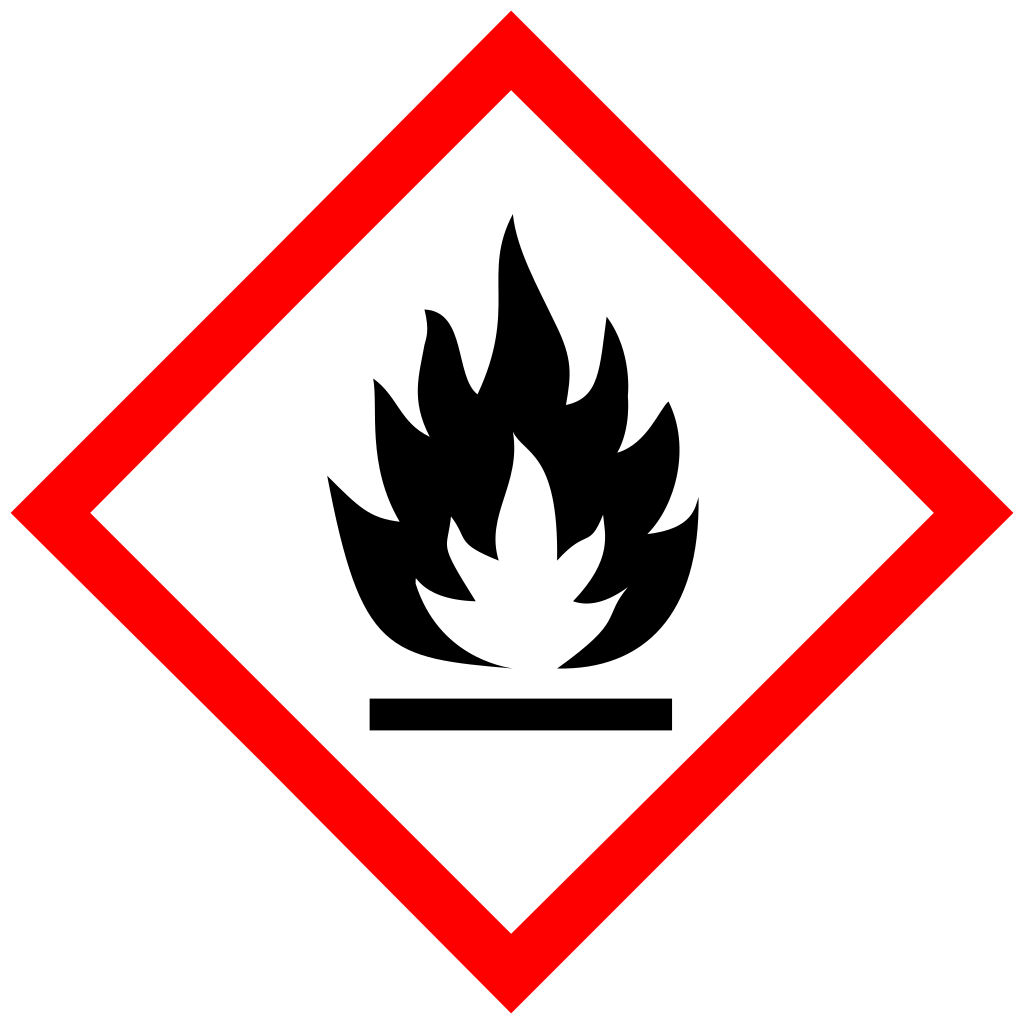
Flammable
The flame pictogram identifies specified flammable, pyrophoric, self-heating, water-reactive, self-reactive, organic-peroxide, and desensitized-explosive hazards. Read the label for the specific classification.
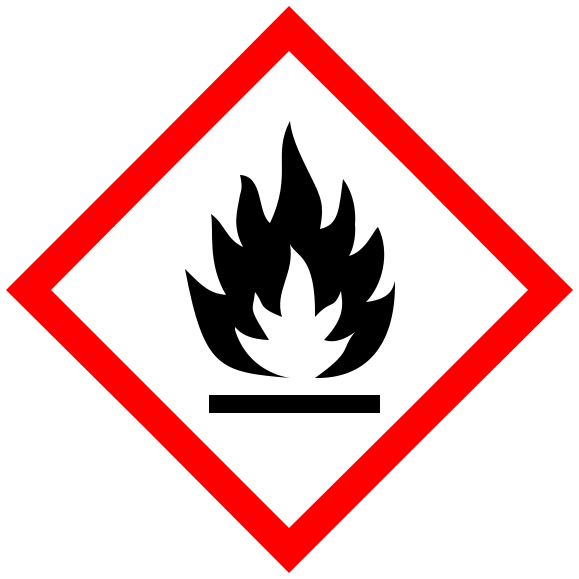
Understanding this sign
GHS pictograms use a black symbol on white within a red diamond border to communicate chemical hazard classes.
Read the whole label and safety data sheet. A pictogram can cover several hazards and does not specify controls by itself.
The Broadest Physical-Hazard Pictogram in GHS
No other pictogram spans as many hazard classes as the GHS02 flame. It is assigned to flammable gases of Category 1 (split into 1A and 1B in newer GHS revisions), aerosols of Categories 1 and 2, flammable liquids of Categories 1 to 3, and flammable solids of Categories 1 and 2. It also covers pyrophoric liquids and solids, self-heating substances, substances that emit flammable gases on contact with water, self-reactive substances and organic peroxides of Types B through F, and desensitized explosives.
The unifying idea is ignition under normal or foreseeable conditions, but the mechanisms differ sharply. A Category 2 flammable liquid such as acetone ignites from an external spark; a pyrophoric reagent such as tert-butyllithium ignites spontaneously in air within minutes; a water-reactive material such as calcium carbide generates flammable acetylene when wetted. The flame alone does not tell you which mechanism applies, so the hazard statement on the label and Section 2 of the safety data sheet must always be read with it.
Categories, Signal Words, and Example H-Statements
Flammable liquids illustrate how the category drives the signal word. Categories 1 and 2 (flash point below 23 °C) take Danger with H224 (extremely flammable liquid and vapour) or H225 (highly flammable liquid and vapour); Category 3 (flash point between 23 °C and 60 °C) takes Warning with H226 (flammable liquid and vapour). Category 4 liquids, recognized under GHS and OSHA HazCom but not under EU CLP, carry H227 with no pictogram at all.
Other classes bring their own statements: H220 for extremely flammable gases, H222 for extremely flammable aerosols, H228 for flammable solids, H250 for pyrophoric materials, H251 and H252 for self-heating substances, and H260 or H261 for water-reactive materials that emit flammable gases. Because these codes map to very different storage rules — inerting for pyrophorics, moisture exclusion for water-reactives, temperature control for self-reactives — the H-statement is the operative instruction, and the flame pictogram is the attention-getter.
Regulatory Context: OSHA HazCom 2012 and EU CLP
Under 29 CFR 1910.1200, every shipped container of a flammable-classified chemical must display the GHS02 pictogram in a red diamond frame, and the classification feeds directly into other OSHA rules: flammable liquid categories determine storage limits under 29 CFR 1910.106, and the flammability data drive area classification for electrical equipment. OSHA's 2024 HazCom update, which aligned the standard mainly with GHS Revision 7, refined flammable gas subcategories and added aerosol Category 3, which carries H229 without the pictogram.
The EU CLP Regulation (EC) No 1272/2008 applies the same building blocks with a few divergences: no flammable liquid Category 4, harmonized classifications for many substances in Annex VI, and the Annex V artwork requirement for the pictogram itself. CLP labels for flammables also trigger downstream duties, notably ATEX explosive-atmosphere assessments under Directive 1999/92/EC and the Seveso III thresholds for sites holding large flammable inventories.
What the Flame Does Not Tell You
GHS02 is frequently misread as a generic fire symbol. It is not: it appears only when a substance meets defined classification criteria, so combustible materials that miss the cut-offs — a Category 4 liquid like diesel under CLP, or ordinary combustible solids like wood pellets — legally carry no flame even though they burn. Conversely, the flame on a self-heating substance warns of spontaneous ignition in bulk storage, a hazard invisible to anyone treating the symbol as shorthand for keep away from sparks.
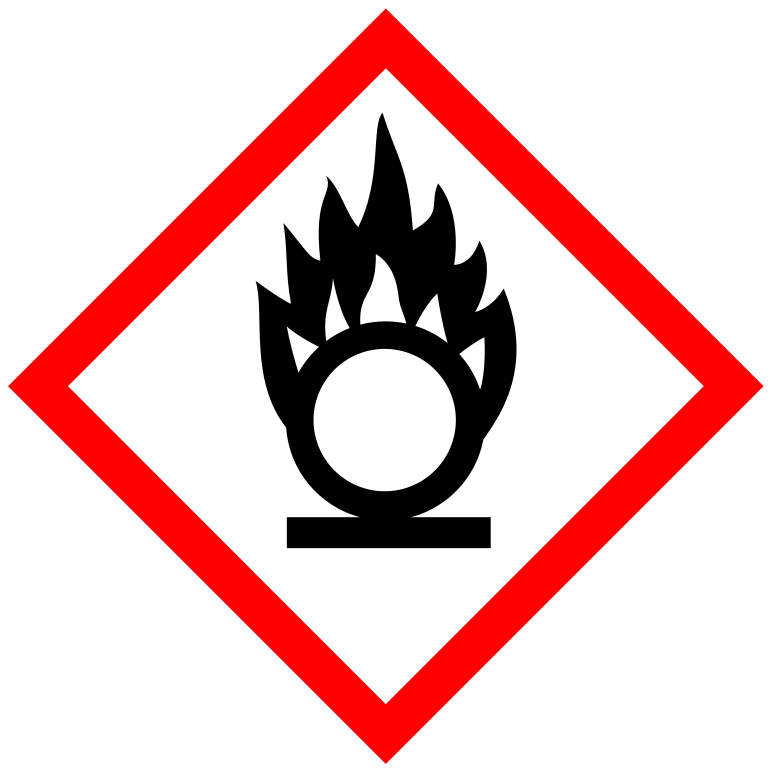
Distinguish GHS02 from its neighbours. GHS03, the flame over a circle, marks oxidizers that intensify fires without necessarily being combustible themselves; storing GHS02 and GHS03 materials together is a classic segregation failure. GHS01 marks detonable materials. In transport, the red Class 3 and Class 2.1 diamonds carry a similar flame, and GHS permits omitting the supply pictogram on outer packaging where the equivalent transport label already appears. Under CLP, when GHS02 is on the label, the GHS04 gas cylinder becomes optional.
Reading the flame pictogram
The flame can communicate flammability, pyrophoricity, self-heating, release of flammable gas, and specified self-reactive, organic peroxide, or desensitized explosive hazards. Not every category in every flammability-related class carries this pictogram.
What to check alongside it
A flame and a flame over a circle communicate different hazards. The latter is the oxidizer pictogram. A flame does not tell you the ignition temperature, suitable extinguishing agent, or complete storage conditions.
The application notes above were checked against the linked public sources on . Jurisdiction-specific notes are identified in the text.
Where you will see GHS02
Found on solvent containers, aerosol storage, flammable-liquid cabinets, fuel handling areas, pyrophoric reagent stations, waste solvent drums, chemical receiving docks, and production lines where ignition control is part of the safe system of work.
Common questions about GHS02
Which chemicals require the GHS02 flame pictogram?
Any substance or mixture classified in a flammability class that assigns it: flammable gases Category 1, aerosols Categories 1 and 2, flammable liquids Categories 1 to 3, flammable solids, pyrophoric liquids and solids, self-heating substances, water-reactive materials emitting flammable gases, self-reactive substances and organic peroxides Types B to F, and desensitized explosives. Common workplace examples include acetone, ethanol, isopropanol, propane, most spray aerosols, and peroxide curing agents.
Why does diesel not carry the flame pictogram in Europe?
Under EU CLP, flammable liquids stop at Category 3, which requires a flash point at or below 60 °C. Typical diesel flash points sit just above that threshold, so it is not classified as flammable and carries no GHS02 pictogram, although it still burns and is labeled for other hazards. Under GHS and OSHA HazCom, a Category 4 exists for flash points up to 93 °C, but that category carries the H227 statement without a pictogram.
What is the difference between GHS02 and GHS03?
GHS02 (flame) marks materials that themselves ignite or release flammable gas. GHS03 (flame over circle) marks oxidizers — gases, liquids, and solids that make other materials burn faster or ignite, even though many oxidizers are not combustible. The distinction drives storage: flammables and oxidizers must be segregated from each other, because together they remove two sides of the fire triangle at once.
Does a flammable aerosol can need both GHS02 and the gas cylinder pictogram?
No. Aerosols are classified in their own hazard class and are excluded from the gases-under-pressure class, so a Category 1 or 2 aerosol carries GHS02 with H222 or H223 plus the pressurized-container precautionary statements, but not GHS04. Category 3 aerosols carry no pictogram at all, only the signal word Warning and H229.
Reference details
| Symbol code | GHS02 |
|---|---|
| Sign family | GHS Chemical Pictograms |
| Standard reference | UN GHS Revision 11 (2025); local implementation varies UN GHS Revision 11 (2025) |
| Screen color reference | #FF0000. Screen colors are not a production color specification. |
| Download formats | SVG reference artwork; a 1024 × 1024 pixel PNG conversion on a white canvas. |
| Record date | · How to interpret our dates |
| Page updated |
Choosing a physical sign size
Download dimensions are not installation dimensions. Select sign size, material, placement, and lighting using the applicable standard and the actual viewing conditions. Chemical label sizing follows its own rules. Read the artwork and sizing guide.
Sources and artwork credits
- UN GHS Revision 11 (2025)
- OSHA hazard communication pictograms
- OSHA 1910.1200 Appendix C: allocation of label elements (US)
- Artwork source
- Wikimedia Commons file page
- Creator credited by source
- Unknown author
- License
- Public domain
- Source metadata checked
SVG files are local reference copies. PNG files are raster conversions. Check the linked file history and license terms before reuse; a source-metadata check is not certification of the artwork or a workplace installation.
Report a correction to this reference