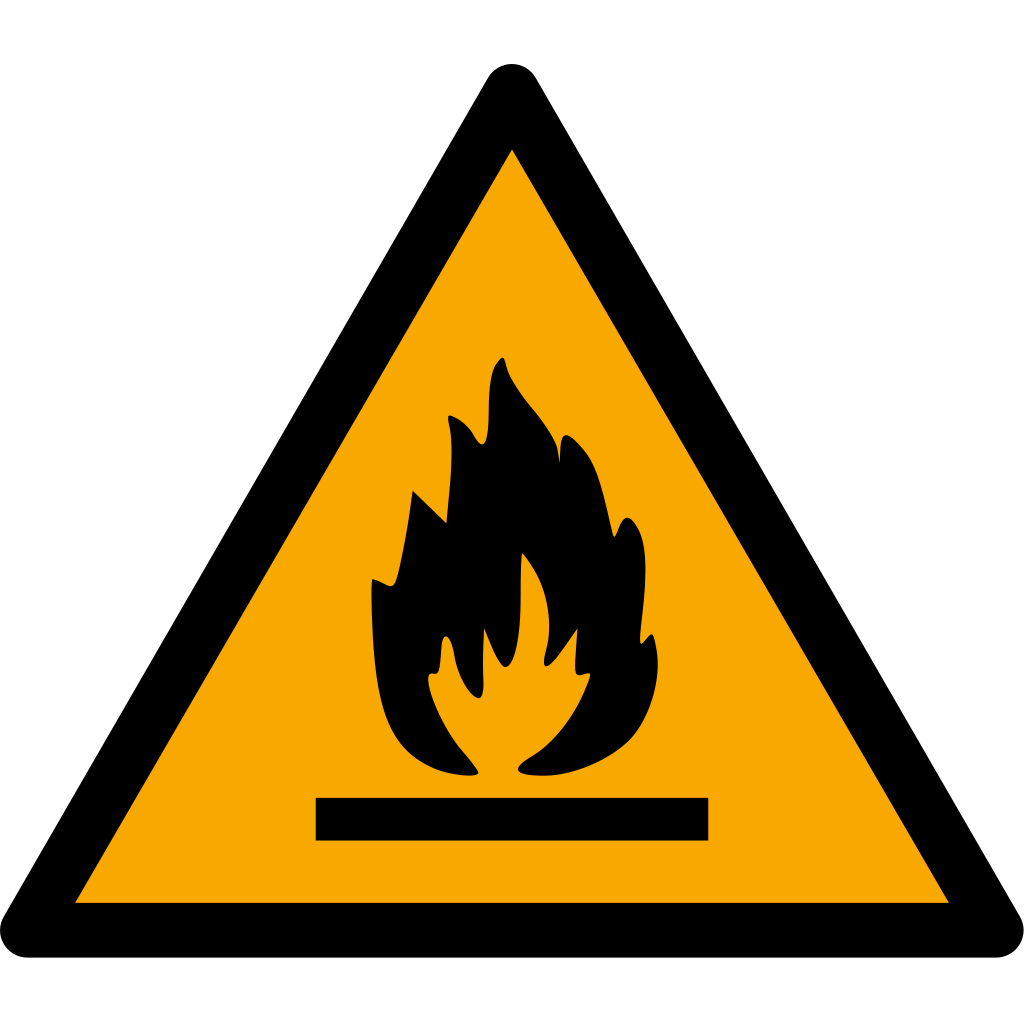
Flammable Material
Warns of flammable material.
Understanding this sign
Yellow triangular signs draw attention to a hazard, such as electricity, moving machinery, or a hot surface.
A warning pictogram does not state the severity, safe distance, or protective measures. Read the accompanying instructions.
What W021 Tells the Viewer
W021 — a black flame in the yellow ISO 3864-1 warning triangle — warns that flammable material is present and that introducing heat, sparks, open flame, static discharge, or a hot surface could start a fast-developing fire. The material may be a liquid giving off ignitable vapor, a flammable gas, an aerosol, a combustible dust, or a readily ignitable solid; the sign speaks to the ignition side of the fire triangle, telling the viewer that the fuel side is already satisfied.
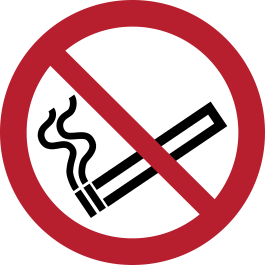
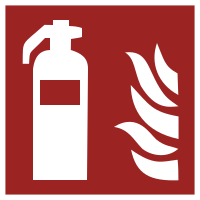
It is a warning about an area or item of equipment, not an instruction. W021 does not itself ban anything; it justifies the bans posted next to it and primes the viewer to notice them. That distinction drives correct sign selection: a solvent store usually needs W021 to explain the hazard and P003 (no open flame or ignition sources) or P002 (no smoking) to state the rule, plus the fire-equipment signs that locate extinguishers.
Three Flames, Three Jobs: W021, GHS02, P003
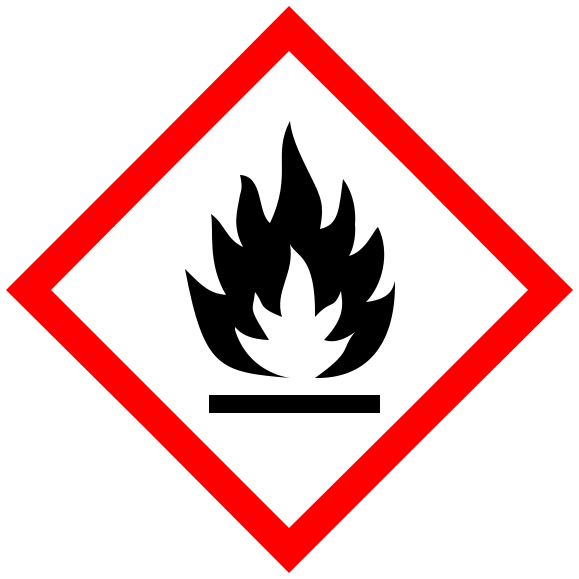
The flame symbol appears in three distinct systems, and confusing them is the most common flammable-signage error. GHS02 is the red-diamond flame on container labels, applied under GHS-aligned rules such as OSHA HazCom and the EU CLP Regulation to products classified as flammable; it belongs on drums, cans, and packages and moves with them. W021 is the fixed yellow triangle marking the room, cabinet, tank, or process area where such materials live.
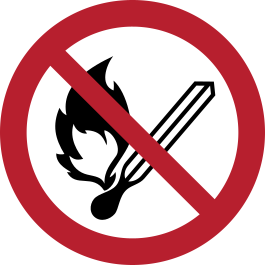
P003 is the red prohibition circle over a match, forbidding open flames, sparks, and smoking. Read together at a fuel store, the three signs form a complete sentence: the label says this product is flammable, the triangle says this area contains flammable material, and the circle says therefore no ignition sources here. Posting the prohibition without the warning leaves the rule unexplained; posting the warning without the prohibition leaves the required behavior unstated.
Regulatory Context for Flammable Area Signage
In the United States, OSHA's flammable liquids standard (29 CFR 1910.106) and NFPA 30 govern how flammable liquids are stored and handled, and controlling ignition sources — with conspicuous no-smoking or ignition-source signage at storage and dispensing areas — is a core expectation of that framework. Flammable-liquid safety cabinets are additionally required to carry their own conspicuous warning legend, which the W021 symbol can reinforce but does not replace.
In the European Union, workplace signs including W021 fall under Directive 92/58/EEC, while places where an explosive atmosphere can form come under the ATEX workplace directive (1999/92/EC), which prescribes its own distinctive triangular EX sign at zone entrances. W021 and the EX sign are not substitutes: W021 flags flammable material generally, whereas the EX sign marks a classified hazardous zone with legal consequences for equipment selection and work permits inside it.
Placing the Flammable Warning Where It Works
High-value locations include solvent and paint mixing rooms, fuel and LPG stores, aerosol warehouses, drum staging and decanting points, battery charging bays where hydrogen can accumulate, spray booths, and process plant containing flammable vapors or liquids. Mount the sign at the entry to the controlled area and on the cabinet or vessel itself, so that both the person approaching the room and the person opening the cabinet get the warning at the moment it is relevant.
Sizing follows viewing distance under ISO 3864-1 practice: a 100 mm triangle reads at roughly 5 m, 200 mm at roughly 10 m, and 400 mm at roughly 20 m, so yard-scale tank farms need the large formats while a cabinet label can be 50 mm. Because ignition control depends on behavior, always co-locate the relevant prohibition sign and keep supplementary text specific — naming the material class and the rule outperforms a bare triangle.
Where you will see W021
Installed at solvent rooms, fuel stores, paint mixing areas, aerosol storage, battery charging zones with ignitable atmospheres, waste-drum staging areas, and process equipment containing flammable vapors or liquids.
Common questions about W021
What is the difference between the W021 sign and the GHS flame pictogram?
GHS02 is a label element: the flame in a red diamond printed on containers of products classified as flammable under GHS-based regulations like OSHA HazCom and EU CLP. W021 is a workplace sign: a yellow warning triangle fixed to the rooms, cabinets, tanks, and areas where flammable materials are stored or used. The label follows the product; the sign marks the place.
Do I need W021 or P003 at a flammable liquid store?
Usually both, because they say different things. W021 warns that flammable material is present; P003 prohibits open flames, sparks, and smoking. The warning explains the hazard and the prohibition states the behavior required. Regulators focus on the ignition-source control, so if only one sign can be posted, the prohibition carries the enforceable rule — but pairing them is standard practice.
Is the W021 flame sign the same as the ATEX EX sign?
No. The ATEX sign — a triangle containing the letters EX — marks entrances to zones classified for explosive atmospheres under the EU ATEX workplace directive, with legal implications for equipment and permits inside the zone. W021 is a general flammable-material warning without zone classification behind it. A site can legitimately display W021 at a solvent cabinet and the EX sign at the door of a classified vapor zone.
Where should flammable material signs be posted in a warehouse?
At the entrances to areas holding flammable stock — aerosol cages, solvent rooms, drum stores, charging bays — and on safety cabinets and tanks themselves, sized for the approach distance. Add the matching prohibition sign for ignition sources at the same points, and check your fire code and insurer requirements, which often specify additional text signage such as wording at storage room doors.
Reference details
| Symbol code | W021 |
|---|---|
| Sign family | ISO Warning Signs |
| Standard reference | ISO 7010:2019 / ISO 3864-1 ISO Online Browsing Platform: W021 |
| Screen color reference | #FFCC00. Screen colors are not a production color specification. |
| Download formats | SVG reference artwork; a 1024 × 1024 pixel PNG conversion on a white canvas. |
| Record date | · How to interpret our dates |
| Page updated |
Choosing a physical sign size
Download dimensions are not installation dimensions. Select sign size, material, placement, and lighting using the applicable standard and the actual viewing conditions. Chemical label sizing follows its own rules. Read the artwork and sizing guide.
Sources and artwork credits
- Artwork source
- Wikimedia Commons file page
- Creator credited by source
- MaxxL
- License
- Public domain
- Source metadata checked
SVG files are local reference copies. PNG files are raster conversions. Check the linked file history and license terms before reuse; a source-metadata check is not certification of the artwork or a workplace installation.
Report a correction to this reference