General Warning
Warns of a general hazard. Read the accompanying information to identify the specific danger.

Understanding this sign
Yellow triangular signs draw attention to a hazard, such as electricity, moving machinery, or a hot surface.
A warning pictogram does not state the severity, safe distance, or protective measures. Read the accompanying instructions.
What ISO 7010 W001 Communicates
W001 is the general warning sign: an exclamation mark inside the standard ISO 3864-1 warning format of a black triangular band and black symbol on a yellow field. It tells the viewer that a hazard exists and demands attention, but deliberately gives no detail about what that hazard is. On its own it says only "caution, danger here"; the specific nature of the risk has to come from adjacent text, a safety data sheet, a permit, or a briefing.
Because W001 carries no hazard-specific meaning, ISO 7010 treats it as a fallback rather than a first choice. Where a dedicated pictogram exists for the actual danger — electricity, a hot surface, a corrosive substance, moving machinery — that specific sign must be used instead. W001 is intended for hazards that have no assigned symbol, for temporary or changing conditions, and for situations where a supplementary text panel carries the real message.
When a General Warning Is the Right Call
Reach for W001 when the hazard is genuine but unusual enough that no standard pictogram fits it, such as an uneven temporary walkway, an active survey or test, or a one-off maintenance condition. It also works as a header on a combined sign where the exclamation triangle sits above a written description of the exact risk. In each case the sign is only useful if it is paired with words: a bare exclamation triangle with nothing beneath it leaves workers guessing.
Avoid W001 as a lazy substitute for a specific sign. If the danger is a trip hazard, a low overhead beam, or a slippery floor, ISO 7010 provides a purpose-made pictogram that communicates faster and needs less reading. Overusing the general warning sign also dilutes its impact; when every hazard on a site wears the same exclamation triangle, people stop reading the supplementary text that makes each one meaningful.
Supplementary Text and Layout
The value of W001 lives almost entirely in its accompanying text. ISO 3864-1 and ISO 7010 allow a supplementary sign — usually a rectangular panel with black text on a white or yellow background — placed directly below or beside the triangle. Keep the wording short, concrete, and action-oriented: name the hazard and state what to do, for example "Uneven floor — watch your step" rather than a vague instruction. The text should be legible at the distance from which the sign will actually be read.
For multilingual sites, the pictogram provides the immediate alert while the text panel can be repeated in the required languages. Where the same temporary hazard recurs, a reusable frame that holds interchangeable text inserts keeps the sign accurate as conditions change. The one rule that matters most: never leave a W001 triangle in place after the hazard it described has gone, because a warning that points to nothing trains people to ignore all of them.
W001 Versus Lookalike Symbols
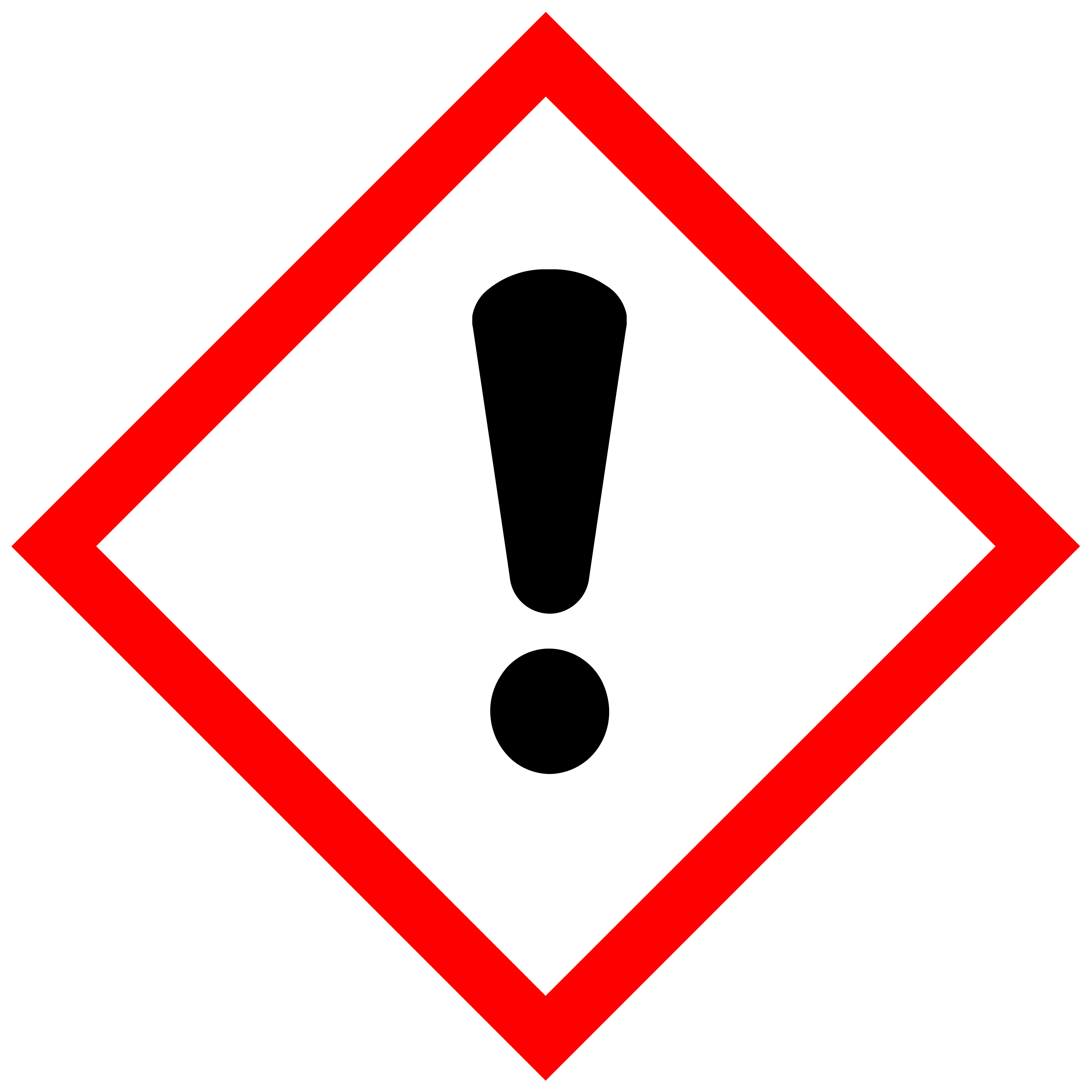
W001 is frequently confused with the GHS07 exclamation-mark pictogram used on chemical labels, but the two are not interchangeable. GHS07 is a red diamond border around a black exclamation mark and is a defined hazard-classification symbol for effects such as acute toxicity (lower categories), skin or eye irritation, and respiratory sensitisation. W001 is a yellow safety-sign triangle for placement in a workplace and carries no classification meaning at all. Using one where the other belongs sends the wrong regulatory signal.
It is also worth separating W001 from mandatory and prohibition signs, which some people lump together as "warning" signage. A blue circle is a mandatory action such as wear eye protection; a red circle with a bar is a prohibition. W001, as a yellow triangle, only warns. When you need to require behaviour or forbid it, the general warning sign is the wrong shape and colour, and a reader who knows the ISO 3864-1 colour code will treat it accordingly.
Where you will see W001
Used at temporary hazards, maintenance work zones, machine access panels, loading areas, electrical rooms, test rigs, construction barriers, and any area where a specific warning sign is unavailable or must be reinforced by text.
Common questions about W001
When should I use the general warning sign instead of a specific one?
Use W001 only when no dedicated ISO 7010 pictogram exists for the hazard, or as a header above supplementary text that describes an unusual or temporary risk. If a specific sign is available — for electricity, hot surfaces, forklifts, and so on — use that instead, because a purpose-made pictogram communicates the danger faster and with less reading.
Does W001 need extra text to be effective?
Almost always, yes. The exclamation triangle alerts people that a hazard is present but says nothing about what it is. Pair it with a short supplementary text panel that names the hazard and the required precaution. A W001 sign with no accompanying explanation leaves workers unable to judge the risk or the correct response.
Is W001 the same as the GHS07 exclamation mark on chemical labels?
No. GHS07 is a red-bordered diamond used to classify chemical hazards such as irritation and lower-category acute toxicity on product labels. W001 is a yellow safety-sign triangle used to warn of workplace hazards and has no chemical-classification meaning. They share an exclamation mark but serve completely different purposes and should not be swapped.
Reference details
| Symbol code | W001 |
|---|---|
| Sign family | ISO Warning Signs |
| Standard reference | ISO 7010:2019 / ISO 3864-1 ISO Online Browsing Platform: W001 |
| Screen color reference | #FFCC00. Screen colors are not a production color specification. |
| Download formats | SVG reference artwork; a 1024 × 1024 pixel PNG conversion on a white canvas. |
| Record date | · How to interpret our dates |
| Page updated |
Choosing a physical sign size
Download dimensions are not installation dimensions. Select sign size, material, placement, and lighting using the applicable standard and the actual viewing conditions. Chemical label sizing follows its own rules. Read the artwork and sizing guide.
Sources and artwork credits
- Artwork source
- Wikimedia Commons file page
- Creator credited by source
- Maxxl2
- License
- Public domain
- Source metadata checked
SVG files are local reference copies. PNG files are raster conversions. Check the linked file history and license terms before reuse; a source-metadata check is not certification of the artwork or a workplace installation.
Report a correction to this reference