Do Not Touch
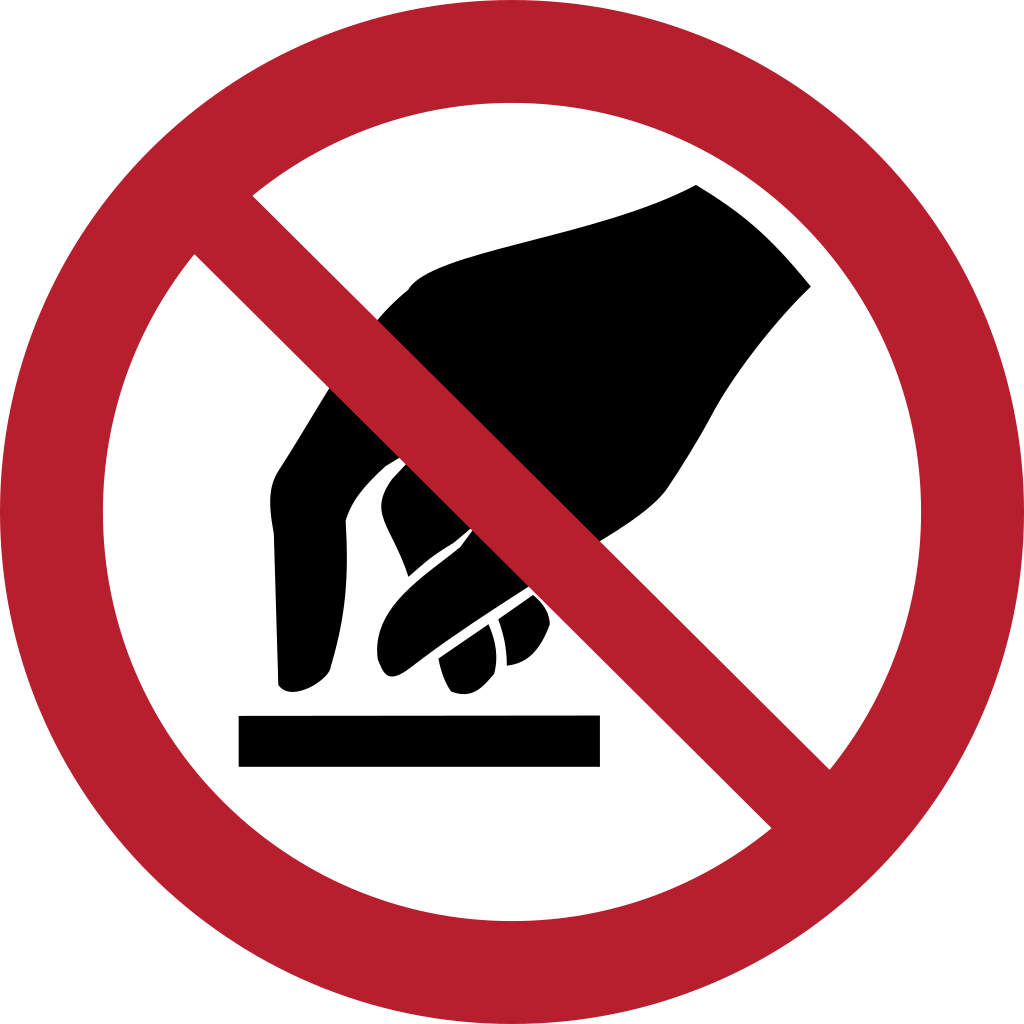
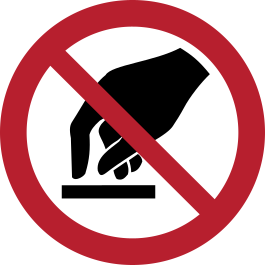
Touching the marked object or surface is prohibited.
Understanding this sign
Red circular signs with a diagonal bar identify an action that must not be taken in the marked area.
Check what object or action the symbol prohibits. A prohibition sign does not identify all the hazards in an area.
A Behavior Ban That Works for Many Hazards
P010 forbids one action: touching the marked object or surface. The pictogram of a hand crossed by the red bar is intentionally hazard-agnostic — the reason contact is dangerous may be an energized conductor, a surface hot or cold enough to burn, a moving part, a corrosive residue, a contamination-controlled component, or an instrument whose reading a fingertip would disturb. Whatever the cause, the required behavior is identical, and that is what the sign communicates.
The flip side of that generality is that P010 explains nothing. A worker who does not understand why contact is forbidden may judge the rule optional, especially on equipment that looks inert. On anything beyond an obvious case, add a short supplementary line — LIVE TERMINALS, SURFACE TO 180 °C, CALIBRATED: DO NOT HANDLE — or mount the matching warning sign next to it so the prohibition has a visible justification.
P010 or a Warning Sign? Choosing the Right Message
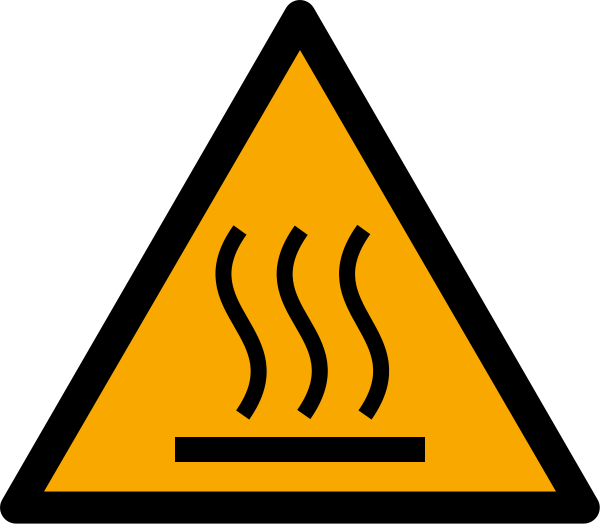
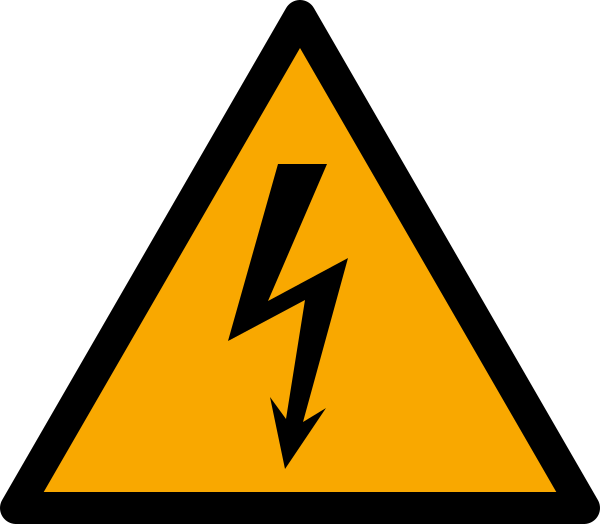
ISO 3864 separates the two jobs cleanly: warning triangles such as W017 (hot surface) or W012 (electricity) identify a hazard, while the red circle of P010 commands a behavior. Use the warning when people must work near the hazard and simply need to know it exists; use P010 when the control strategy is that nobody's hands go on the item at all. On high-consequence equipment the strongest labeling combines both, hazard above, prohibition below.
P010 also serves cases that are not personal-injury hazards. Semiconductor tooling, optics, cultured samples, wet paint, museum exhibits, and reference standards get marked because touch damages the object or the process rather than the person. That is a legitimate use of the symbol, but keep such postings visually distinct from safety-critical ones on the same site — if every bench label looks equally severe, the label on the energized busbar loses its force.
Mounting Directly on the Point of Contact
Unlike area signs, P010 earns its keep at close range. Apply it on or immediately beside the specific surface, terminal cover, guard, or housing it protects — a 50 mm label on a control panel or motor casing is often more effective than a 200 mm sign on the wall three meters away, because the eye meets it in the instant before the hand moves. On large plant, repeat the label at each realistic touch point rather than assuming one placement covers the machine.
Durability drives material choice here more than for most prohibition signs. Labels on hot housings, washdown equipment, or solvent-wiped lab benches face heat, chemicals, and abrasion; a faded or half-peeled do-not-touch label communicates that the rule itself has lapsed. Specify temperature-rated, chemically resistant stock for those services and include the labels in routine inspection rounds.
What a Sign Cannot Do
P010 never substitutes for engineering controls that the law requires. Exposed live parts must be guarded or enclosed under electrical safety rules, and dangerous moving machinery must be physically guarded — OSHA's machine guarding standard (29 CFR 1910.212) and equivalent EU machinery requirements do not accept signage in place of a guard. The proper role of the label is residual: it reinforces the rule at points where a guard is opened for maintenance or where a hazard cannot be fully enclosed.
For work that requires deliberate contact with normally forbidden equipment, the sign integrates with procedures rather than being removed. Lockout/tagout isolates the energy, a permit defines the task, and the standing P010 marking continues to protect everyone not on that permit. Auditing near-misses at marked equipment is worthwhile: repeated casual contact usually means the touch point is in the natural path of a routine task, and relocating a handle or adding a physical standoff fixes what another sticker will not.
Where you will see P010
Applied to hot surfaces, guarded machine areas, sensitive instrumentation, energized enclosures, contamination-controlled equipment, rotating or moving parts, and laboratory setups where touch could injure the user or disturb the process.
Common questions about P010
When should I use a do not touch sign instead of a hot surface warning?
Use W017 when people work near the hot item and need to know the hazard exists; use P010 when the rule is that no one touches the item at all. The warning informs, the prohibition commands. For equipment that is both hot and strictly hands-off, posting the two together is the clearest labeling.
Is a do not touch sign acceptable protection for live electrical parts?
No. Electrical regulations require live parts to be guarded, enclosed, or otherwise made inaccessible; a sign is not a permitted substitute for those physical controls. P010 is appropriately used on enclosures and covers as a reinforcement, and during maintenance in combination with lockout/tagout, not as the primary safeguard.
Can P010 be used to protect equipment or products rather than people?
Yes. The ISO-defined function is simply to prohibit touching, and it is routinely applied to calibrated instruments, cleanroom tooling, optics, wet coatings, and exhibits where contact would damage the item or the process. Just keep asset-protection labels distinguishable from injury-critical ones so the strongest postings retain their urgency.
How big should a do not touch label on machinery be?
Match it to the reading distance at the touch point. A 50 mm diameter label suits panels, housings, and bench equipment read at arm's length; step up to 100 mm or more when the sign must be noticed on approach across a room. Placing the label at each realistic contact point matters more than maximizing any single label's size.
Reference details
| Symbol code | P010 |
|---|---|
| Sign family | ISO Prohibition Signs |
| Standard reference | ISO 7010:2019 / ISO 3864-1 ISO Online Browsing Platform: P010 |
| Screen color reference | #FF0000. Screen colors are not a production color specification. |
| Download formats | SVG reference artwork; a 1024 × 1024 pixel PNG conversion on a white canvas. |
| Record date | · How to interpret our dates |
| Page updated |
Choosing a physical sign size
Download dimensions are not installation dimensions. Select sign size, material, placement, and lighting using the applicable standard and the actual viewing conditions. Chemical label sizing follows its own rules. Read the artwork and sizing guide.
Sources and artwork credits
- Artwork source
- Wikimedia Commons file page
- Creator credited by source
- ISO
- License
- Public domain
- Source metadata checked
SVG files are local reference copies. PNG files are raster conversions. Check the linked file history and license terms before reuse; a source-metadata check is not certification of the artwork or a workplace installation.
Report a correction to this reference